
Pulse Asia Research’s December 2025 Ulat ng Bayan Survey:
Media Release on Corruption
09 January 2026
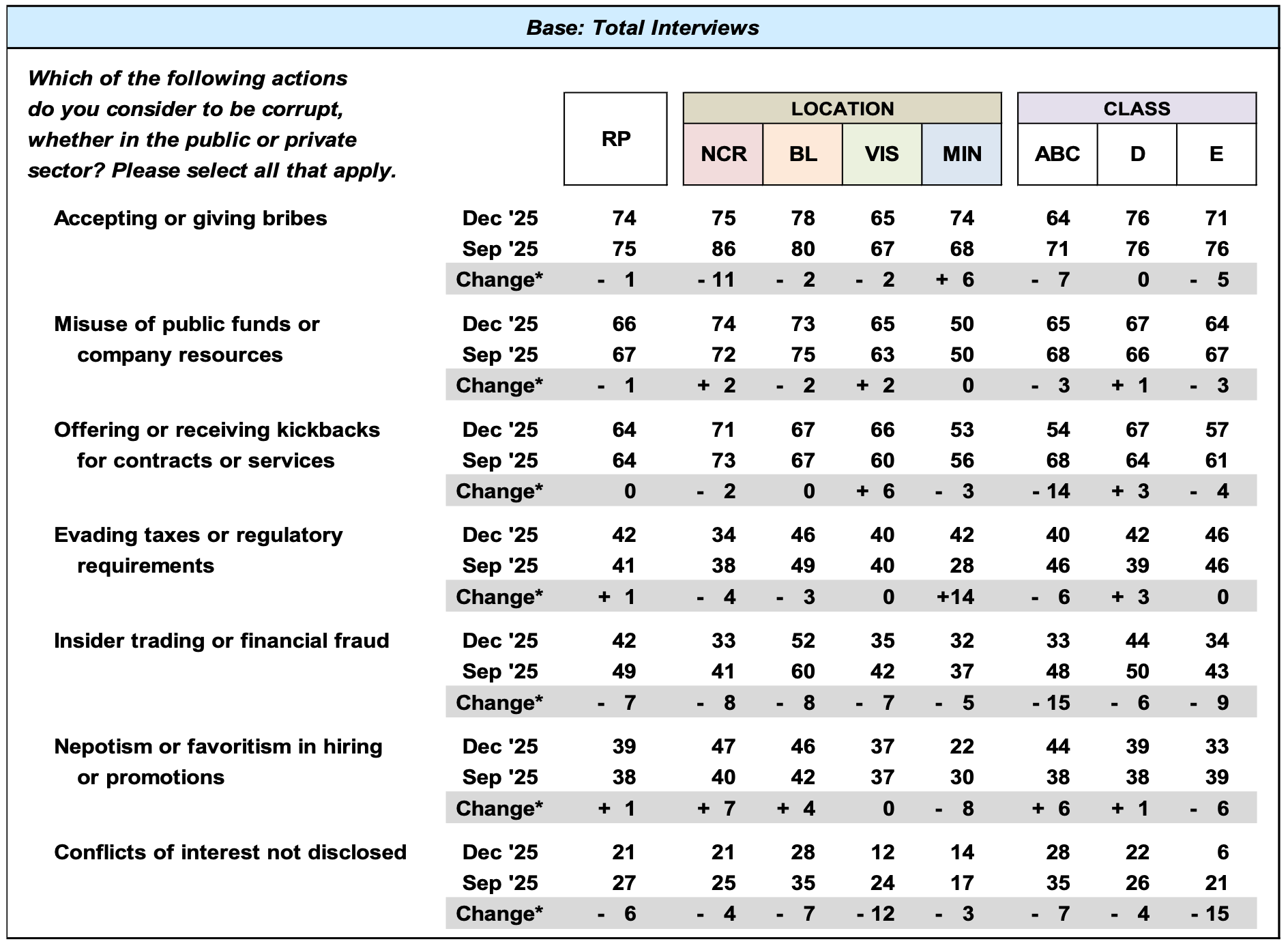
Most Filipino adults consider accepting or giving bribes (74%), misusing public funds or company resources (66%), and offering or receiving kickbacks for contract or services (64%) as corrupt whether these take place in the public or private setting; public opinion on this matter remains essentially constant between September 2025 and December 2025
Out of seven (7) options to select from, majorities say the acts of accepting or giving bribes (74%), misusing public funds or company resources (66%), and offering or receiving kickbacks (64%) are corrupt in nature. Small to big majorities in every geographic and socioeconomic subgrouping are of the view that accepting or giving bribes (65% to 78% and 64% to 76%, respectively) and offering or receiving kickbacks (53% to 71% and 54% to 67%, respectively) are corrupt acts whether these are practiced in the public or private sector. Meanwhile, near to huge majorities in these subgroupings say the misuse of public funds or company resources is a corrupt act (50% to 74% and 64% to 67%, respectively). (Please refer to Table 1.)
Table 1
ACTIONS IN THE PUBLIC OR PRIVATE SECTOR PERCEIVED AS CORRUPT
December 12 - 15, 2025 / Philippines
(In Percent / Multiple Response Allowed)
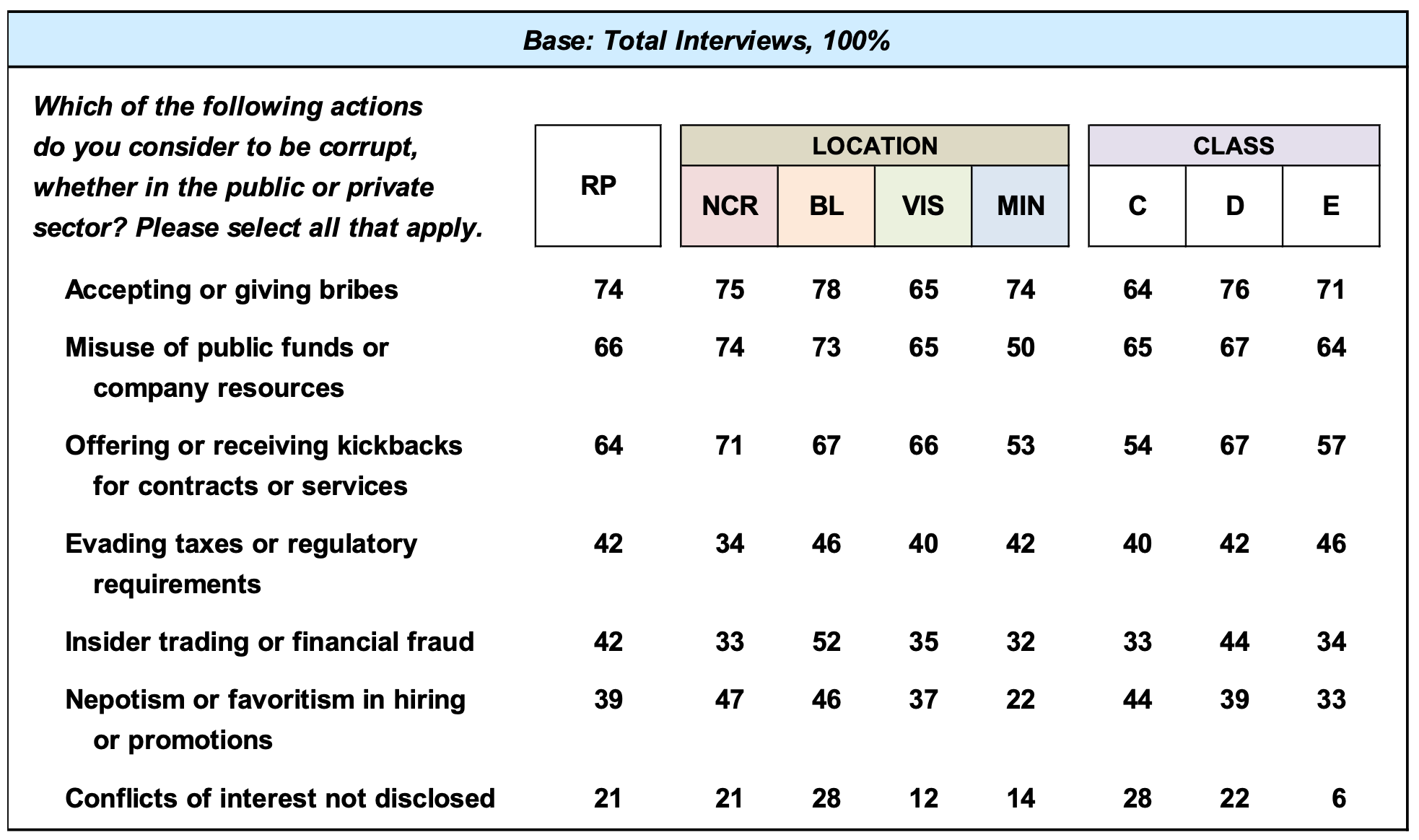
At the national level, the other public or private actions deemed as corrupt by Filipino adults are evading taxes or regulatory requirements (42%), insider trading or financial fraud (42%), nepotism or favoritism in hiring or promotions (39%), and non-disclosure of conflicts of interest (21%). Numerically speaking, the non-disclosure of conflicts of interest is the least often mentioned action across areas and classes (12% to 28% and 6% to 28%, respectively).
Between September 2025 and December 2025, the only significant overall changes are the decline in the percentages of those who consider either the non-disclosure of conflicts of interest (-6 percentage points) or insider trading or financial fraud (-7 percentage points) as corrupt acts. Across geographic and socioeconomic subgroupings, there is an increase in the percentage of Mindanawons who say tax evasion or non-compliance with regulatory requirements are corrupt acts (+14 percentage points) and the drop in the percentage of those who consider non-disclosure of conflicts of interest as a form of corruption (-12 percentage points) among Visayans. (Please refer to Table 2.)
Table 2
ACTIONS IN THE PUBLIC OR PRIVATE SECTOR PERCEIVED AS CORRUPT
September and December 2025 / Philippines (In Percent / Multiple Response Allowed)
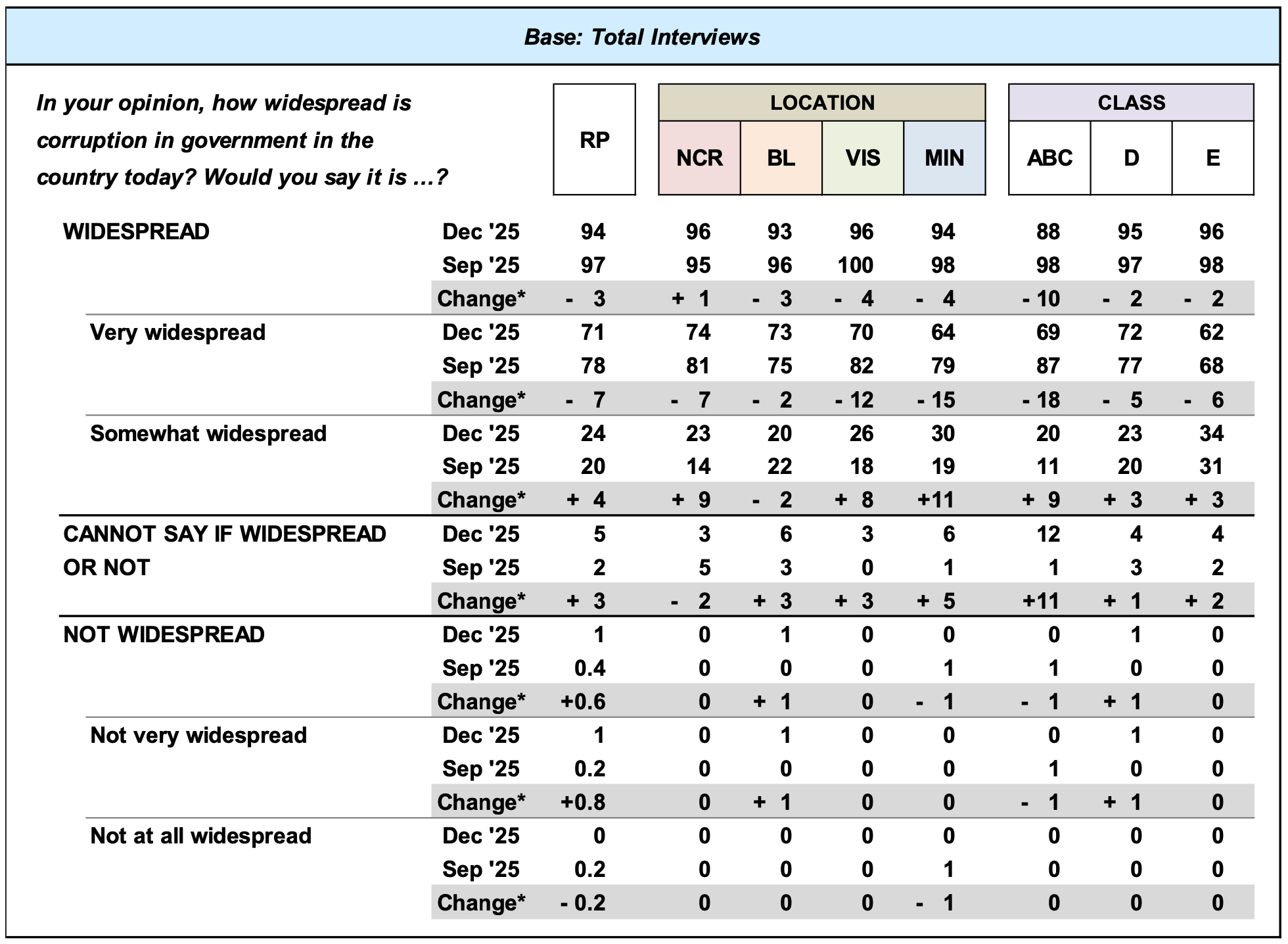
Practically all Filipino adults say corruption in government is widespread (94%), with considerable to big majorities describing it as very widespread (71%); from September 2025 to December 2025, the percentage of those who consider corruption in Philippine government to be very widespread decreases (-7 percentage points)
For nearly every adult in the country (94%), corruption in government is widespread – a view shared by most adults across geographic areas and socioeconomic classes (93% to 96% and 88% to 96%, respectively). In particular, the predominant sentiment at the national level (71%) and in the different areas and classes (64% to 74% and 62% to 72%, respectively) is that corruption in government is very widespread. The rest of the adult population either expresses indecision on the matter (5%) or believes that corruption in government is not widespread (1%). (Please refer to Table 3.)
Table 3
PREVALENCE OF CORRUPTION IN GOVERNMENT
December 12 - 15, 2025 / Philippines
(In Percent)

Public opinion on this matter is virtually changed from September 2025 to December 2025, with the only significant movements being the decline in the percentages of those who opine that corruption in government is very widespread not only in the Philippines (-7 percentage points) but also in the Visayas (-12 percentage points), Mindanao (-15 percentage points), and Class C (-18 percentage points). (Please refer to Table 4.)
Table 4
PREVALENCE OF CORRUPTION IN GOVERNMENT
September and December 2025 / Philippines
(In Percent)
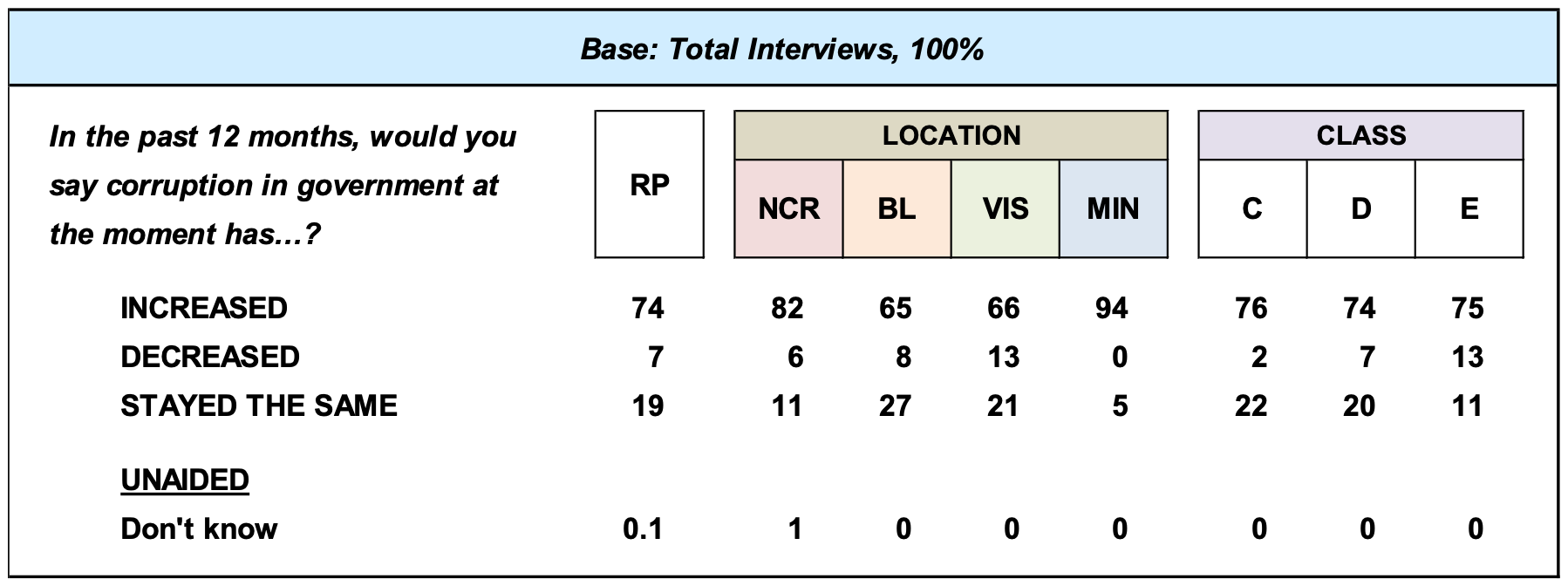
The view that corruption in Philippine government has increased in the past 12 months is shared by 74% of the adult population, lower than the September 2025 figure (85%)
The prevailing opinion at the national level (74%) and in each area and class (65% to 94% and 74% to 76%, respectively) is that corruption in government has increased over the previous 12 months. A contrary view is expressed by 7% while 19% say there is no change in the extent of corruption in Philippine government during this period. (Please refer to Table 5.)
Table 5
WHETHER THE EXTENT OF CORRUPTION IN GOVERNMENT HAS
INCREASED OR DECREASED IN THE PAST 12 MONTHS
December 12 - 15, 2025 / Philippines
(In Percent)
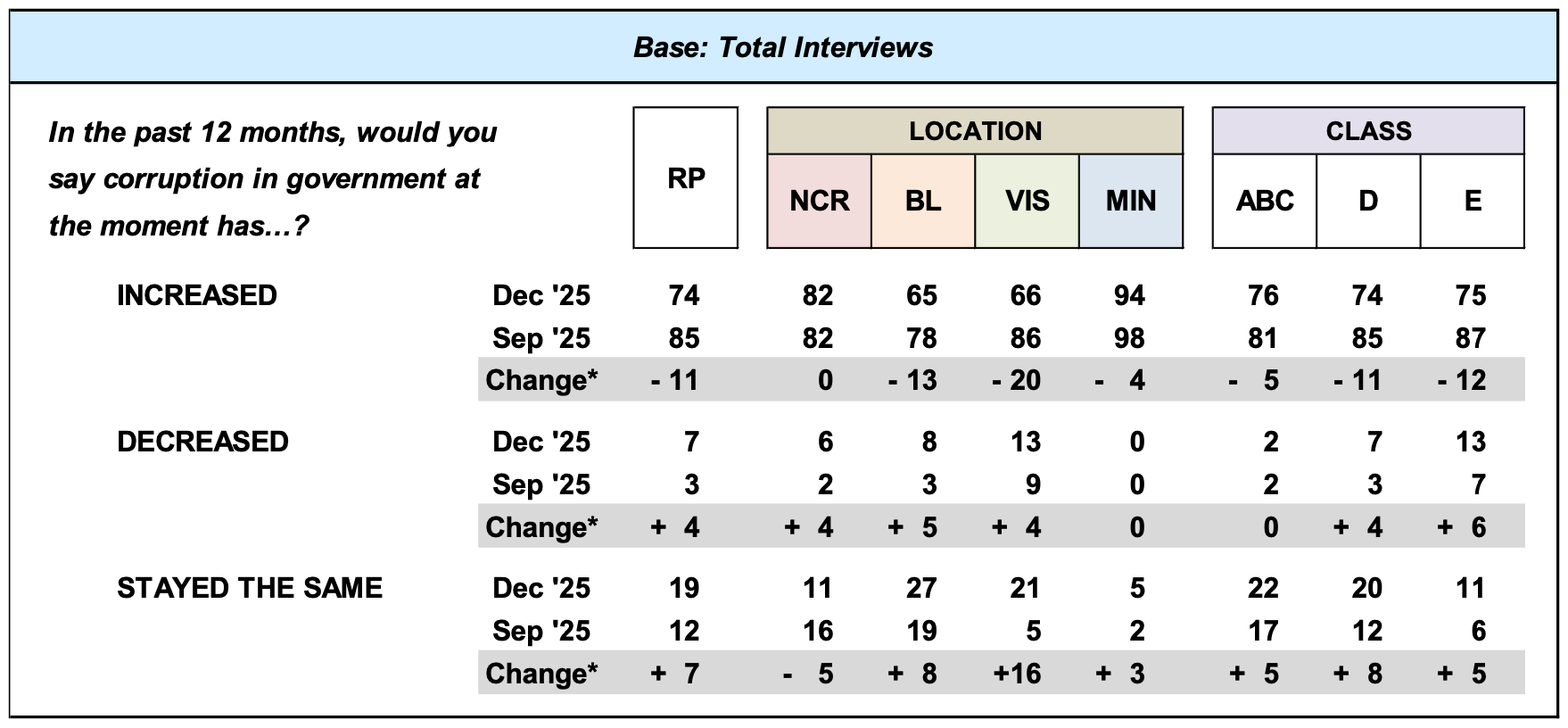
Agreement with the view that corruption in the country’s government increased in the past year eases from September 2025 to December 2025 in the Philippines (-11 percentage points) as well as in the rest of Luzon (-13 percentage points), the Visayas (-20 percentage points), and Class D (-11 percentage points). During the same period, agreement with the opinion that the extent of corruption in government did not change year-on-year becomes more pronounced not only at the national level (+7 percentage points) but also in the Visayas (+16 percentage points) and Class D (+8 percentage points). (Please refer to Table 6.)
Table 6
WHETHER THE EXTENT OF CORRUPTION IN GOVERNMENT HAS
INCREASED OR DECREASED IN THE PAST 12 MONTHS
September and December 2025 / Philippines
(In Percent)
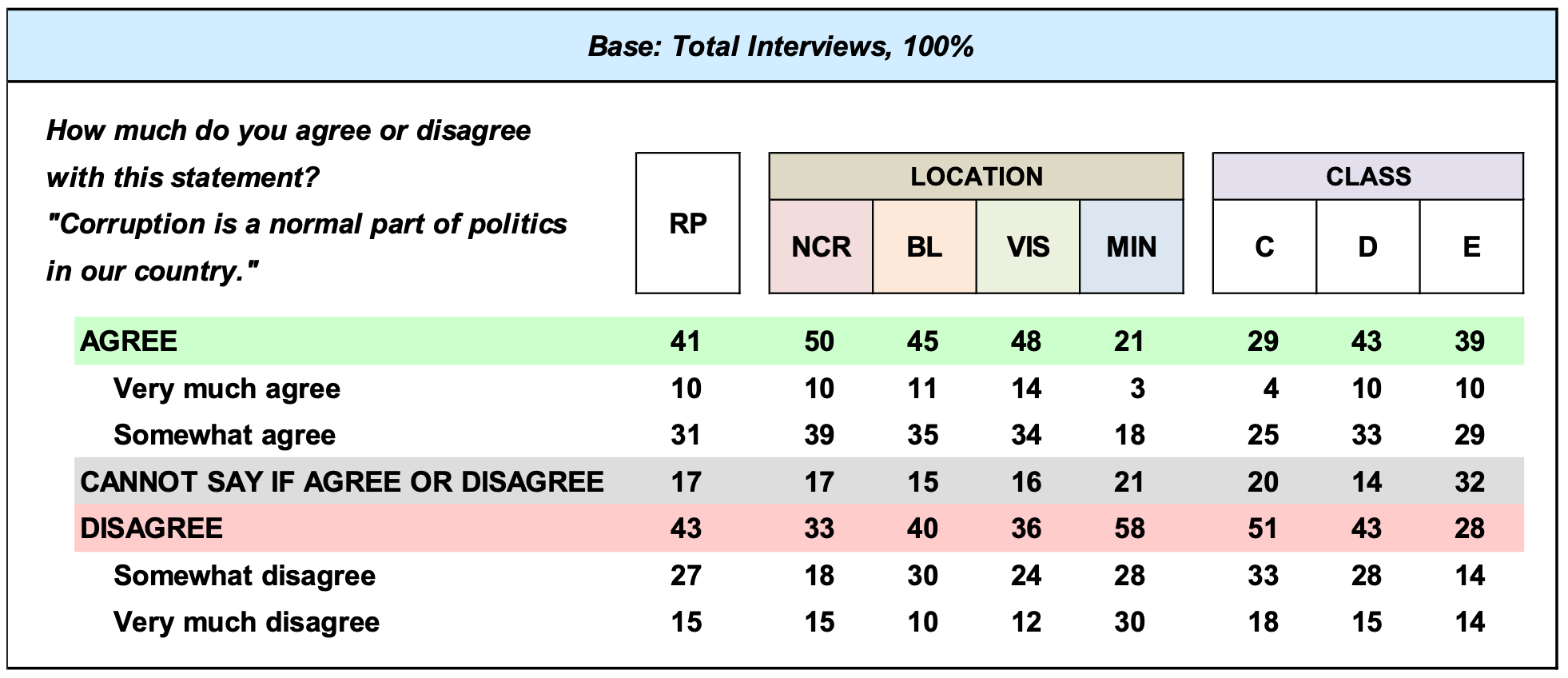
Virtually the same percentages of adults either agree or disagree with the view that corruption is a normal part of Philippine politics (41% versus 43%)
Overall, about the same percentages of the adult population express either agreement or disagreement with the opinion that corruption is a normal part of politics in the country (41% versus 43%). The same pattern of public opinion may be observed in the rest of Luzon (45% versus 40%) and Class D (both at 43%). The rest of Filipino adults are ambivalent on the matter (17%). (Please refer to Table 7.)
Most Mindanawons (58%) and those belonging to Class C (51%) do not see corruption as being a normal part of Philippine politics while near majorities of Metro Manilans (50%) and Visayans (48%) believe otherwise. There is a three-way split in Class E, with 39% agreeing with the view that corruption is a normal part of the country’s politics, 32% being ambivalent on the matter, and 28% expressing disagreement.
Table 7
AGREEMENT / DISAGREEMENT WITH TEST STATEMENT:
"Corruption is a normal part of politics in our country."
December 12 - 15, 2025 / Philippines
(In Percent)
If you liked what you just read and want more of Our Brew, subscribe to get notified. Just enter your email below.
Related Posts
The ICC Case against Rodrigo Duterte: Questions and Answers
Feb 18, 2026
‘Record-low’ 46% of Filipino Adults ‘Very Happy’ With Love Life - SWS
Feb 13, 2026
VP Sara Duterte’s Net Satisfaction Rating Rises in Latest SWS Survey
Feb 12, 2026