
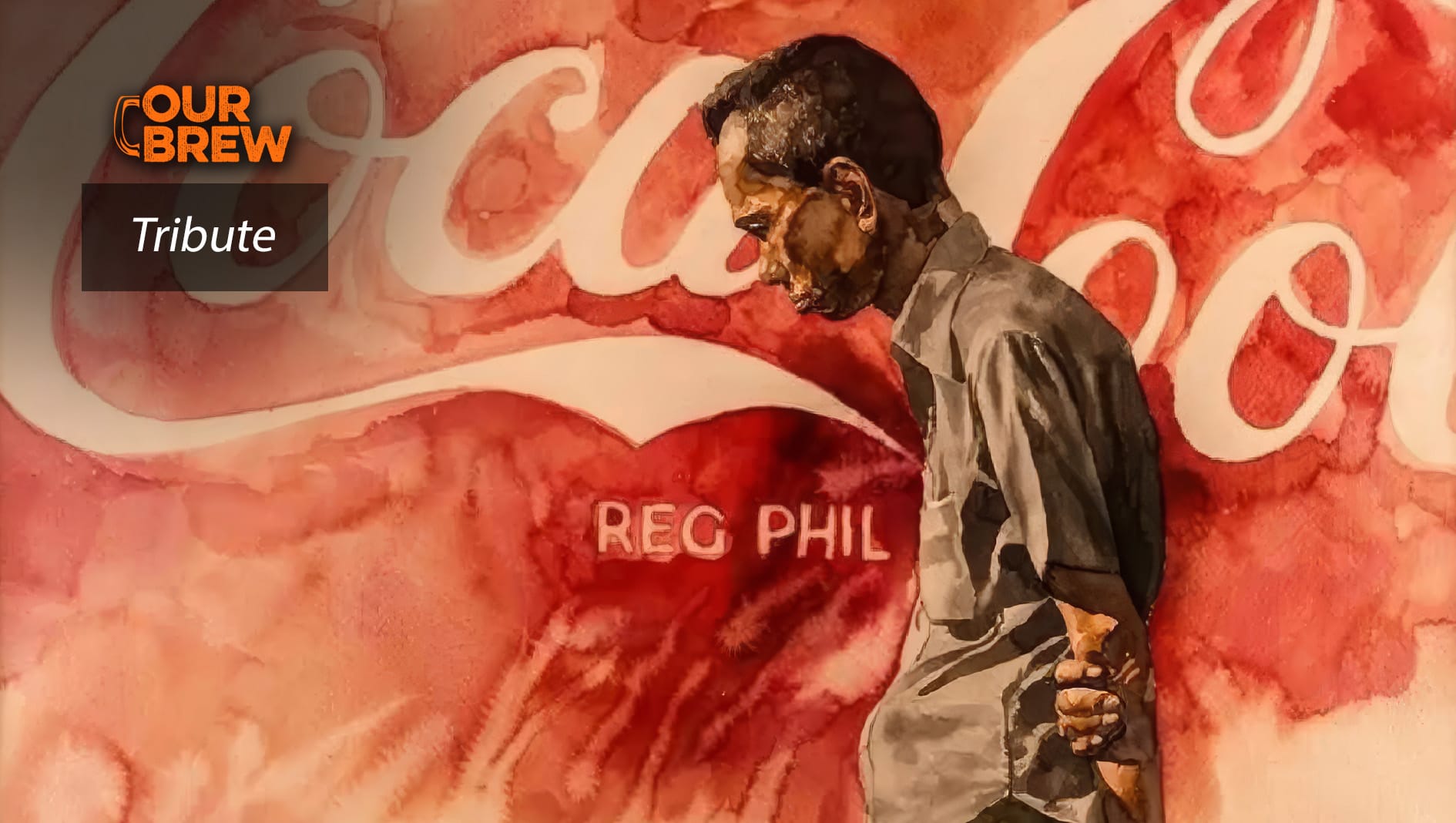

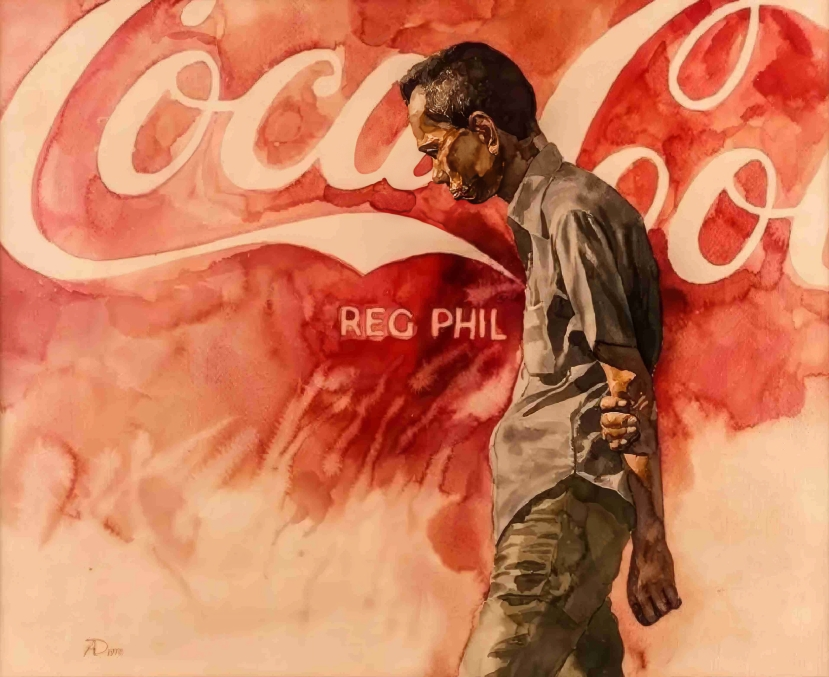
Antipas “Biboy” Delotavo, who died on December 2, was an artist of quiet, self-effacing demeanor. His body of work, representative of the Social Realist (SR) movement born during the turbulent 70s, speaks eloquently, at times harshly, on his behalf, like a dagger in the heart of a nation beset by poverty, plunder and state-sanctioned killings.
Jose Tence Ruiz, Delotavo’s contemporary and comrade-in arms, paid tribute to the late artist in a series of Facebook posts which we are reprinting, with minor edits, with the author’s permission
By Jose Tence Ruiz
While it may be debated that the nurturing of a homebred nationalist sensibility in Filipino cultural practice might be traced all the way back to the ladino efforts of Tomas Pinpin in the 17th century AD, one must accede that Antipas Delotavo deserves at least a kilometer marker in this illustrious 400 year plus timeline. His efforts have contributed to the strengthening and continuity of a cultural ambience inside of which we now confidently, nay proudly, declare ourselves as Filipinos.
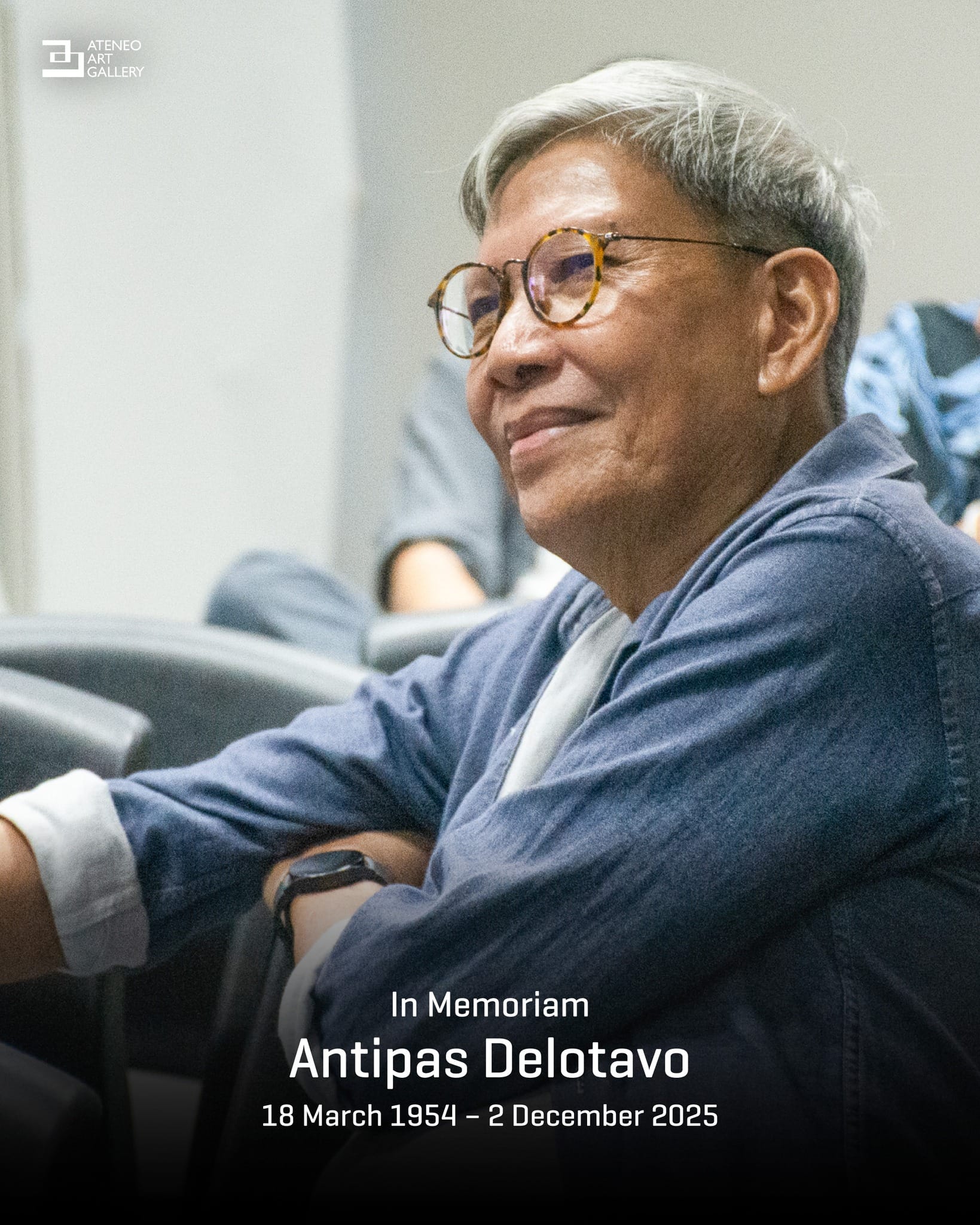
Delotavo, a son of Iloilo City, studied both in Iloilo and at the Philippine Women’s University (PWU) in Manila where he encountered members of what would be now looked back on as the “Kaisahan,” an idealistic cohort of young artists who would attempt to disrupt the colonial thread of thought that shrouded Filipino post-Hispanic and post-American culture, and sought to lay the revised premise for how we as a modern republic see ourselves in the 21st century, a people with a tangible heritage, and conversely a significant and worthy identity moving forward.
Certain pundits might have complained that socially oriented art fell short of its lofty esthetic goals, but a fair observation of active global histories and trends has borne out that each advanced country’s potent art is linked not to ornamentalist formalisms but to an aesthetic assessment, even a critique, of their history and collective experience.
Delotavo is a multi-awarded watercolorist, one of the Philippines most respected portraitists, whether in watercolor or oils, and belongs to an elite and revered roster that might include Amorsolo, Galicano, and Martino Abellana. Since he started in 1977, Delotavo has held dozens of exhibits in the Philippines and in Madrid, New York, Singapore and Fukuoka, Japan. He has won top awards in the Art Association of the Philippines Competitions, The Philippine Art Awards, a Hall of Fame in the Gallery Genesis Kulay sa Tubig contests, a 13 Artists recognition from the Cultural Center of the Philippines in 1990, an Araw ng Maynila Patnubay sa Sining Award in 2005, a 100 Alumni of the Century recognition from Iloilo’s University of San Agustin in 2004 and a Garbo ng Bisaya Award from the Dumaguete hosting of the VIVA Excon in 2012. In 1987, newly installed president Corazon C. Aquino asked him to do her official Malacañang portrait.
Delotavo Insists
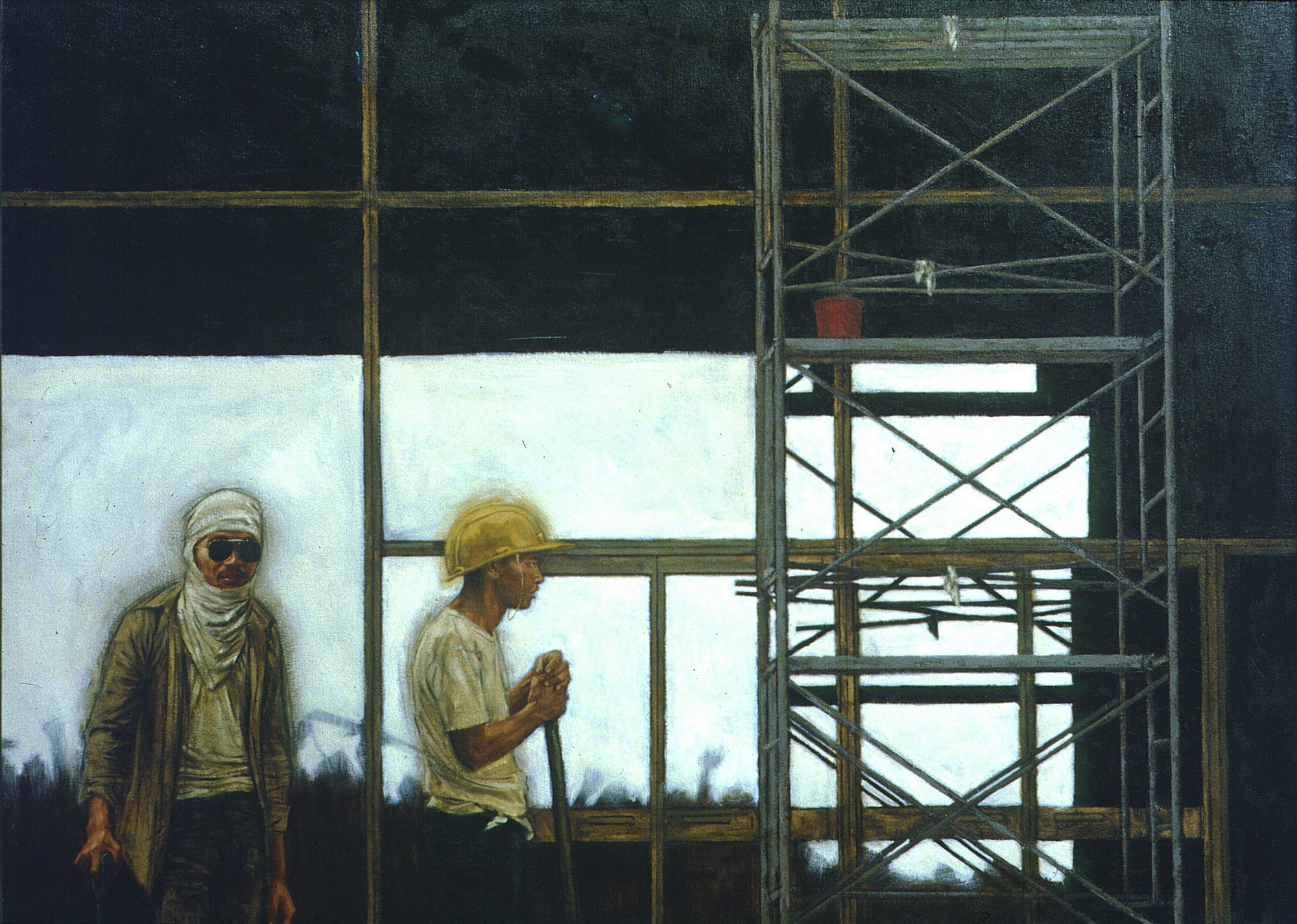
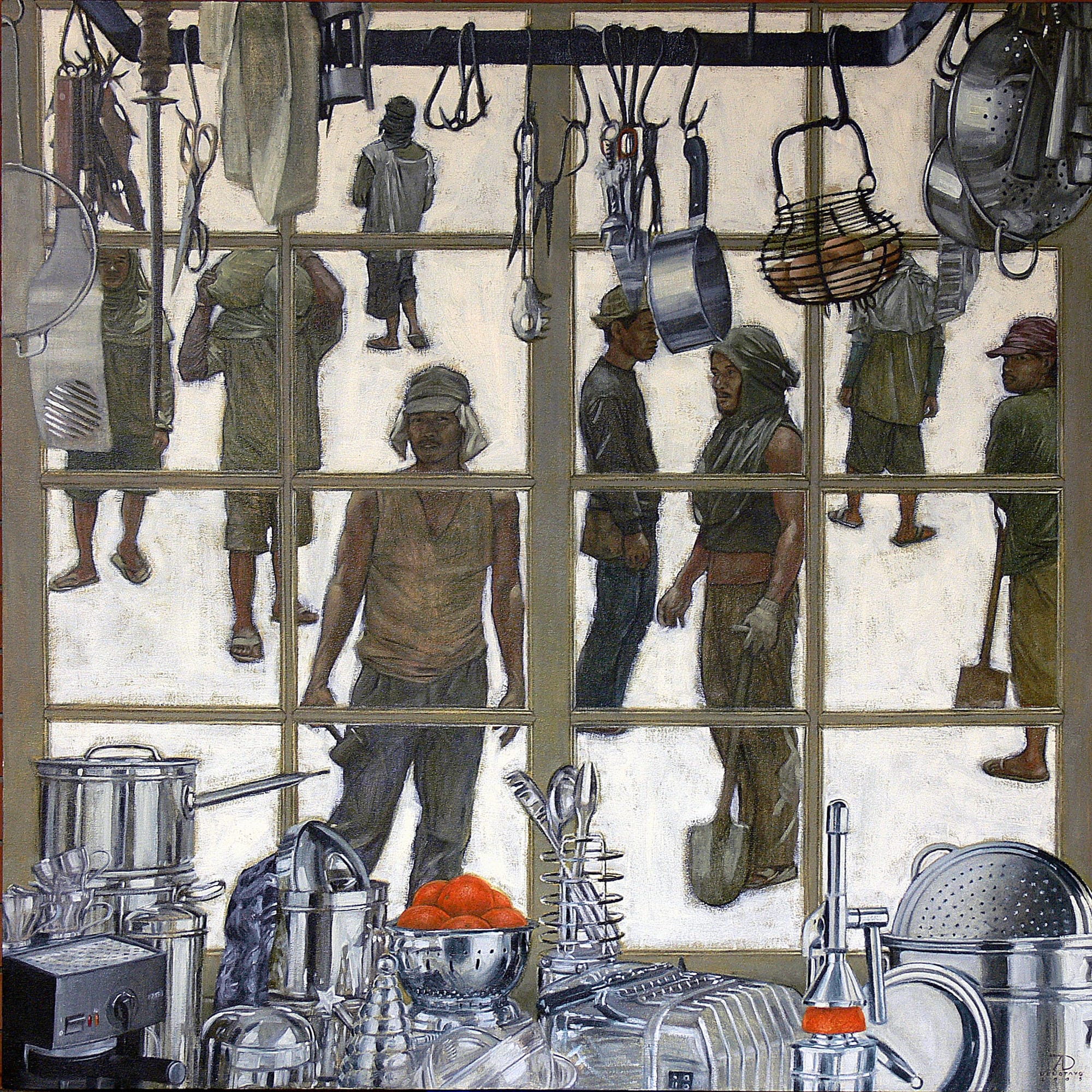
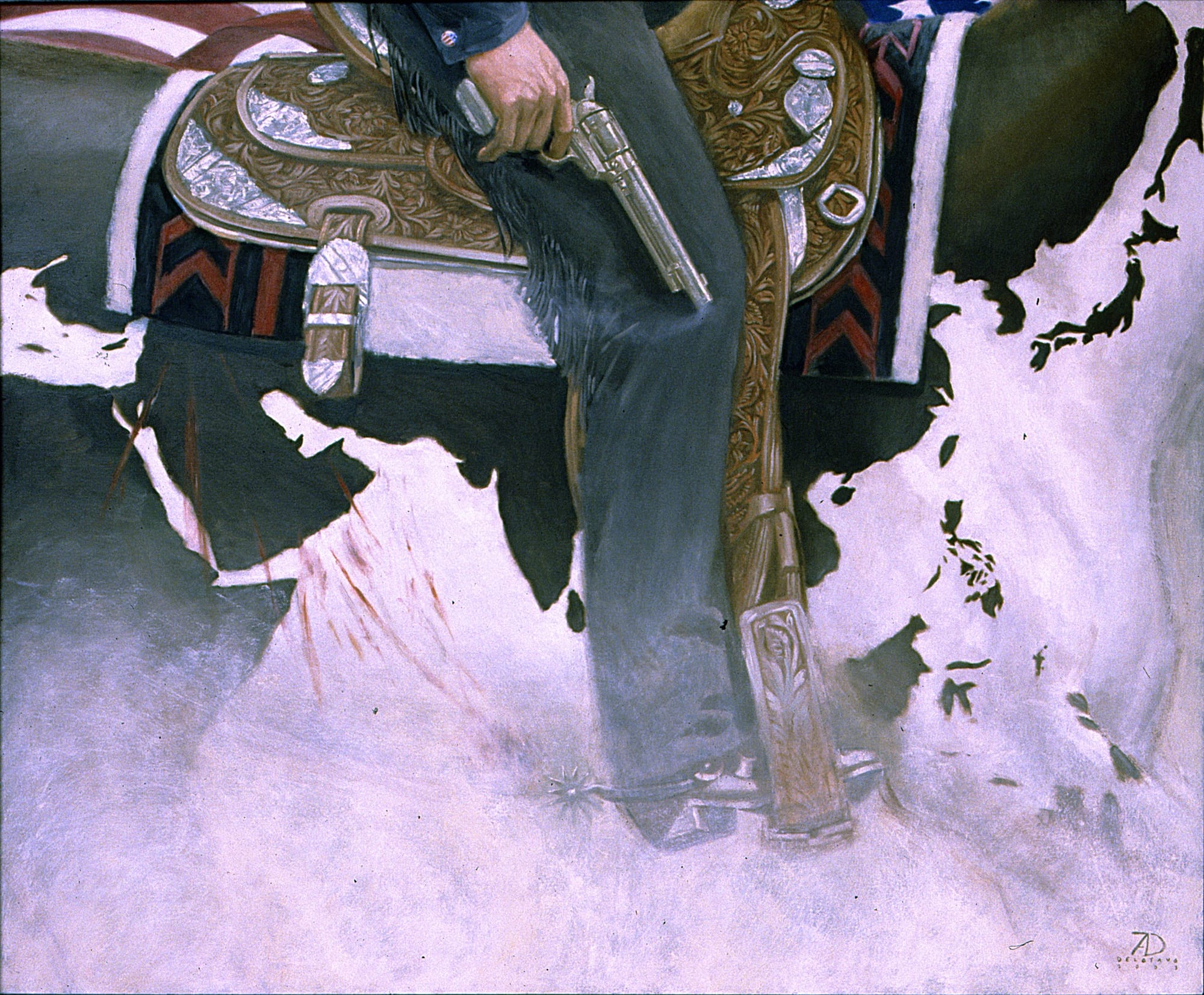
Delotavo has had over the last five decades to insist: He insists that being a Filipino is to participate in and with the larger constituency, not necessarily bannered by the Top 500 families or Oligarch networks, but to be consciously immersed in the larger, more stressful and challenged majority that make up more than 60% of what is still an emergent or developing economy, a still under armed and poorly defended state subject to the awkward and uneven power alliances with neighbors and spiritual kindred.
He has opted for a faction that has historically been disadvantaged, and whose continuing disenfranchisement will prevent this nation from its full potential. It is an alliance that has to be both fraught and patient, yet, strangely, optimistic. His cultural views, his cultural destiny, even a possible aesthetic legacy, rest on this choice. It is a tough one, but the history of nations has given us many precedents.
And some of those precedents have made their tough choices pay off. Delotavo has made his choice, and history will have to justify his choices, or not.
The Will to Salient Juxtaposition
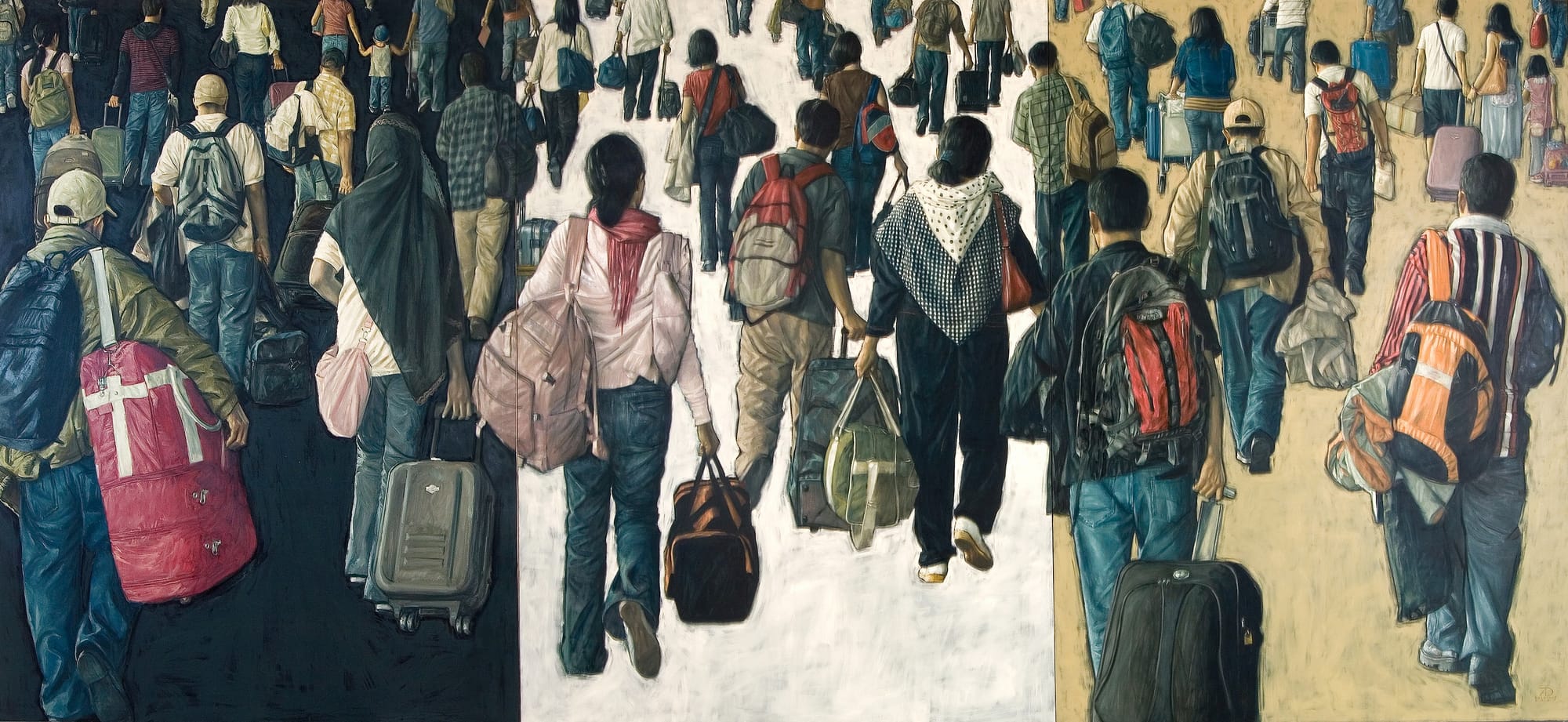
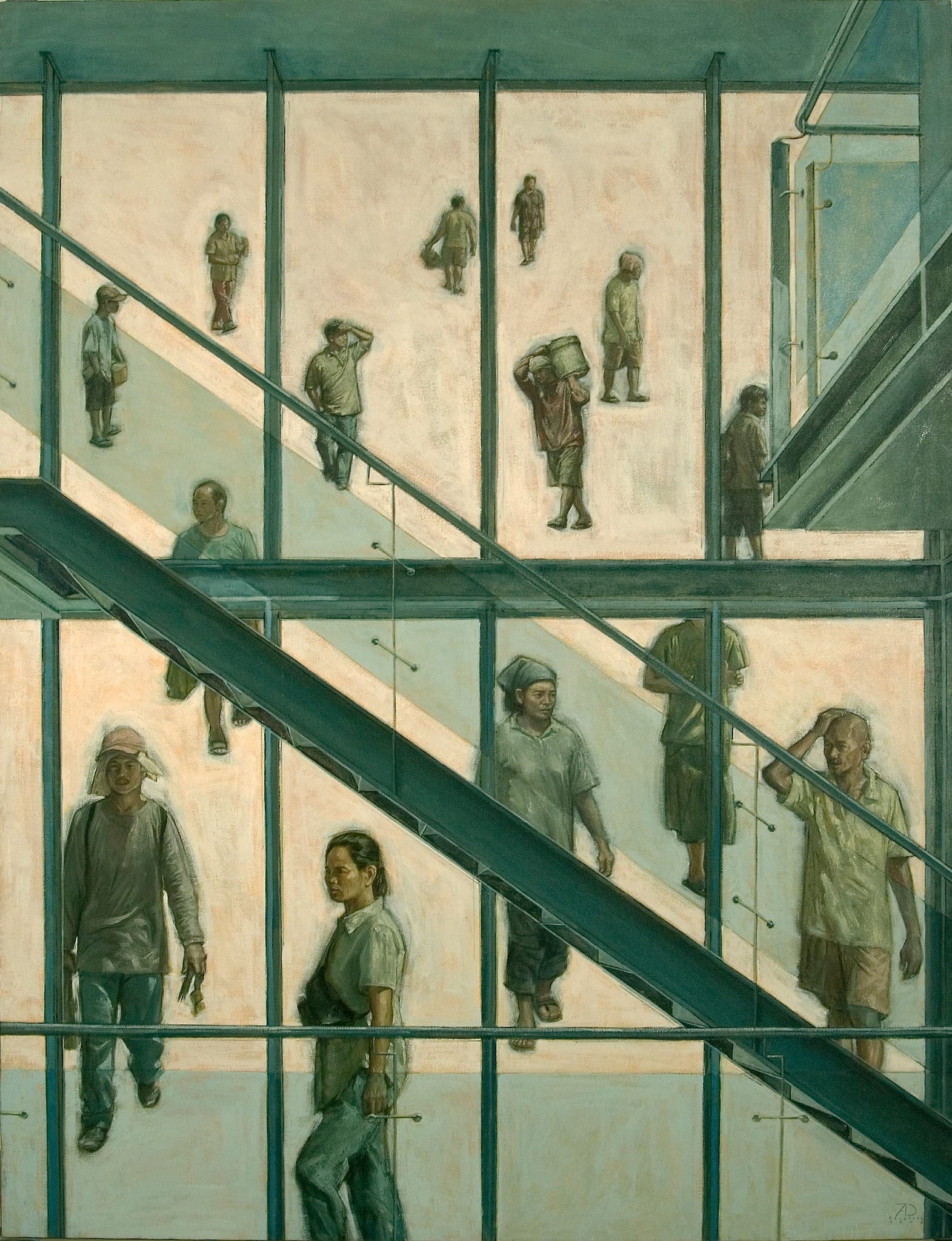
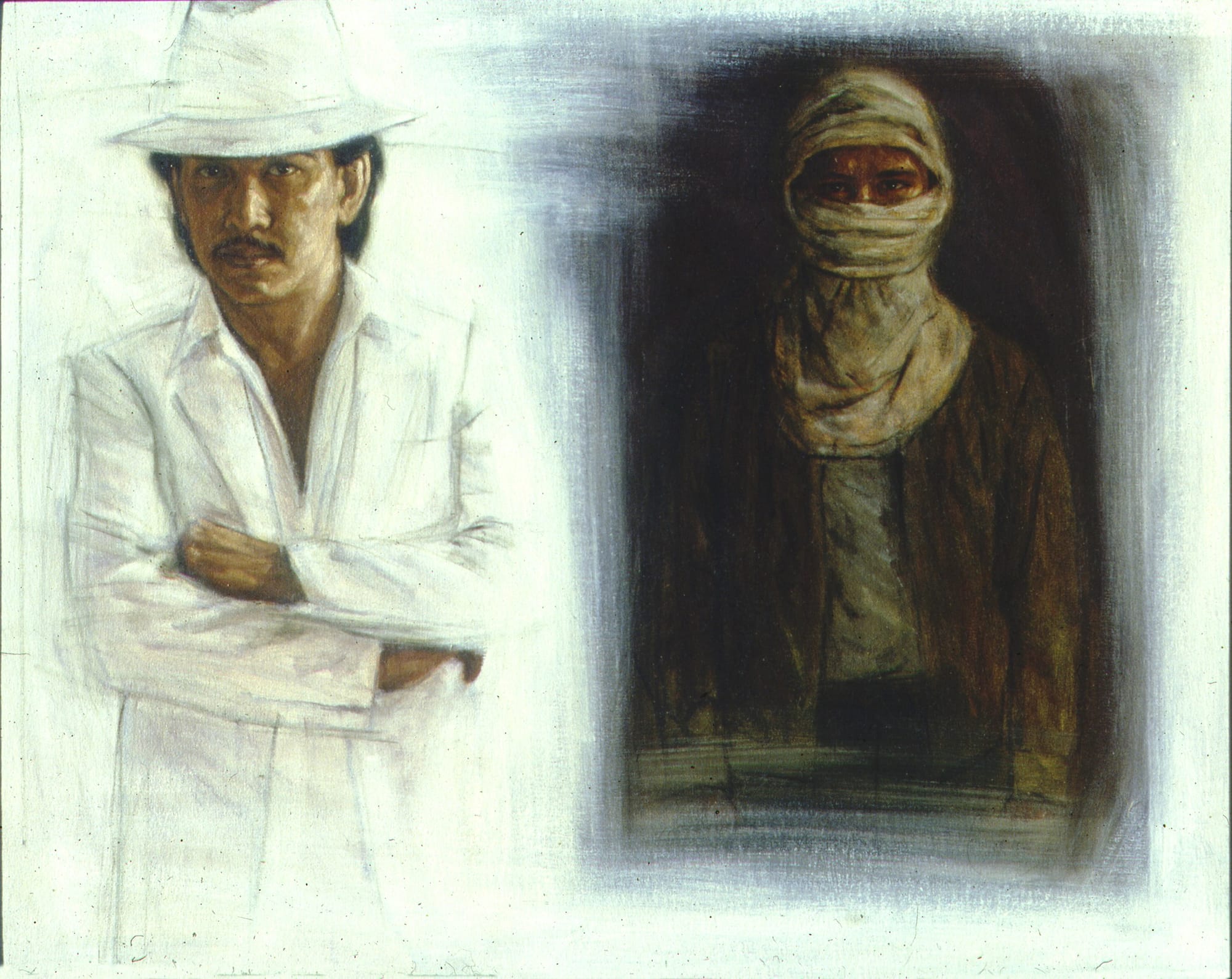
The impact of Delotavo’s recent works and longtime metier lies in his juxtaposition of worlds that are, in real terms, mutually exclusive, yet impinge on each other like awkward, unwilling neighbors. His five-decade practice also comes with his shock-of-recognition portraiture and recurrent decision to sample the tropes of overabundant material excesses that live not very far from his abject and often dispossessed and resigned everyman.
Juxtaposition works as an effective didactic method inasmuch as it contrasts, if not compares, two opposing sides, two facets of one existence that allow one side to enjoy pleasure, treasure and luxe until it is sick from the abundance, while the other is starved and deprived to the point that it remains undernourished, unattended, unwell, if not downright sick, this time of unmitigated destitution.
All our democratic, aesthetic leanings clamor for this anomaly of inequity to be mediated, for charity to remedy if not negotiate with greed, for selfishness to yield to altruism, but alas, as the insightful Indian American philosopher Aijaz Ahmad declared, the logic of capital is now too deeply entrenched in all of our societies.
Delotavo’s juxtapositions have been treading these tainted waters for so, so long, hoping not to be exhausted, hoping not to succumb to drowning in their murky inertia or lapse into convenient ornamentalism with just enough of a redolence of progressive rhetoric, however we construe that in 2023.
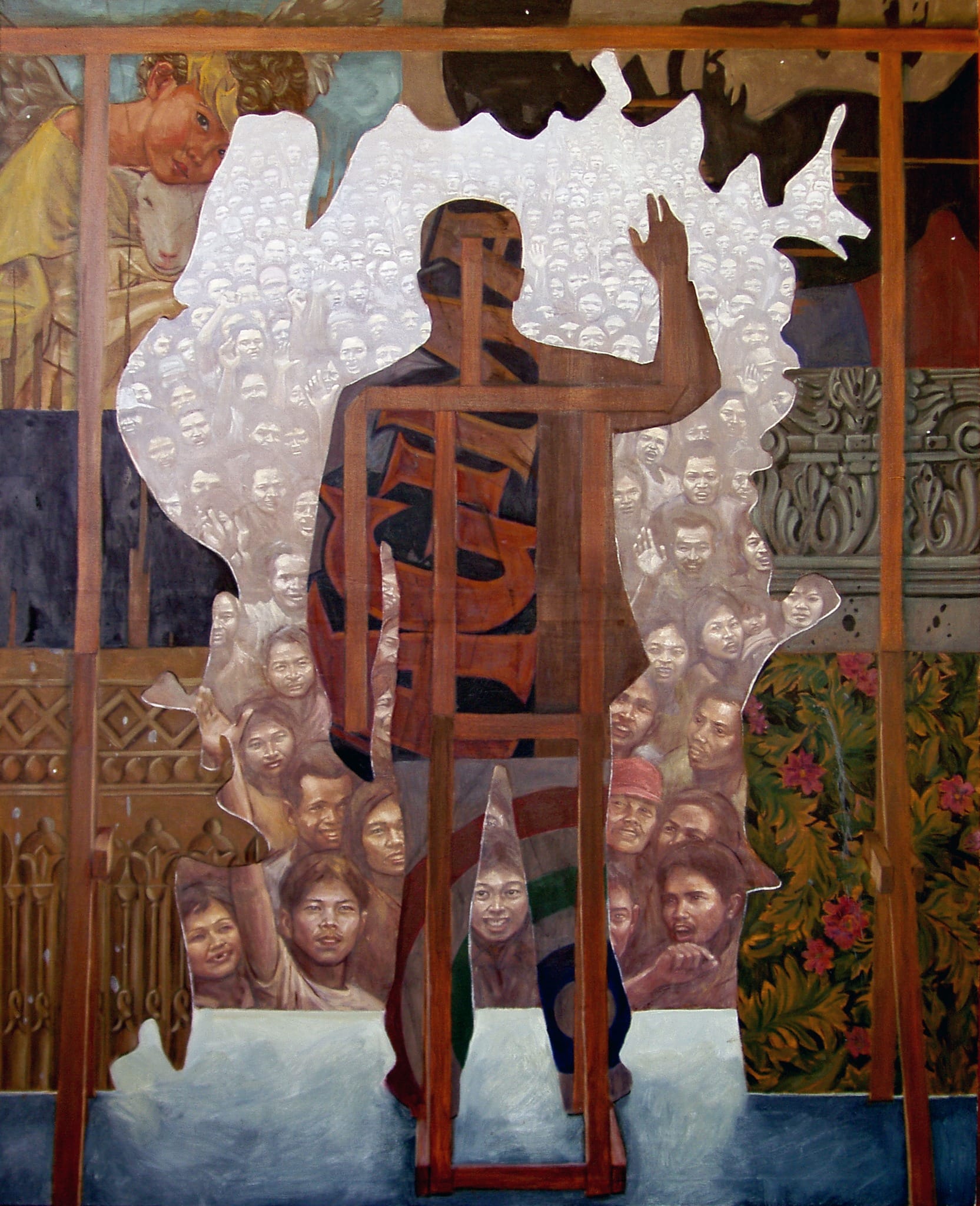
In his exhibit “Iloilo Variants,” Delotavo localizes his juxtapositions, rendering recognizable architectural landmarks of Iloilo’s industrial and commercial history against which he situates, or floats his dispossessed denizens. It's not a straightforward landscape, more of a historico-cultural layering, with an added genericized modernist horizon hovering as an inviting but uncertain future for these markers of Hispanic and neo-classic colonial occupation, architectural monarchs etched into the mental narrative of those who would call Iloilo their home or point of origin.
Delotavo does not necessarily reject the progress and beauty that these Art Deco and Neo Classic landmarks have brought to his home province. He does glaringly remark, though, that the mechanisms and social systems needed to distribute these gifts of the colonizers must have fallen short, are not up to speed to the point that by juxtaposing their grandeur with the unflinching, and longstanding plainness of the citizens that he sets beside them, he creates works that manifest, nay enunciate, the ironic inequity.
This may lie at the heart of his brand of Social Realism, this may lie at the core of an art that celebrates even while it observes and critiques with a tinge of deep discomfort; a deep discomfort much like one peering at a banquet from an unattainable distance while placating a ravenous stomach, a famished gut and an even hungrier soul.
Plumbing
Social Realism is Dead. Long Live Social Realism. That’s about as useful a way to repurpose a time worn elegy of passage when talking of newly-minted art.
Outsiders to the still unfolding project of SR have taken comfort in pigeonholing it in either a footlocker sized category of myopic vision or obsolescence, only to conveniently elide some pertinently inescapable specifics : Where did the post colonial anxieties of 90s hotshot Manuel Ocampo come from? Minimalism? AbEx residue? Punk? And what was Punk a symptom of? Did Mark Justiniani’s Settlement evolve from Cubism, Geometric OpArt or Ornamentalism? Do Louie Cordero’s colloquial absurdities come from a formalism that bred H.R. Ocampo and Ben Maramag?
Do absurd punk nihilists like Lagenneger have any DNA link to Zen or mysticism or cosmic universalism? Is Borlongan an heir to Amorsolo or Martino Abellana? Which tradition does Lyra Garcellano’s caustic reflexivity come from? Yoga? Voodoo? What is the episteme of Jojit Solano’s contra-catholic montages? Not an Albersian geometric rationality, that’s for sure.
The thing is, folks, SR is no embalmed corpse. Nor even its wax facsimile. It is a fleshy morsel of lechon leg which many have fed off and is now somehow ingrained in our aesthetico-molecular makeup. When? Then, till 2018, of course. Where might Ronald Ventura, Rodel Tapaya or even Alwin Reamillo get their social muscle if not from this very leg of lechon. Go to Baluarte Santa Barbara at the Manila Biennial 2018 and see the residue of anti and post colonial anxiety cobbled temporarily and contemporarily in Kawayan De Guia’s derelict Lady Liberty. Is not Walang Boots, Pete Jimenez’s linking of Rizal’s footsteps, disused shoe lasts and the corruption driven deficit of infantry footwear a favorite trajectory of “SR” critique? Where does Felix Bacolor’s Thirty Thousand Liters, an array of pastel blue fonterra milk drums germinate its link to wartime bloodshed if not hatched in the most subversive of leftist imaginations. The thing about SR, it hasn’t gone away. It’s become us so much that we don’t notice it around anymore. Like body odor.
In this light, it almost seems natural to render a triad show by Pablo Baensantos, Renato Habulan and Delotavo as mundane.
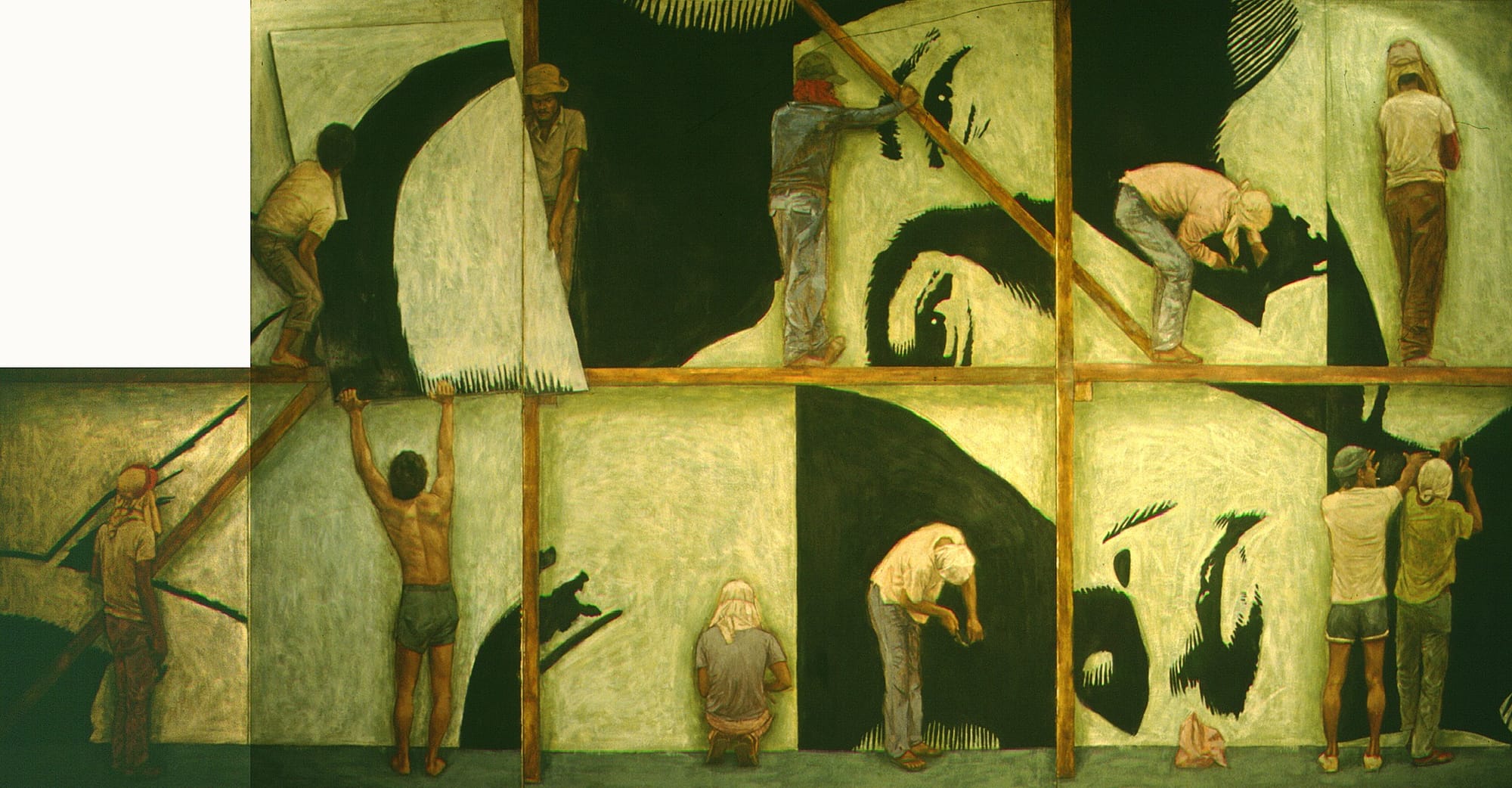
At a time when art was meant, when art was meant to be everything else but the vaunted affliction of the comfortable, their project was borderline criminal and, if minor legal statutes were to be pursued, sufficiently illegal.
Truth be told, they belonged to a much larger community of dissent, with Neil Doloricon, Cap Reyes, Egai Fernandez, Chitoy Zapata, even a twentysomething divinity grad named Manny Garibay and the late digital maven Al Manrique sharing the mission-vision, among dozens of others, who, for the moment we leave unmentioned. And the three have been around, hung around, come around, reconfigured in previous big shows like Hardware1 and Hardware 2, Trianggulo, Aba!, YouTubia and Triad.
In the relentless cacophony of the current true and/or false newstream, the noun Triad is contaminated. It weighs on us with a reek of lawless menace, of surly gang machination with coded skin ink, of the repulsive underbelly that infects accountability in leading and governance. But it blooms into many petals, this word. Color combos in our Munsell based system proceed from Triads, the primary one containing the origin of many functioning hues:
Red, Yellow, Blue. This same Triad is our flag, ultramarine blue sky, crimson blood, yellow/white sun and stars. A neat bundle of pop music hits, including Jimmy Hendrix’s “Little Wing,” Bob Dylan’s “Knocking on Heaven’s Door” and “Mr. Tambourine Man” are stitched together from chord and note configurations that are also called triads.
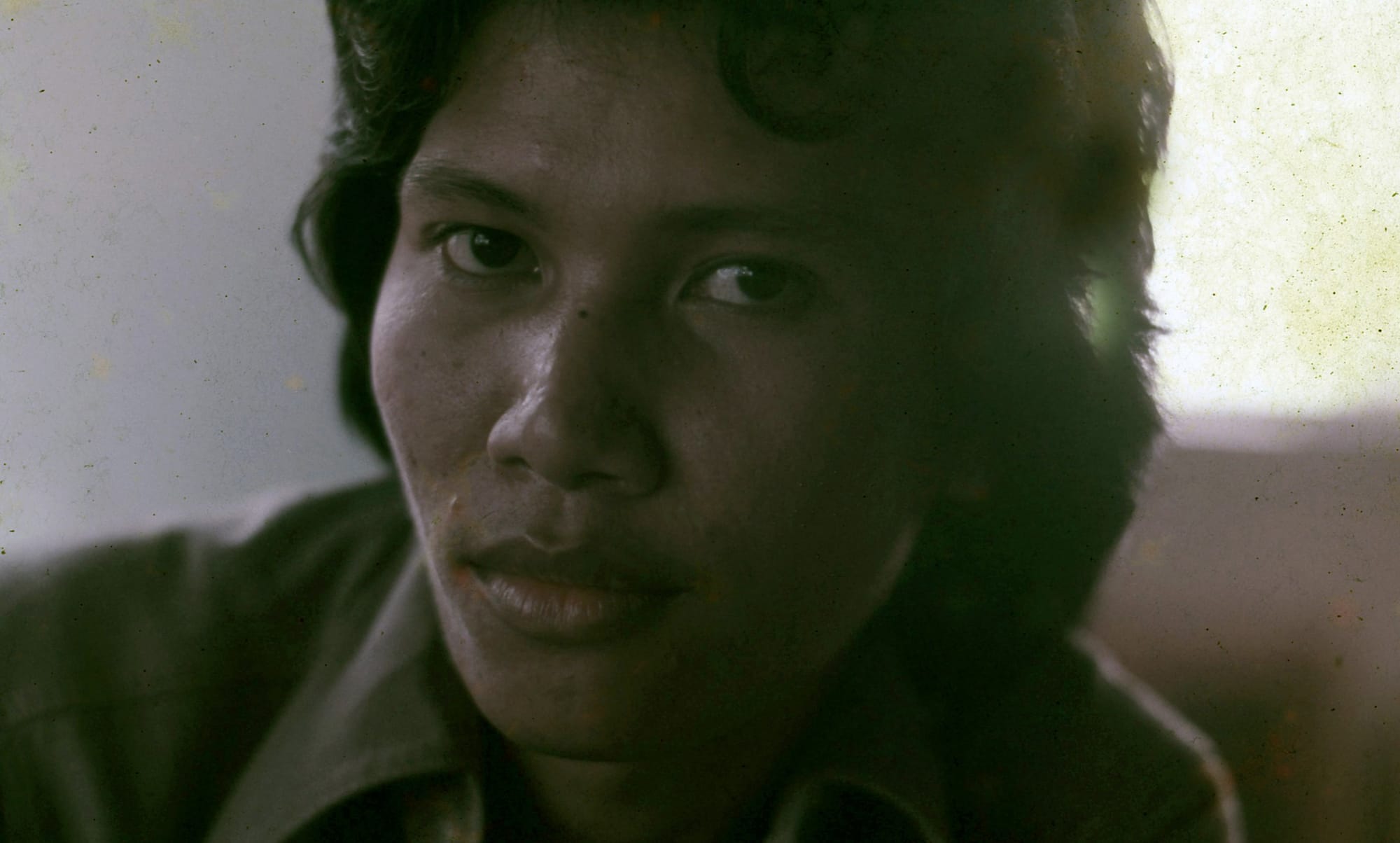
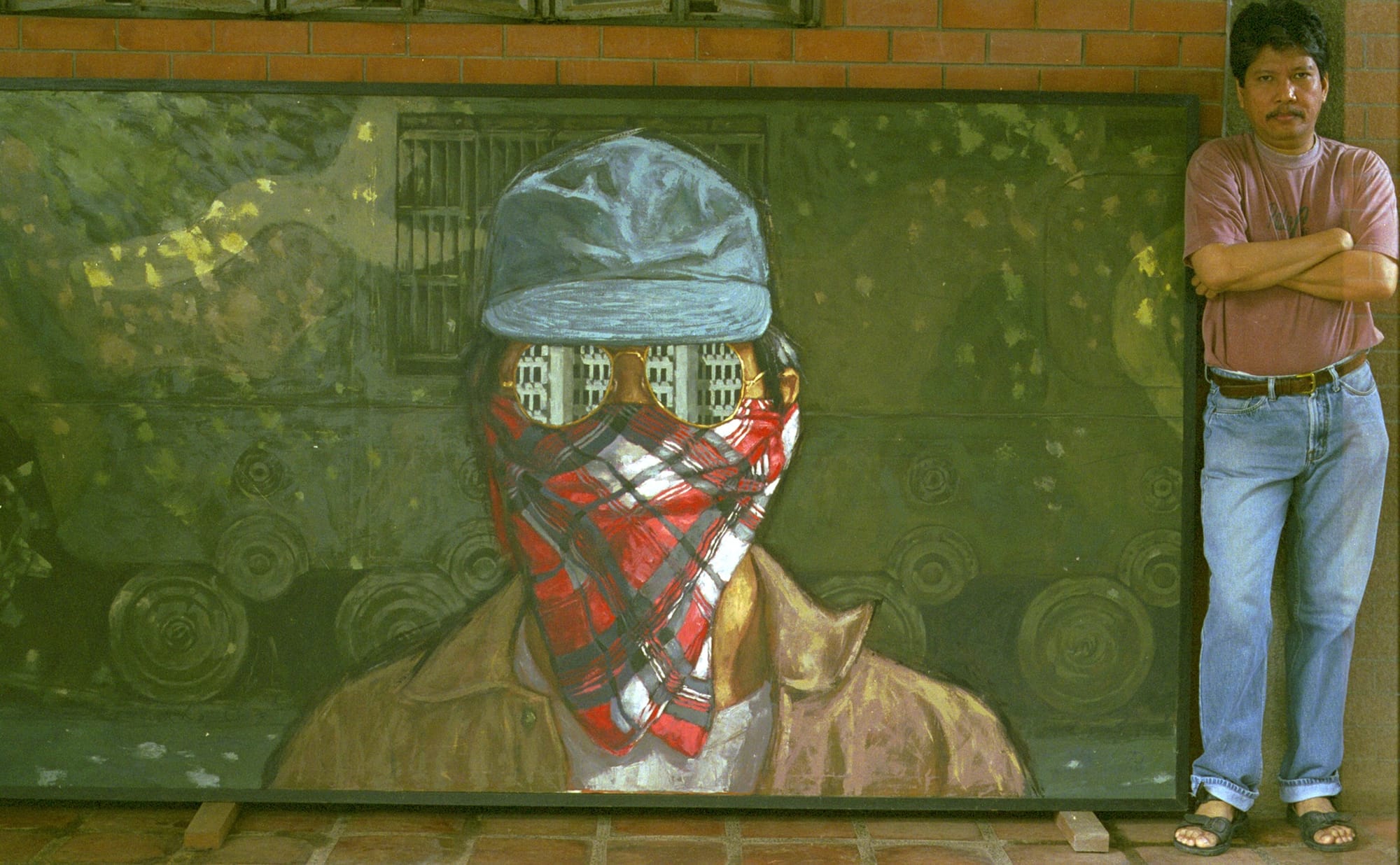
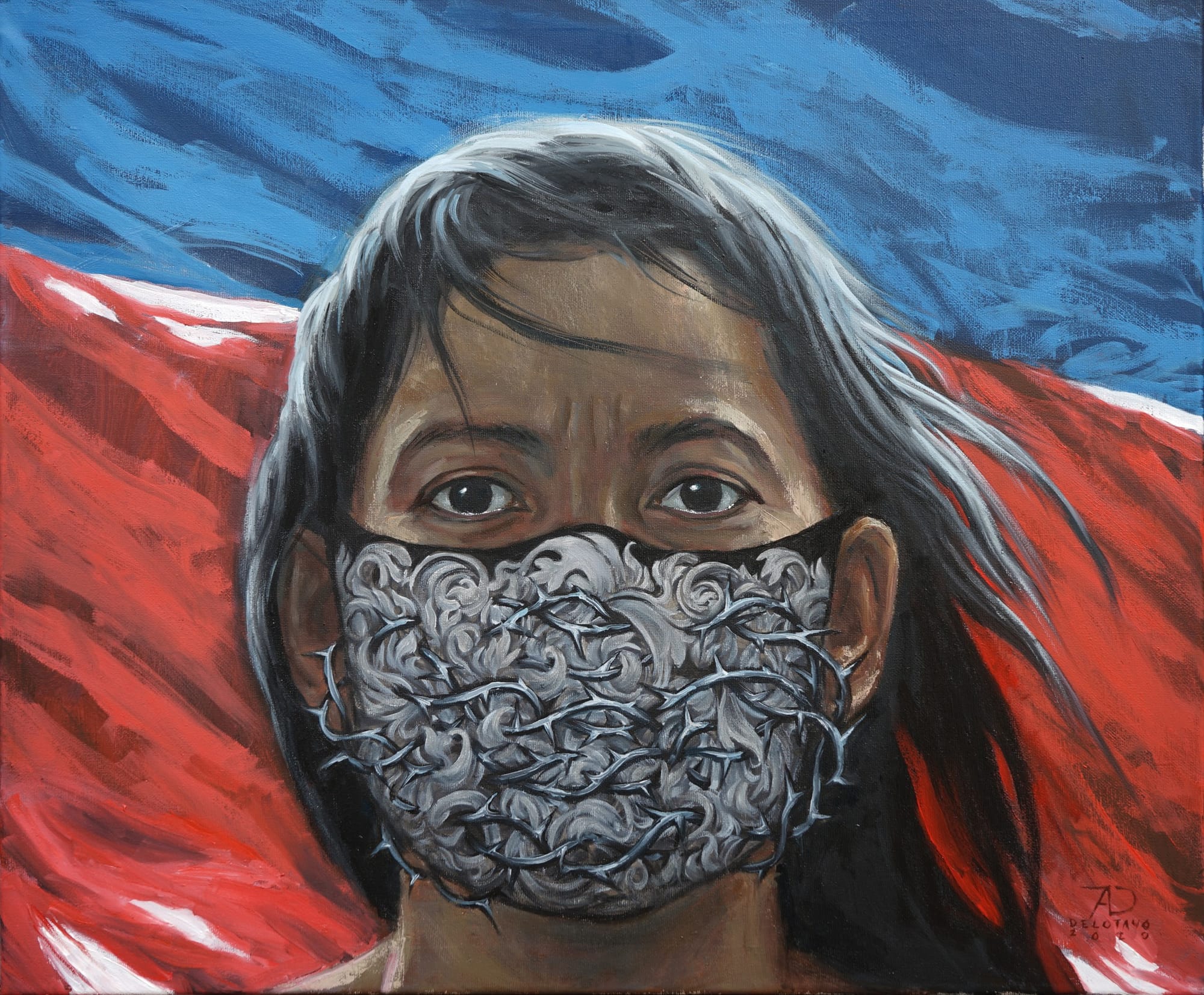
At first glance, Delotavo’s large watercolor portraits recall Chuck Close, Lynyrd Paras or any of the dozen or so practitioners of the aggressively large head-shot. He titles them John or Jane Doe; they are actually neighbors, barangay mates whose names he withholds. As it has been a prevalent image in the news to see criminals or those fingered to be such as faceless bodies caught in a purge of the powerless, recognizability attempts to scrounge back whatever humanity might get distilled from those who have been made statistics.
Art, charged by and in the observation of contradictions in social settings has come a long way from its pioneer motifs thrown up by Bolshevism, Socialist Realism, Yenan Forum prescriptions and even North Korean chosun. These genres served as formative templates for pictures that could confront issues. But we have in the last 40 years or so absorbed multidirectional currents of formal strategy, wit, poetry, enigma, craft, mystery, quandary and invention so that, after formalist logic arrived at one of its teleological destinations in the reductions of Malevich, the formal per se seemed bereft of use without context. And while context in human behavior might be seen as adaptive yet cyclical, it varied, prospered, morphed as technologies were discovered.
Social Realism has ridden this wave, and like waves, it starts from very far away before it breaks on shore, gathering and or dispersing energy from where it began. SR’s long fluctuation may outlive all of it initial adherents and will gather and repel others to react to, with, against and about it. The project, as we have seen for almost a half century will outlive and outpace us, but that is a worthy preoccupation. We have given our small tithe. The triad has lived to initiate but a minor fissure in the veneer of disequilibrium, then has to move on.
For those still plumbing the accumulated depths of human crisis, we have but one suggestion: Do not stare far away awaiting the next SR tsunami; the flood has already funneled into the pipes, and after negotiating all this plumbing, comes to us, now, daily, on demand, when we reach for the tap.
If you liked what you just read and want more of Our Brew, subscribe to get notified. Just enter your email below.
Related Posts
Numbers vs. Influence: My Take on the Philippine Evangelical Church Today
Feb 23, 2026
Who is Missing Which Strongman? Competing Authoritarian Nostalgias in the Philippines
Feb 04, 2026
The Sorrowful Mystery of Cabral’s Death
Dec 20, 2025