

By Pulse Asia
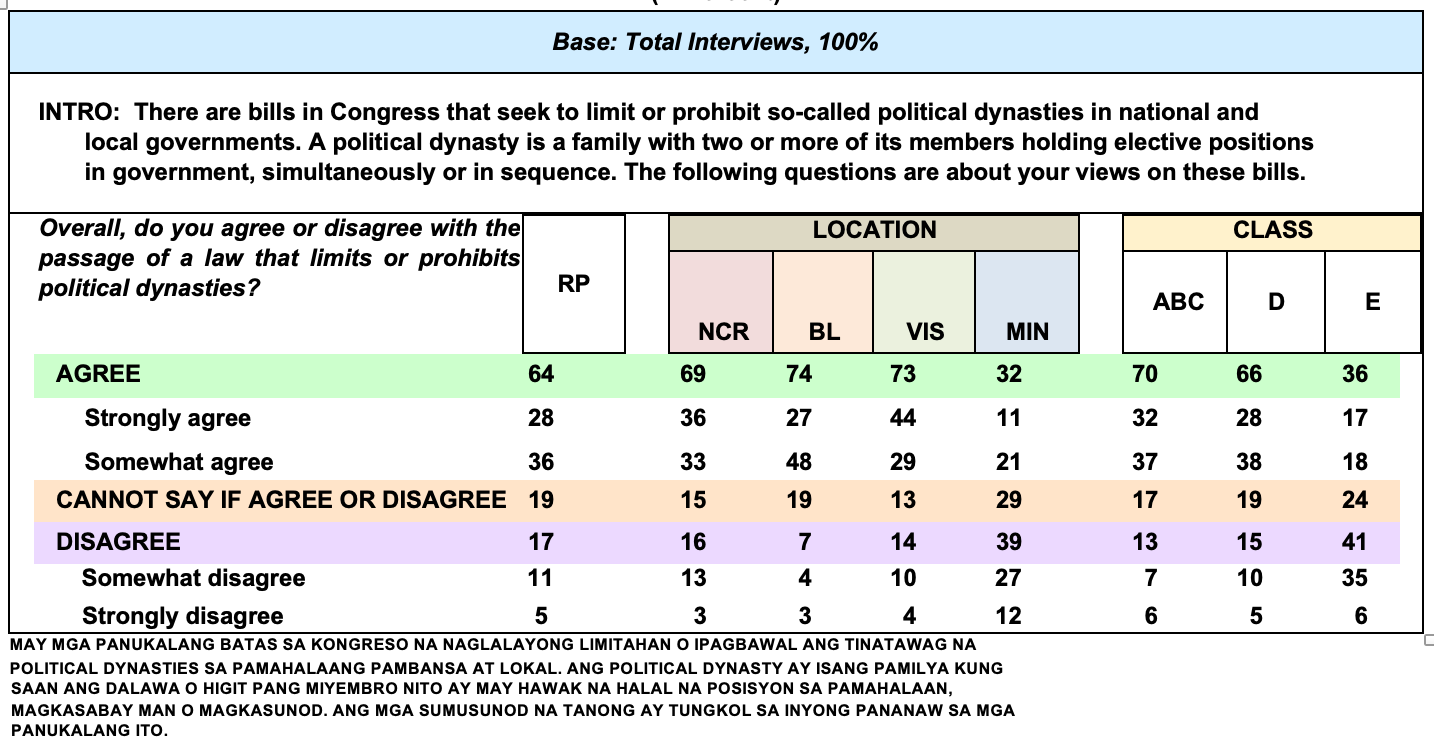
Most Filipino adults (64%) agree with the passage of a law against political dynasties in the country. Majority support for such a legislative measure cuts across levels of government and covers both simultaneous and consecutive holding of elective government positions
Support for legislative proposals to ban political dynasties in the Philippine political arena is the predominant sentiment among Filipino adults, with 64% agreeing with the passage of such a bill. The rest of the adult population either disagrees with such a measure (17%) or expresses indecision on the matter (19%). Majority levels of agreement are posted in Metro Manila (69%), the rest of Luzon (74%), the Visayas (73%), Class ABC (70%), and Class D (66%). A three-way split may be observed in Mindanao (32% agreement, 29% indecision, and 39% disagreement) while almost the same percentages in Class E either agree or disagree with banning political dynasties in the country (36% and 41%, respectively). (Please refer to Table 1.)
Table 1
AGREEMENT OR DISAGREEMENT WITH THE PASSAGE OF A LAW
THAT LIMITS OR PROHIBITS POLITICAL DYNASTIES
February 27 - March 2, 2026 / Philippines
(In Percent)
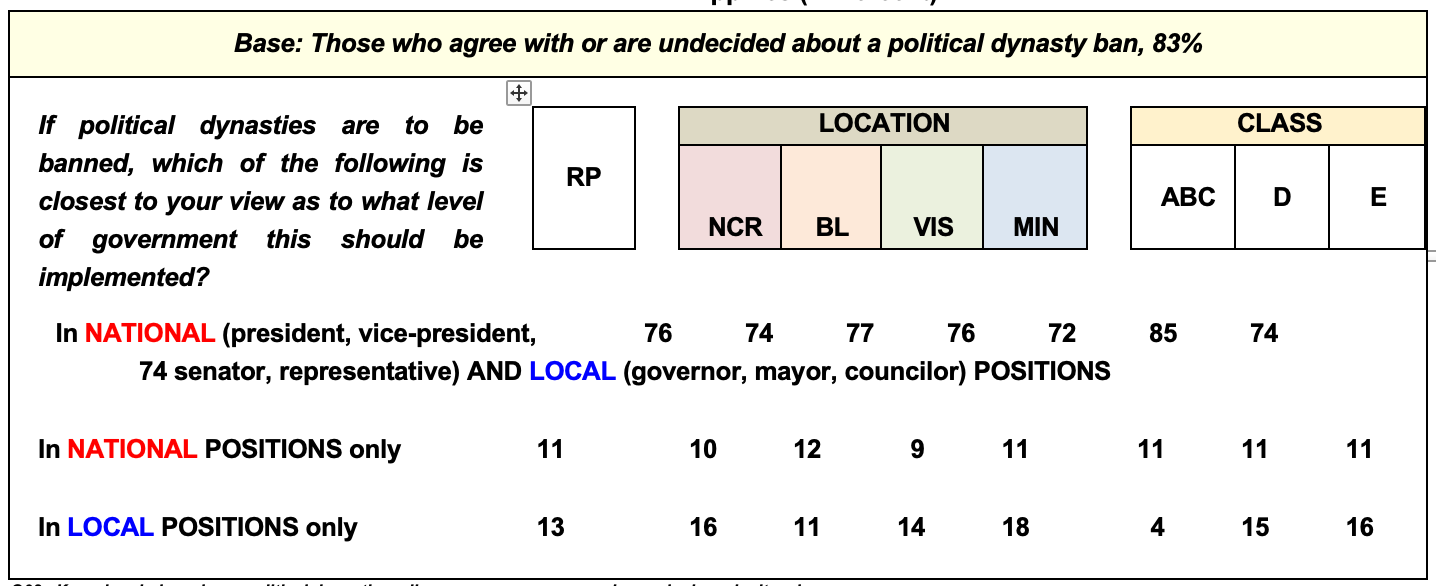
A big majority of those who agree with or are undecided about a ban on political dynasties (76%) opine that such a ban should be implemented at both the national and local levels of government, with majority agreement figures being recorded in all geographic and socioeconomic subgroupings (72% to 77% and 74% to 85%, respectively). Meanwhile, 13% say a ban on political dynasties should cover only local government positions and 11% prefer that it be applicable only to elective positions at the national level.[1] (Please refer to Table 2.)
Table 2
LEVEL OF GOVERNMENT FOR POLITICAL DYNASTY BAN
Nearly seven (7) in 10 Filipino adults (69%) would like to prohibit relatives from holding the same local government post consecutively – a view echoed by sizeable to huge majorities across areas and classes (72% to 78% and 66% to 85%, respectively), with Mindanao being the exception (47%). Almost a quarter is ambivalent on the matter (23%) while practically a tenth is opposed to such a ban (8%). (Please refer to Table 3.)
Table 3
HOLDING THE SAME ELECTIVE POSITION IN LOCAL GOVERNMENT CONSECUTIVELY
February 27 - March 2, 2026 / Philippines
(In Percent)
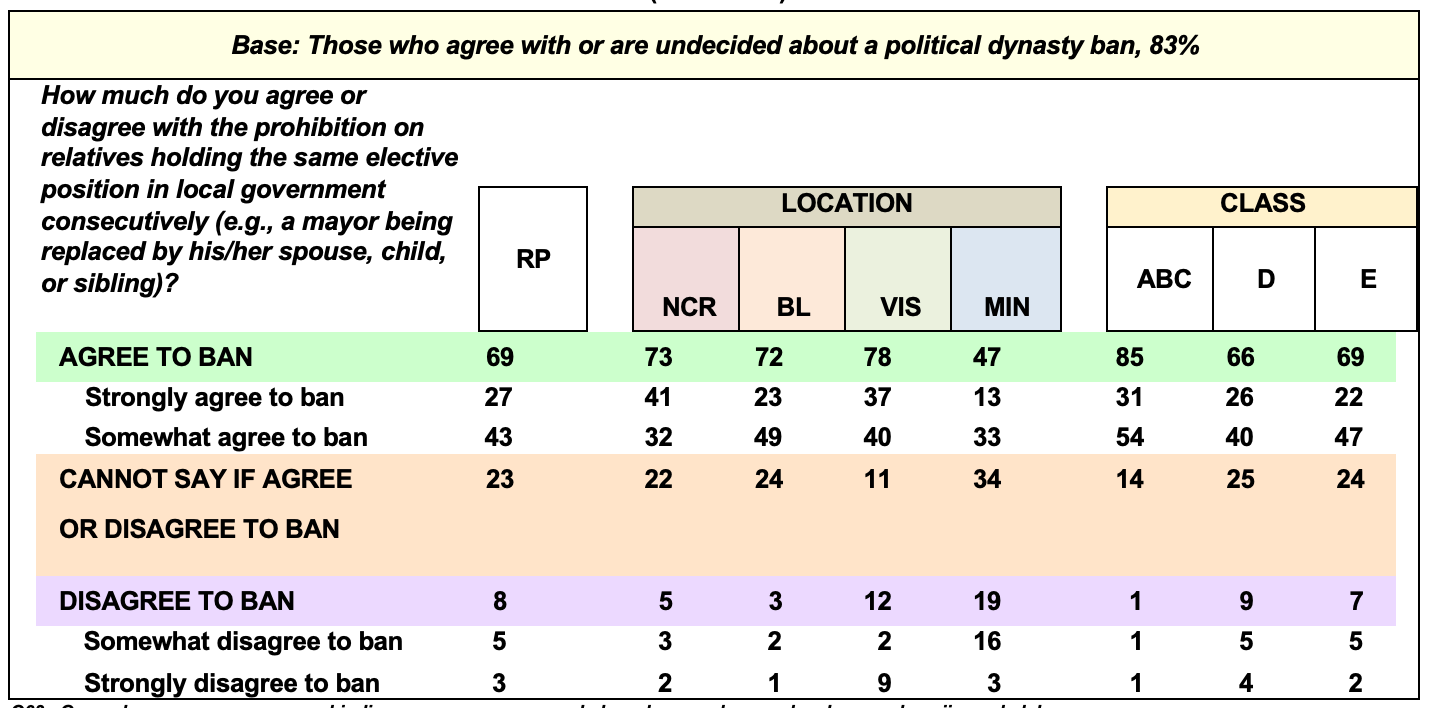
Basically the same pattern of public opinion holds true when it comes to disallowing relatives from holding the same national government post consecutively. Agreement with this proposal is expressed by most adults at the national level (69%), most geographic areas (71% to 78%), and every socioeconomic class (66% to 86%). Again, it is only in Mindanao where a non-majority agreement figure is posted (47%). Indecision on the matter is more pronounced than disagreement (22% versus 9%).
(Please refer to Table 4.)
Table 4
AGREEMENT OR DISAGREEMENT WITH THE PROHIBITION ON RELATIVES HOLDING
THE SAME ELECTIVE POSITION IN THE NATIONAL GOVERNMENT CONSECUTIVELY
February 27 - March 2, 2026 / Philippines
(In Percent)
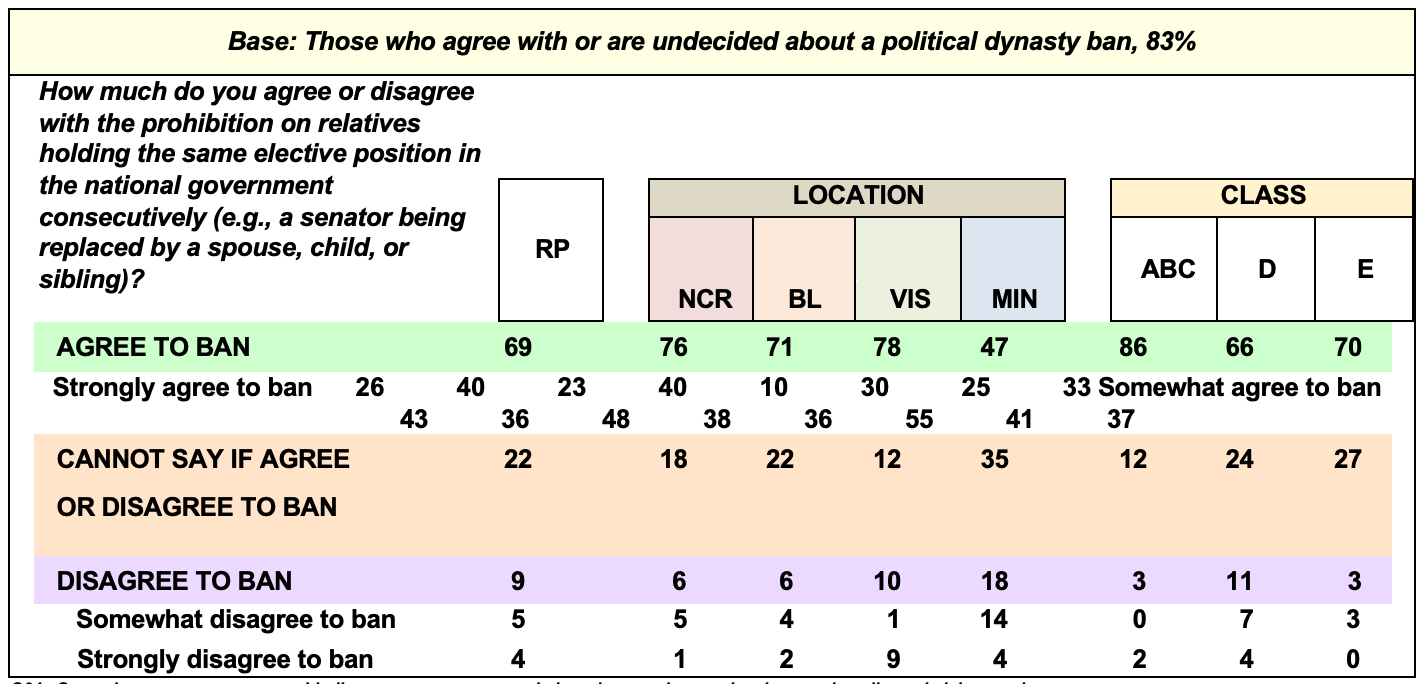
As far as simultaneous holding of government positions is concerned, majorities agree with banning political dynasties in both national and local governments (70%). Such a ban has the support of considerable to huge majorities in nearly all areas and every class (73% to 77% and 65% to 85%, respectively). In Mindanao, essentially the same percentages either agree with this proposal or are undecided on the matter (40% versus 35%). At the national level, 20% are ambivalent on the matter while 10% oppose such a ban. (Please refer to Table 5.)
Table 5
AGREEMENT OR DISAGREEMENT WITH THE BAN ON RELATIVES HOLDING
ELECTIVE POSITIONS IN NATIONAL AND LOCAL GOVERNMENTS SIMULTANEOUSLY
February 27 - March 2, 2026 / Philippines
(In Percent)
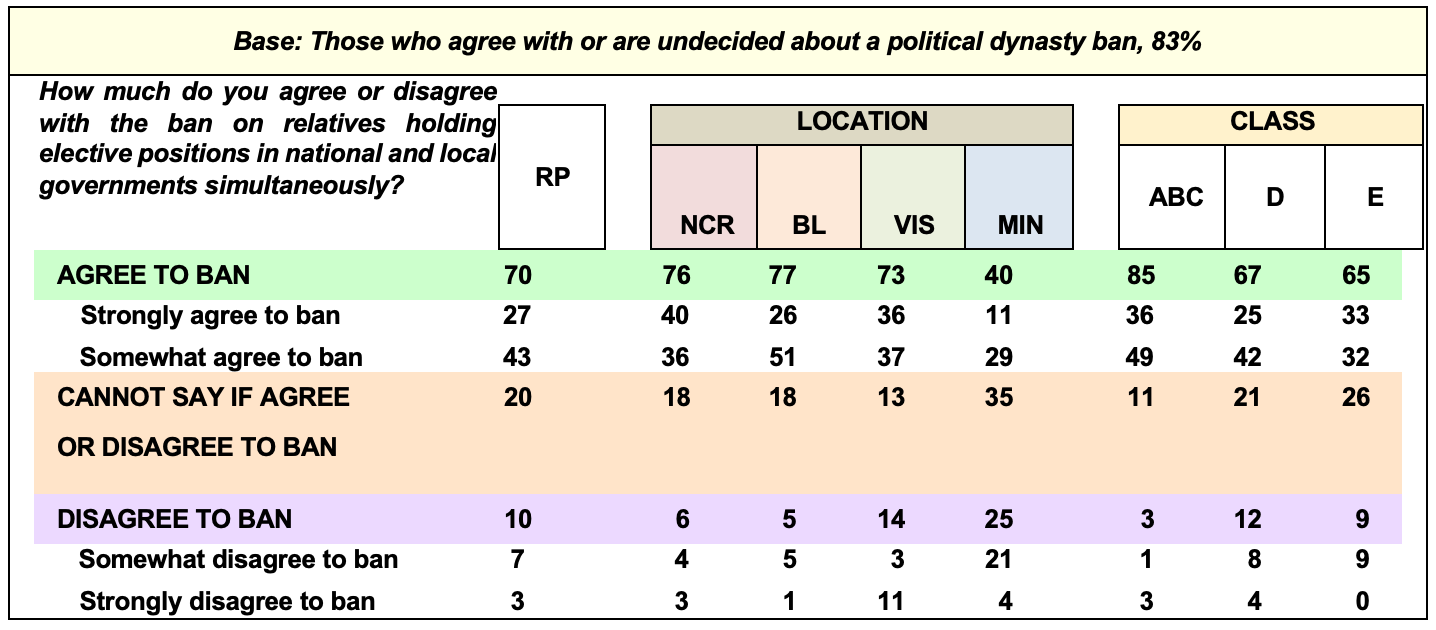
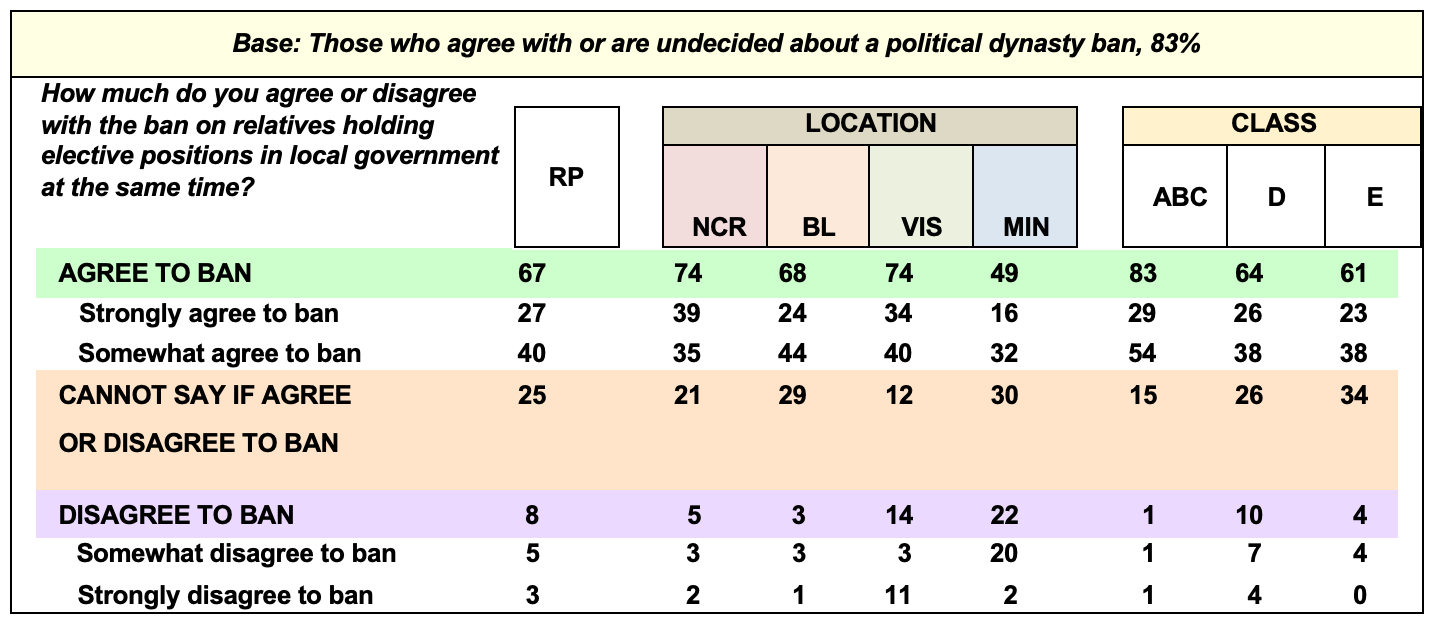
Most Filipino adults who agree with prohibiting political dynasties or are undecided on the matter support a ban on relatives holding local elective positions simultaneously (67%), with majority levels of agreement being registered in most areas and all classes (68% to 74% and 61% to 83%, respectively). Once more, Mindanao is the exception (49%). Ambivalence is expressed by 25% while 8% disagree with such a ban at the local level. (Please refer to Table 6.)
Table 6
AGREEMENT OR DISAGREEMENT WITH THE BAN ON RELATIVES
HOLDING ELECTIVE POSITIONS IN LOCAL GOVERNMENT SIMULTANEOUSLY
February 27 - March 2, 2026 / Philippines
(In Percent)
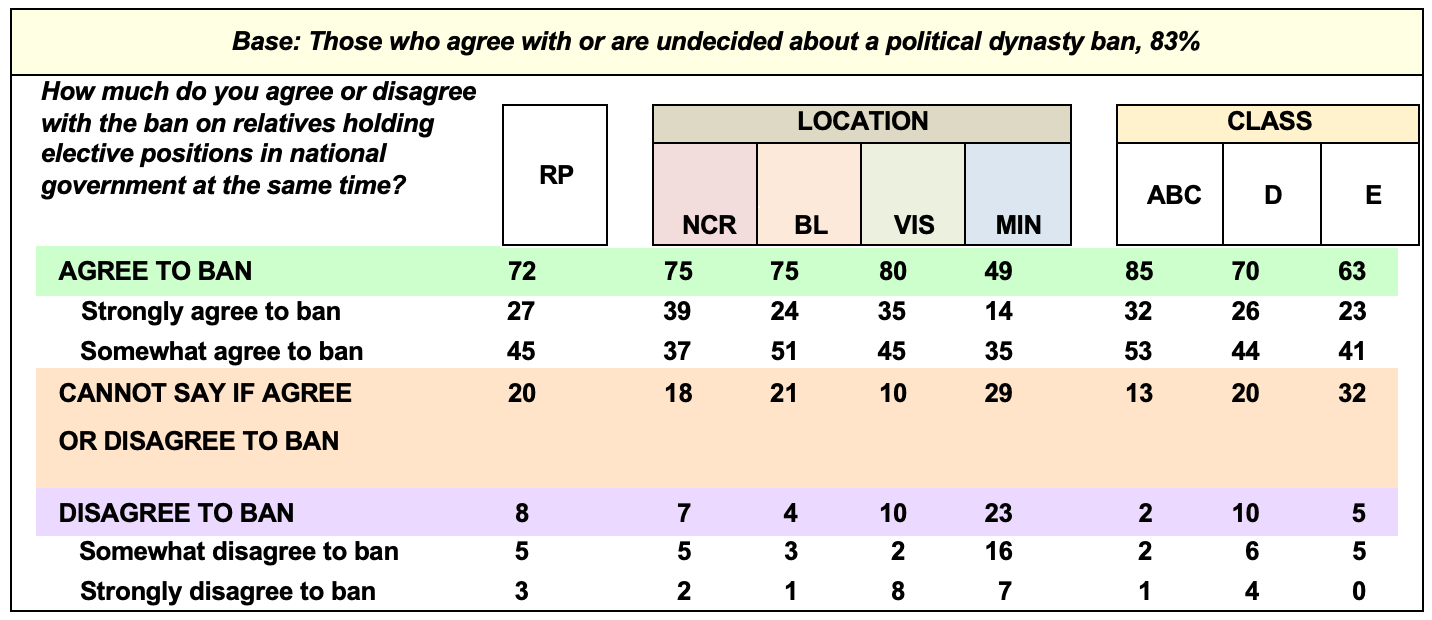
Around three-fourths of those supportive of or are ambivalent about a ban on political dynasties (72%) see the need for a ban on relatives holding national elective positions simultaneously. This opinion is shared by sizeable to big majorities in practically all areas and every class (75% to 80% and 63% to 85%, respectively). A non-majority agreement figure is recorded in Mindanao (49%). Indecision is recorded at 20% while less than a tenth (8%) disagrees with imposing such a ban. (Please refer to Table 7.)
Table 7
AGREEMENT OR DISAGREEMENT WITH THE BAN ON RELATIVES
HOLDING ELECTIVE POSITIONS IN NATIONAL GOVERNMENT SIMULTANEOUSLY
February 27 - March 2, 2026 / Philippines
(In Percent)
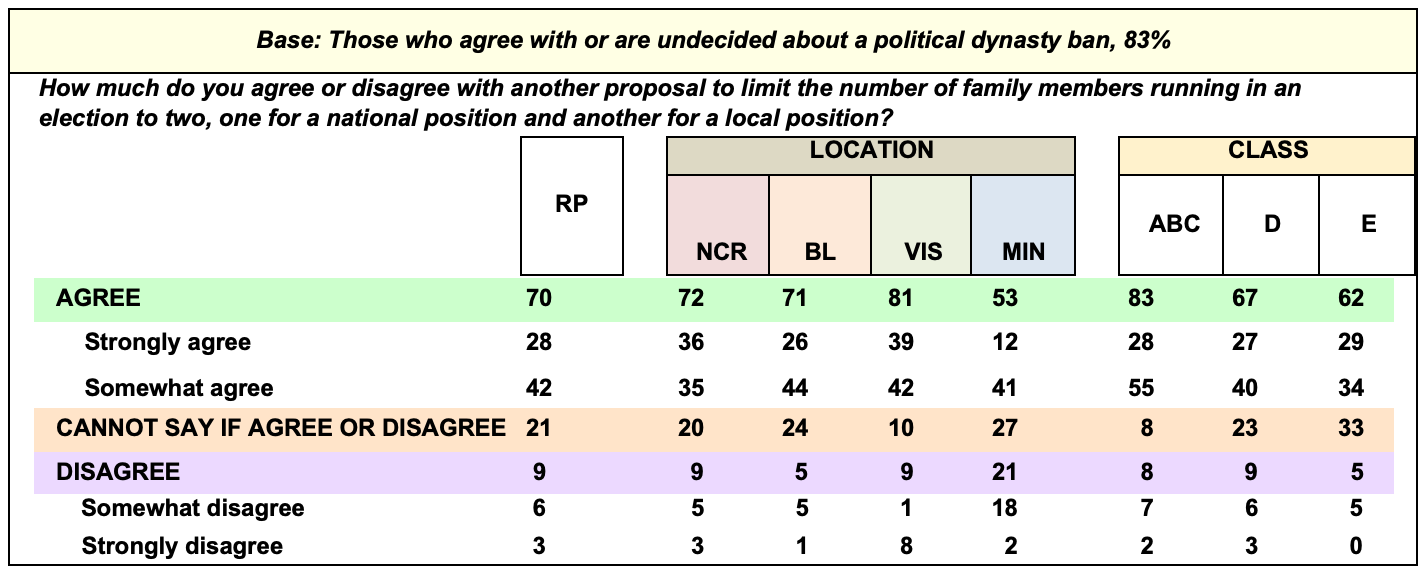
A proposal to limit the number of family members running in an election to only two (2), one for a national position and another for a local position, is supported by 70% of those who agree with banning political dynasties or are undecided on the matter. Majority levels of agreement with such a proposal are posted across geographic and socioeconomic subgroupings (53% to 81% and 62% to 83%, respectively). Disagreement is expressed by 9% while 21% cannot say if they agree or disagree with such a legislative measure. (Please refer to Table 8.)
Table 8
AGREEMENT OR DISAGREEMENT WITH THE PROPOSAL TO LIMIT THE NUMBER OF
FAMILY MEMBERS RUNNING IN AN ELECTION TO TWO, ONE FOR A
NATIONAL POSITION AND ANOTHER FOR A LOCAL POSITION
February 27 - March 2, 2026 / Philippines
(In Percent)
If you liked what you just read and want more of Our Brew, subscribe to get notified. Just enter your email below.
Related Posts
Year on Year, Satisfaction and Trust Gap Between Marcos Jr. And Sara Duterte Narrows - Pulse Asia
Mar 16, 2026
Social Weather Report | 83% of Filipinos say a woman’s role is to look after the home and family; Public opinion on the role of women has been conservative for many years
Mar 06, 2026
The ICC Case against Rodrigo Duterte: Questions and Answers
Feb 18, 2026