

Pulse Asia Research’s December 2025 Ulat ng Bayan Survey:
Media Release on the Flood Control Projects Scandal
12 January 2026
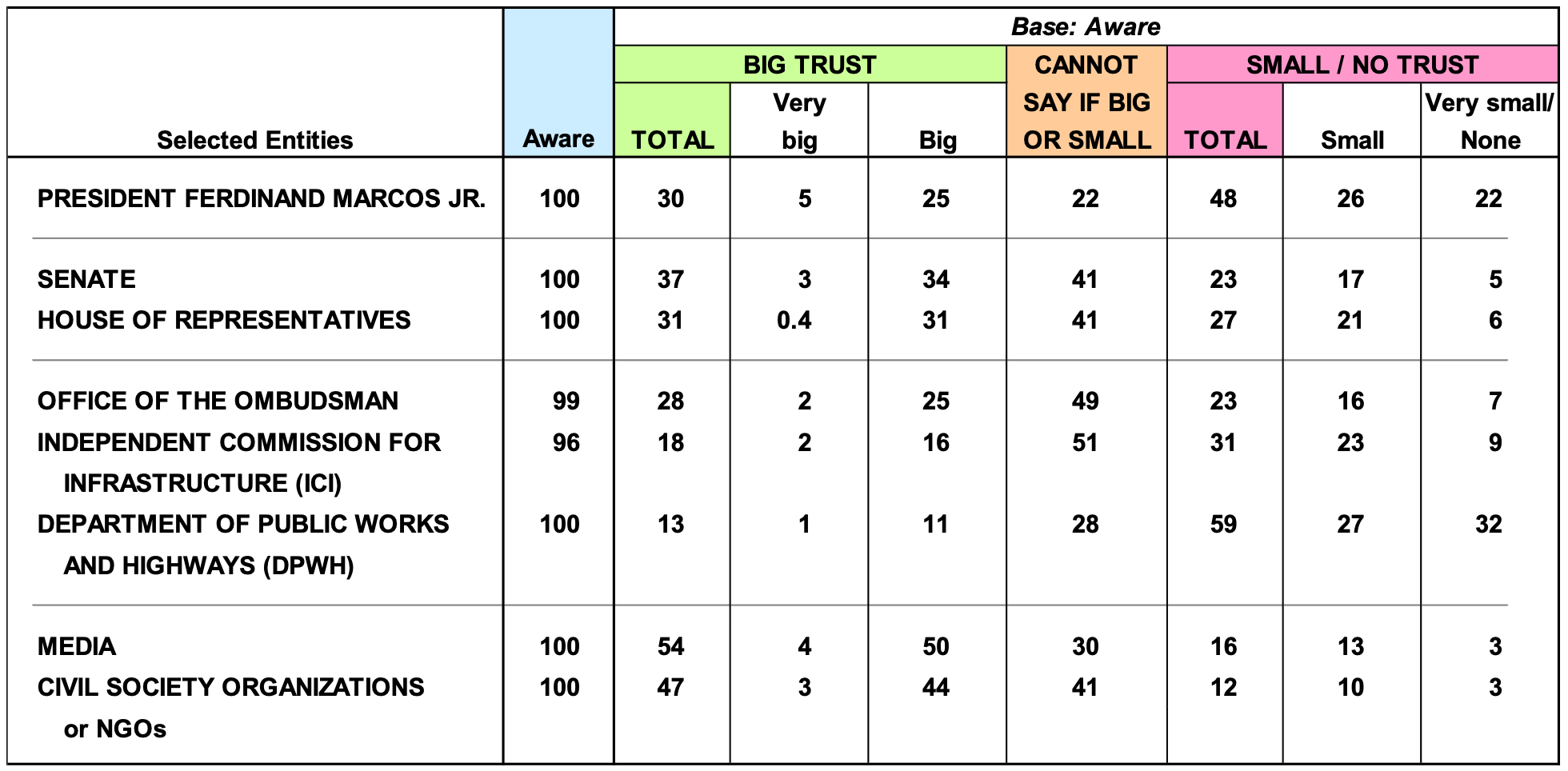
The media is trusted by most Filipino adults (54%) to address the issue of corruption in flood projects in the country
Among selected entities, a small majority of adults in the country (54%) identify the media as the one they trust to be able to address the problem of ghost or substandard flood control projects. A near majority (47%) expresses the same sentiment toward civil society organizations (CSOs) or non-governmental organizations (NGOs). In contrast, near to small majorities do not trust the President (48%) and the Department of Public Works and Highways (59%) to deal with the matter while big pluralities to bare majorities cannot say if they trust or distrust the House of Representatives (41%), the Office of the Ombudsman (49%), and the Independent Commission for Infrastructure (51%). In the case of the Senate, about the same percentages of adults are either ambivalent on the matter of trusting or distrusting the legislative body’s capability to address the flood control projects issue (41%) or trust it to be able to handle the matter (37%). (Please refer to Table 1.)
Table 1
TRUSTWORTHINESS OF SELECTED ENTITIES IN
ADDRESSING THE PROBLEM OF CORRUPTION IN FLOOD CONTROL PROJECTS
December 12 - 15, 2025 / Philippines
(Row Percent)
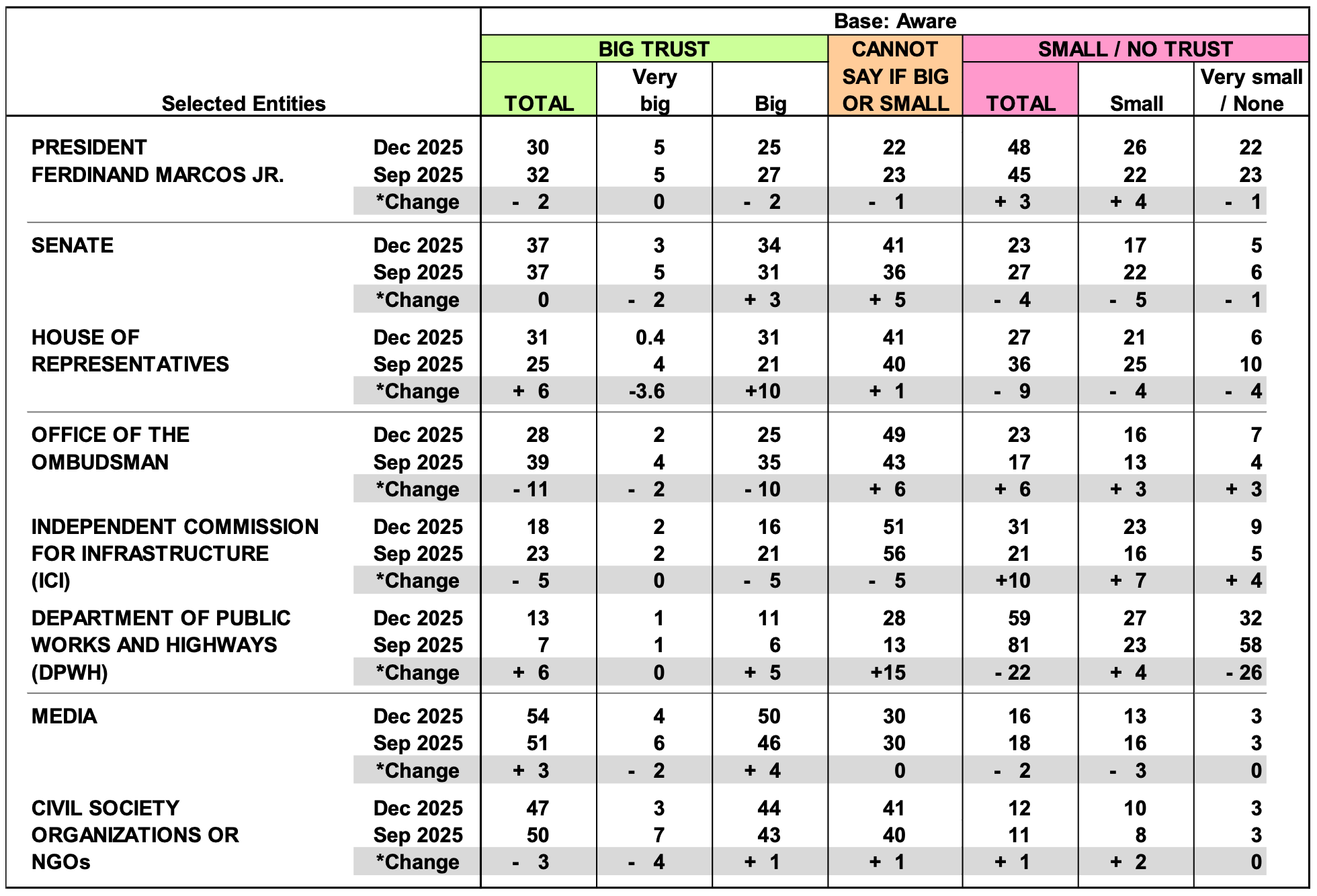
Several notable movements occur between September 2025 and December 2025. While there is an increase in the level of trustworthiness of the House of Representatives (+6 percentage points), distrust in the legislative chamber eases (-9 percentage points). Similarly, trust in the Department of Public Works and Highways becomes more notable (+6 percentage points) and distrust in the agency becomes less pronounced (-22 percentage points). Furthermore, the level of ambivalence regarding the agency’s trustworthiness in relation to its capability to deal with the flood control projects scandal goes up during this period (+15 percentage points). (Please refer to Table 2.)
In contrast, the level of trust in the Office of the Ombudsman drops (-11 percentage points) while distrust and indecision toward its trustworthiness become more marked (both at +6 percentage points). As regards the Independent Commission for Infrastructure (ICI), the level of distrust in the investigative body goes up (+10 percentage points).
Table 2
COMPARATIVE TRUSTWORTHINESS OF SELECTED ENTITIES IN
ADDRESSING THE PROBLEM OF CORRUPTION IN FLOOD CONTROL PROJECTS
September and December 2025 / Philippines
(Row Percent)
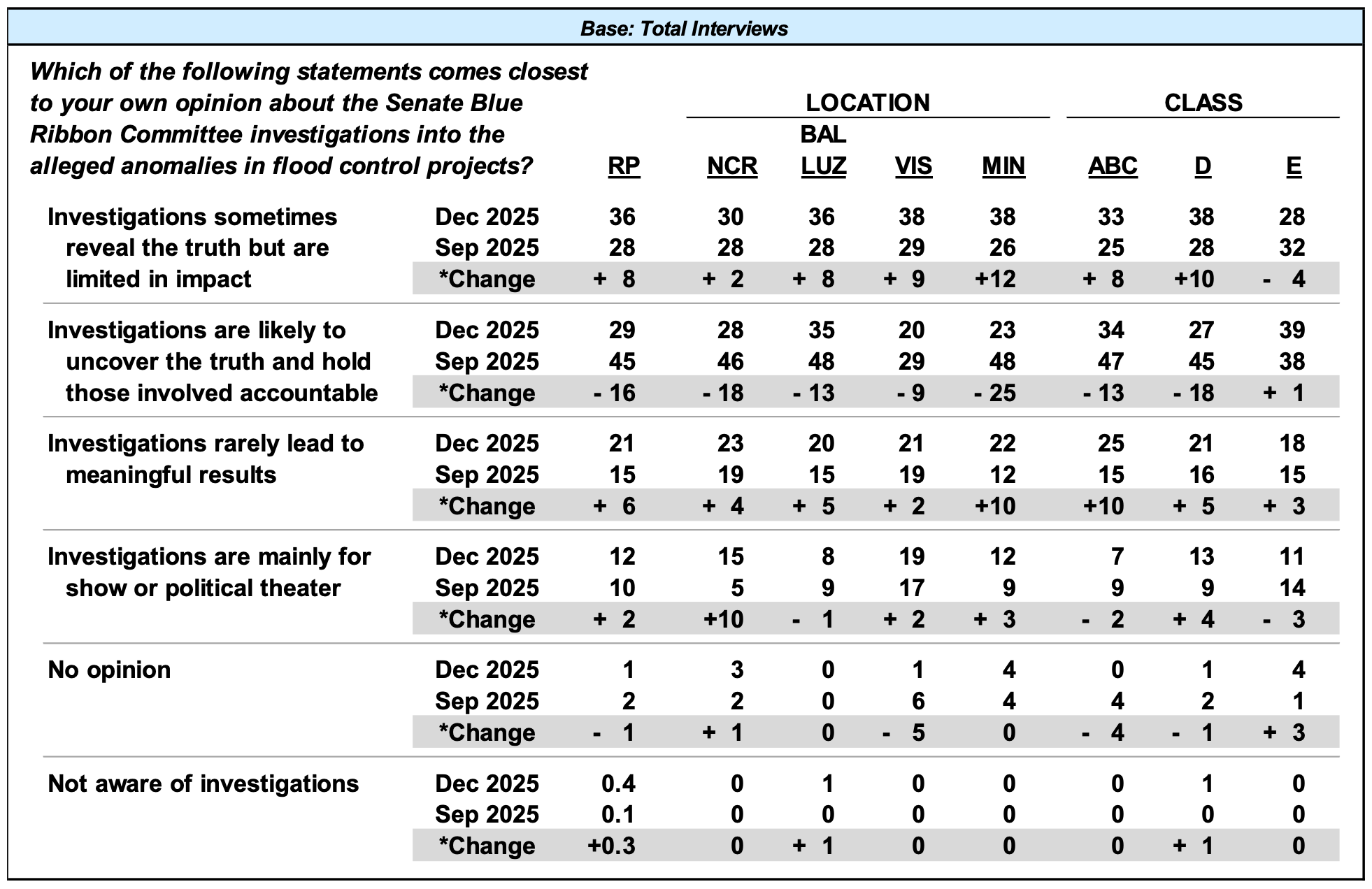
For about a third of the adult population (36%), investigations such as those being conducted by the Senate Blue Ribbon Committee regarding anomalous flood control projects sometimes reveal the truth but have limited impact; agreement with this view becomes more marked from September 2025 to December 2025 (+8 percentage points)
At the national level, 36% of Filipino adults are of the view that the Senate Blue Ribbon Committee’s investigations into the flood control projects scandal sometimes reveal the truth on the matter but have limited impact. Nearly a third of adults (29%) opine that these investigations are likely to uncover the truth and to hold those involved accountable while around a fifth of the adult population (21%) says such investigations rarely have meaningful outcomes. And for a little more than a tenth of Filipino adults (12%), legislative investigations like those being done by the Senate Blue Ribbon Committee are primarily for show or political theater. The rest of adults either have no opinion on the matter (1%) or are unaware of such investigations (0.4%). (Please refer to Table 3.)
Table 3
FILIPINOS' VIEWS ABOUT THE SENATE BLUE RIBBON COMMITTEE'S
INVESTIGATIONS INTO THE ALLEGED ANOMALIES IN FLOOD CONTROL PROJECTS
December 12 - 15, 2025 / Philippines
(Row Percent)
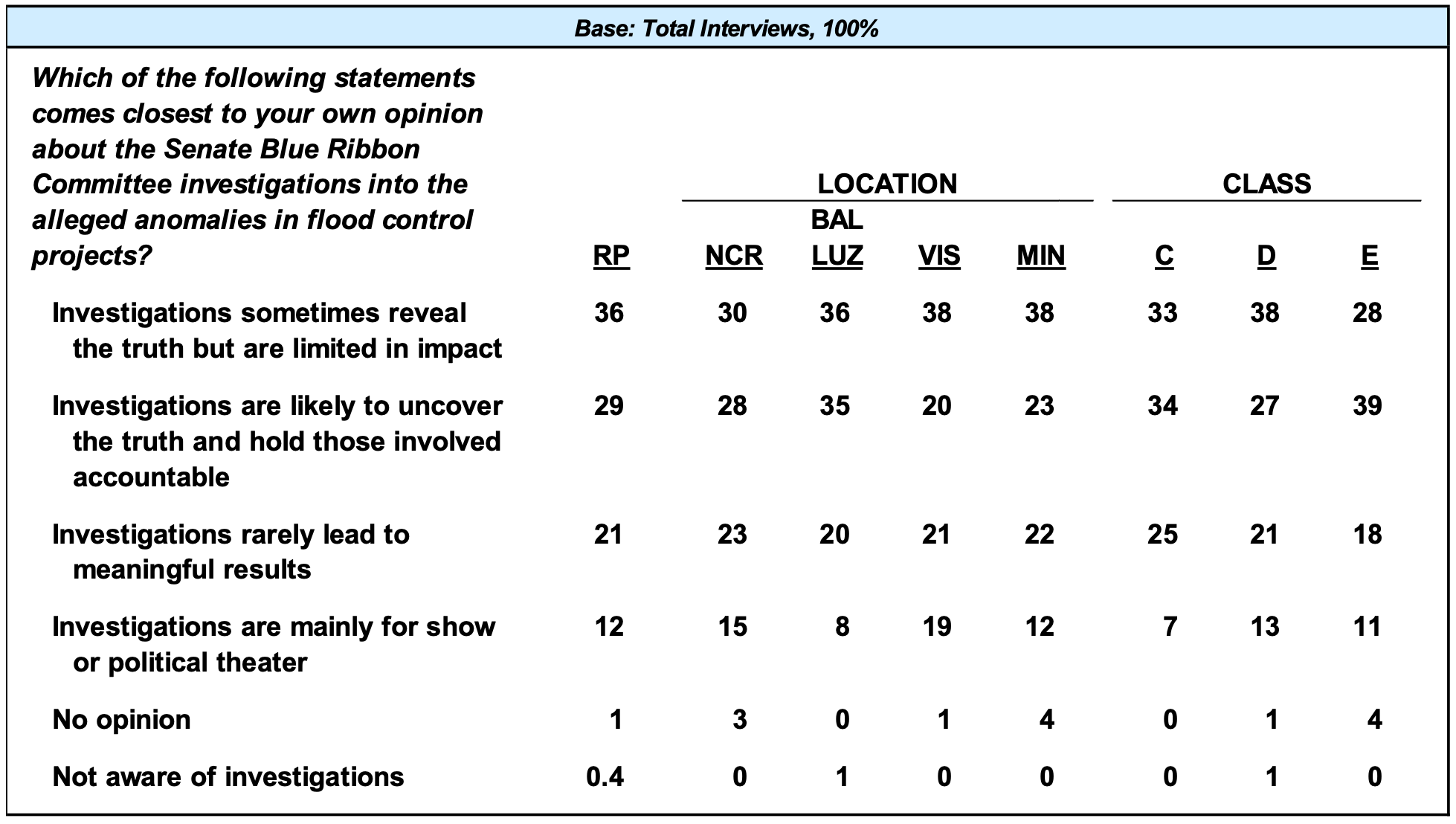
The plurality sentiment in the Visayas, Mindanao, and Class D (all at 38%) is that investigations like the Senate Blue Ribbon Committee’s hearings about the ghost flood control projects sometimes reveal the truth but have limited impact. Essentially the same percentages of those in the rest of Luzon and Class E either share this opinion (28% to 36%) or believe that these investigations are likely to uncover the truth and to hold those involved accountable (35% to 39%). In Metro Manila and Class C, nearly the same percentages believe the Senate’s investigations sometimes reveal the truth but with limited impact (30% to 33%), are likely to uncover the truth and to hold those involved accountable (28% to 34%), or rarely lead to meaningful results (23% to 25%).
From September 2025 to December 2025, agreement with the view that the Senate’s investigations regarding the flood control projects controversy have limited impact becomes more manifest at the national level (+8 percentage points) and also in Mindanao (+12 percentage points) and Class D (+10 percentage points). Conversely, there is a decline in the level of agreement with the view that such investigations are likely to uncover the truth and to hold those involved accountable not only at the national level (-16 percentage points) but also in Metro Manila (-18 percentage points), the rest of Luzon (-13 percentage points), Mindanao (-25 percentage points), and Class D (-18 percentage points). Aside from these, the only other significant change during this period is the increase in the percentage of Filipino adults who see these investigations as rarely resulting in meaningful outcomes (+6 percentage points). (Please refer to Table 4.)
Table 4
COMPARATIVE FILIPINOS' VIEWS ABOUT THE SENATE BLUE RIBBON COMMITTEE'S
INVESTIGATIONS INTO THE ALLEGED ANOMALIES IN FLOOD CONTROL PROJECTS
September and December 2025 / Philippines
(In Percent)
Most Filipino adults (59%) are optimistic that government officials who are found to be involved in the flood control projects scandal will be punished; however, this figure is lower than that obtained by Pulse Asia Research in September 2025 (71%)
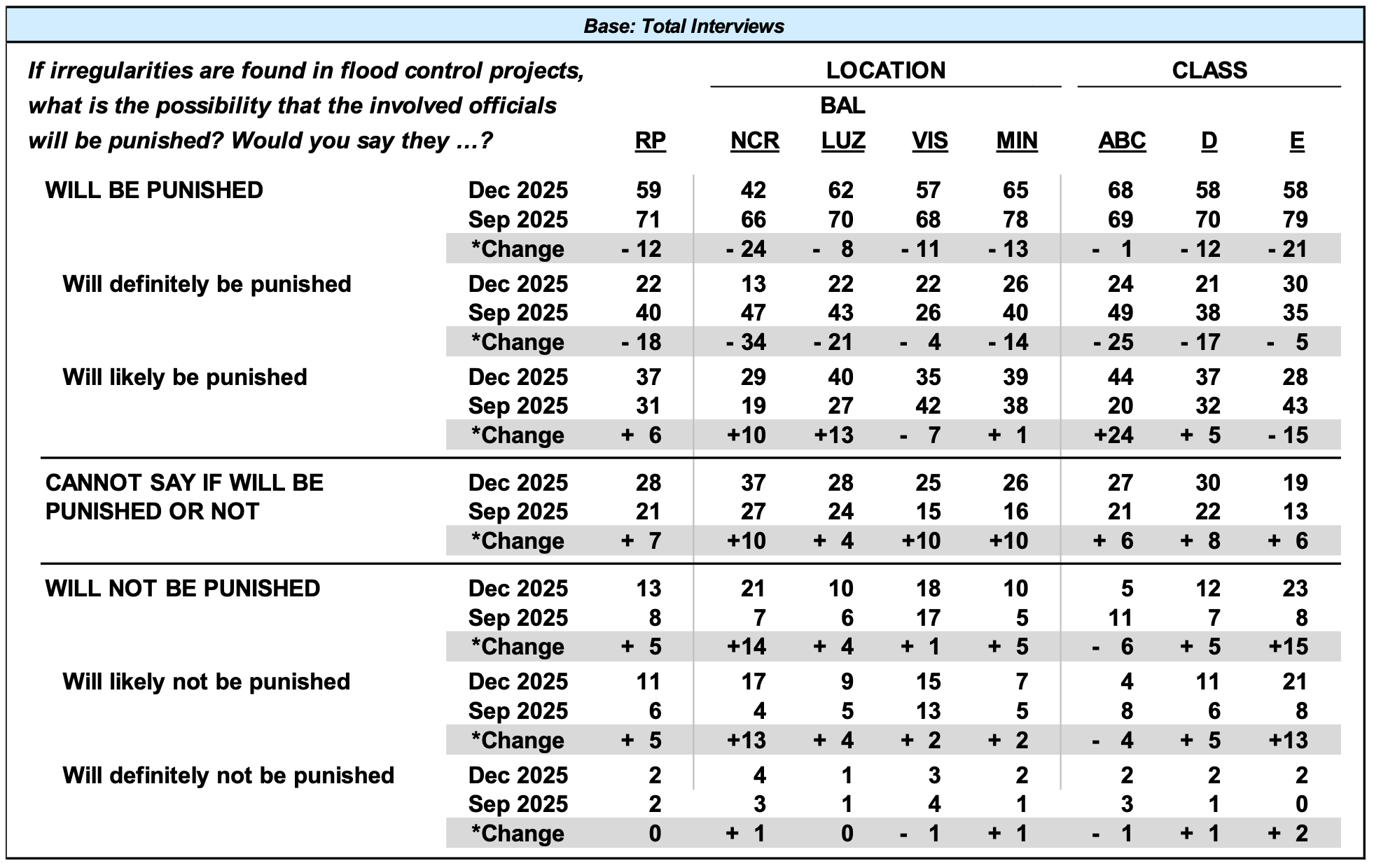
Majorities at the national level (59%) as well as across most areas and all classes (57% to 65% and 58% to 68%, respectively) continue to believe that government officials found guilty in connection with the flood control projects issue will be punished. An exception is Metro Manila where almost the same percentages either agree with this opinion (42%) or express indecision on the matter (37%). Agreement with this view eases between September 2025 and December 2025 not only in the Philippines (-12 percentage points) but also in Metro Manila (-24 percentage points), Mindanao (-13 percentage points), Class D (-12 percentage points), and Class E (-21 percentage points). (Please refer to Tables 5 to 6.)
The rest of Filipino adults are either ambivalent on the matter (28%) or doubtful that the guilty government officials will be punished (13%). From September 2025 to December 2025, the overall level of indecision on the matter goes up (+7 percentage points). The same movement occurs in Class D (+8 percentage points). Regarding agreement with the opinion that government officials found guilty in connection with the flood control scandal will not be punished, it becomes more pronounced among Metro Manilans (+14 percentage points).
Table 5
LIKELIHOOD OF PUNISHMENT FOR GOVERNMENT OFFICIALS FOUND
RESPONSIBLE FOR IRREGULARITIES IN FLOOD CONTROL PROJECTS
December 12 - 15, 2025 / Philippines
(In Percent)
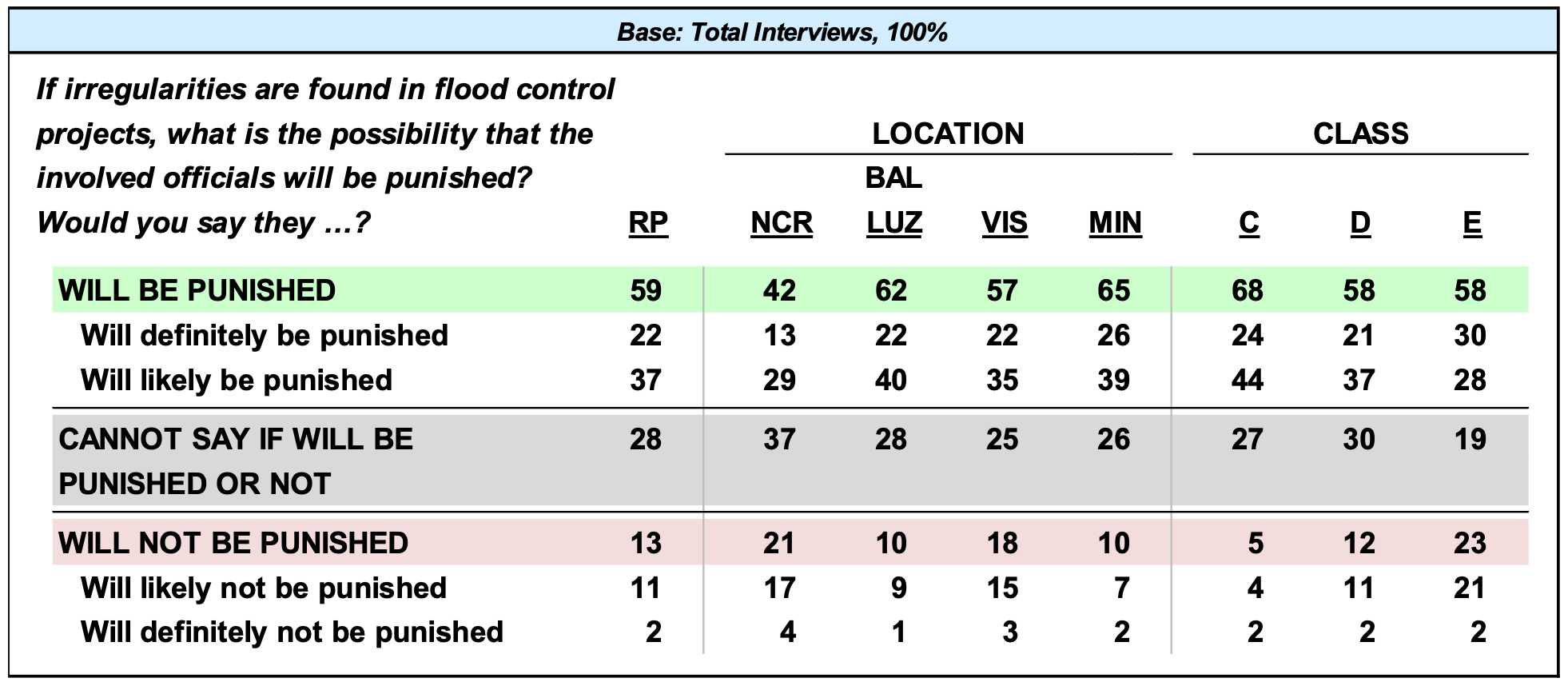
Table 6
COMPARATIVE LIKELIHOOD OF PUNISHMENT FOR GOVERNMENT OFFICIALS
FOUND RESPONSIBLE FOR IRREGULARITIES IN FLOOD CONTROL PROJECTS
September and December 2025 / Philippines
(In Percent)
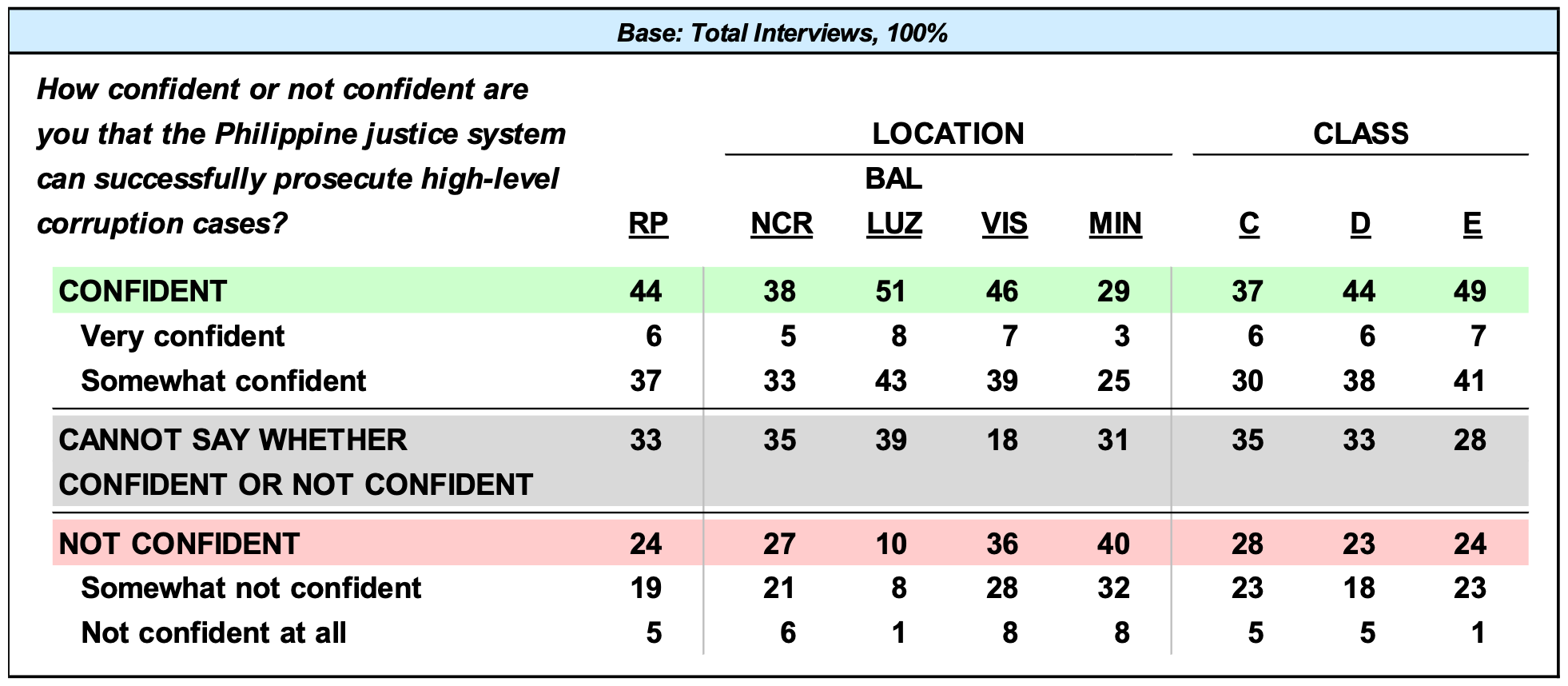
The plurality sentiment in the country is one of confidence in the ability of the justice system to successfully prosecute high-level corruption cases (44%)
For 44% of Filipino adults, the Philippine justice system can successfully prosecute highlevel corruption cases – a view held by big pluralities to bare majorities in the rest of Luzon (51%), Class D (44%), and Class E (49%). Indecision on the matter is expressed by a third of the adult population (33%) while around a quarter (24%) is not confident about the ability of the country’s justice system to do so. Nearly the same percentages of Visayans are either confident or not confident that the Philippine justice system can successfully prosecute high-level corruption cases (46% versus 36%). Public opinion on the matter is split three (3) ways in Metro Manila, Mindanao, and Class C (29% to 38% confident, 31% to 35% undecided, and 27% to 40% not confident). (Please refer to Table 7.)
Table 7
LEVEL OF CONFIDENCE THAT THE PHILIPPINE JUSTICE SYSTEM
CAN SUCCESSFULLY PROSECUTE HIGH-LEVEL CORRUPTION CASES
December 12 - 15, 2025 / Philippines
(In Percent)
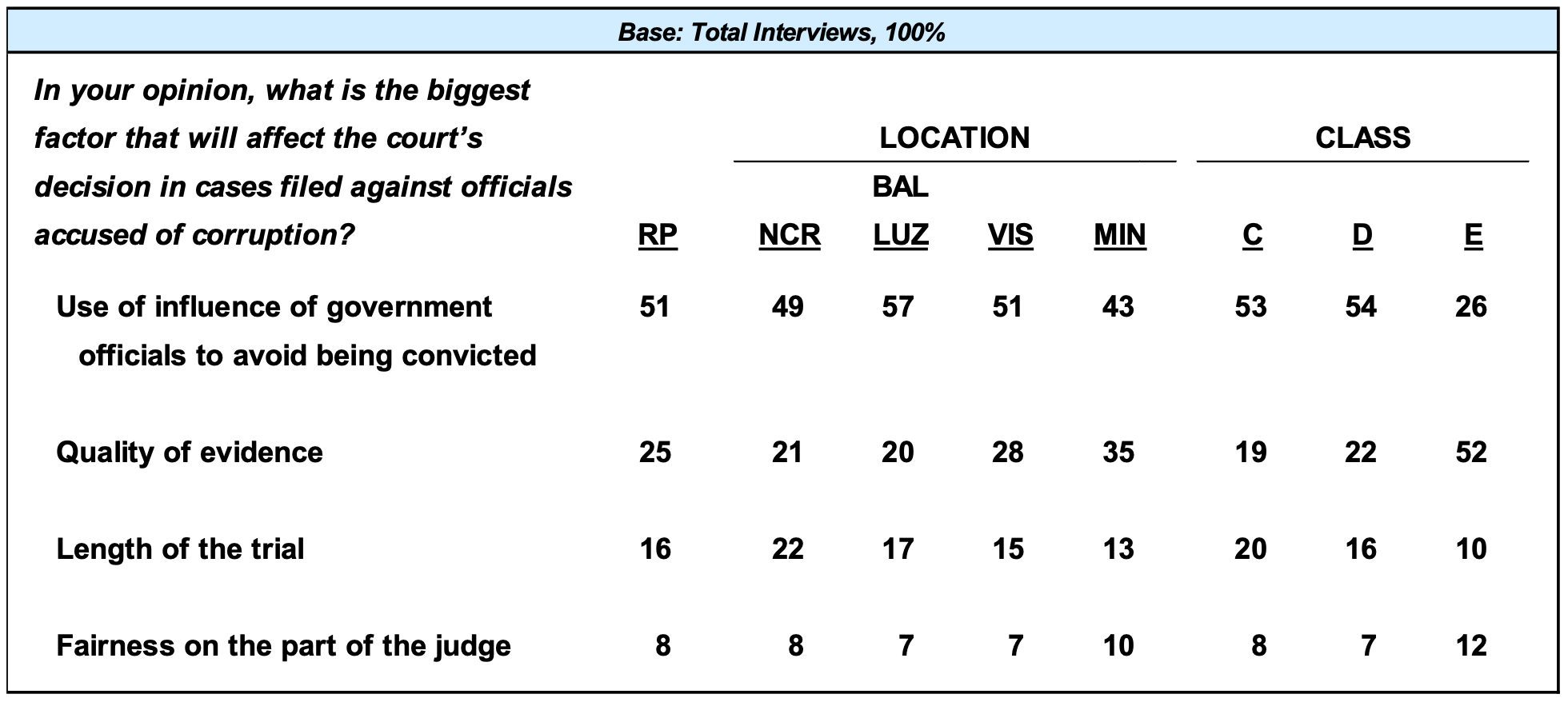
For a bare majority of Filipino adults (51%), the use of influence of government officials to avoid conviction is the biggest factor that will affect court decisions in cases against officials accused of corruption
The primary factor that will affect court decisions regarding cases involving corrupt government officials is the use of influence of such officials to avoid being convicted. This opinion is expressed by near to small majorities in the Philippines (51%), Metro Manila (49%), the rest of Luzon (57%), Visayas (51%), Class C (53%), and Class D (54%). For a small majority in Class E (52%), the biggest factor is the quality of evidence presented against corrupt government officials, a sentiment shared by a quarter of Filipino adults (25%). In Mindanao, around the same percentages identify either the use of influence of government officials to avoid conviction (43%) or the quality of evidence presented against these officials (35%) as the biggest factor that will affect court decisions in cases against those accused of corruption. Overall, the other factors cited by Filipino adults are the length of the trial of corruption cases (16%) and the fairness of judges handling these cases (8%). (Please refer to Table 8.)
Table 8
BIGGEST FACTOR THAT WILL AFFECT THE COURT'S DECISION
IN CASES FILED AGAINST OFFICIALS ACCUSED OF CORRUPTION
December 12 - 15, 2025 / Philippines
(In Percent)
If you liked what you just read and want more of Our Brew, subscribe to get notified. Just enter your email below.
Related Posts
The ICC Case against Rodrigo Duterte: Questions and Answers
Feb 18, 2026
‘Record-low’ 46% of Filipino Adults ‘Very Happy’ With Love Life - SWS
Feb 13, 2026
VP Sara Duterte’s Net Satisfaction Rating Rises in Latest SWS Survey
Feb 12, 2026