


by Social Weather Stations
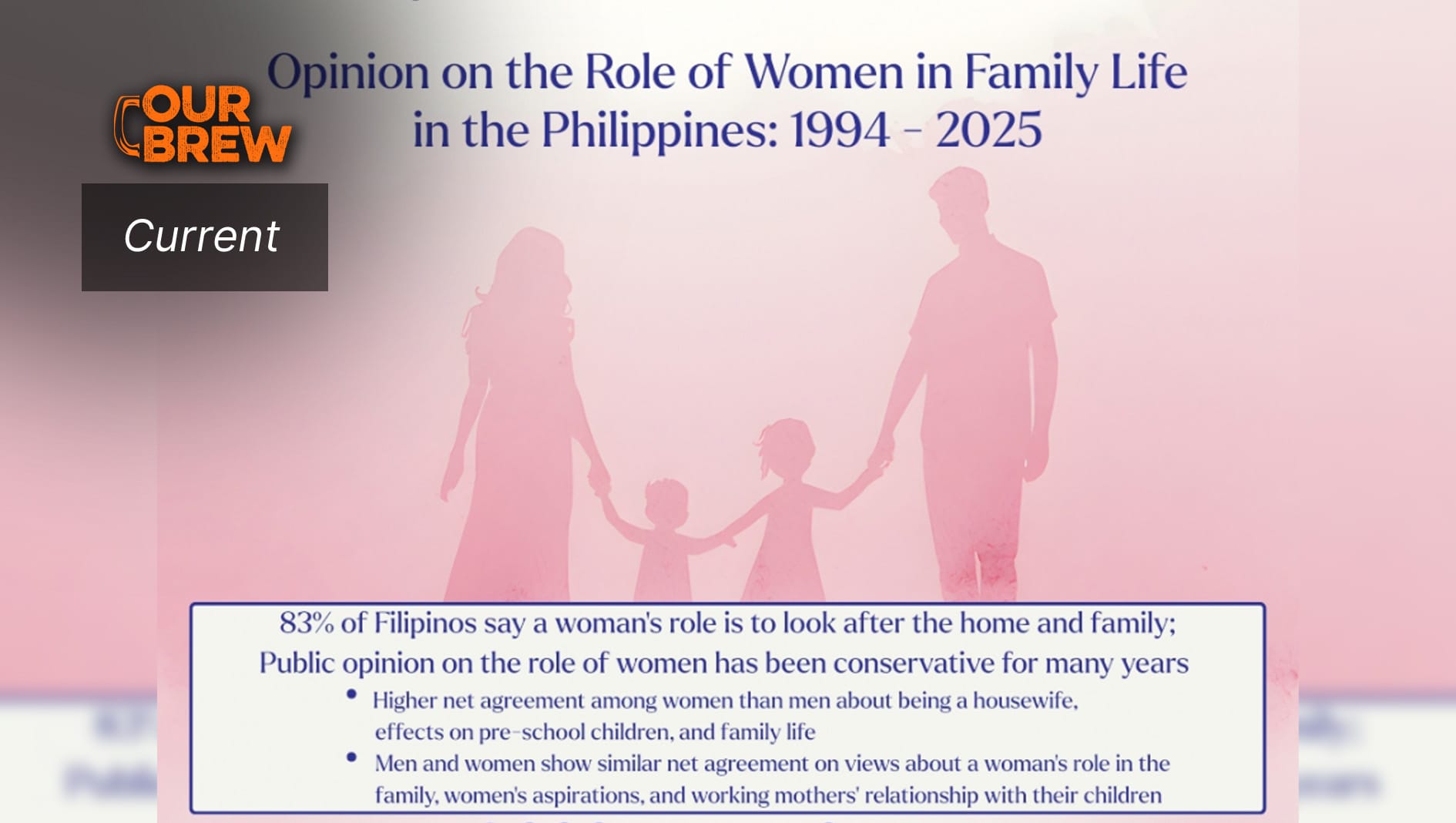
- Higher net agreement among women than men about being a housewife, effects on pre-school children, and family life
- Men and women show similar net agreement on views about a woman’s role in the family, women’s aspirations, and working mothers’ relationship with their children
This March marks the celebration of Women’s Month, highlighting the role of women in society and the continuing conversations around women’s roles in family life.
As part of its continuing effort to monitor public opinion, SWS tracked Filipinos’ views on the role of women in family life from 1994 to 2025, examining attitudes toward women’s work and family responsibilities, to better understand how these beliefs have evolved over time.
The national Social Weather Survey of November 24-30, 2025 found that large majorities of adult Filipinos continue to agree with six statements about women’s roles in the family.
To the test statement, “A man's job is to earn money; a woman's job is to look after home and family,” 83% agreed and 8% disagreed. Nine percent were undecided on the matter. This gives a net agreement[1] score (% agree minus % disagree) of +75, classified as extremely strong. This is up by 6 points from +69 (78% agree and 9% disagree) in September 2021 [Chart 1, also Chart 2].
Regarding the view on “Being a housewife is just as fulfilling as working for pay,” 4 out of 5 (81%) agreed and 11% disagreed. Seven percent were undecided on the matter. This gives a net agreement score of extremely strong +71, up by 4 points from +67 (75% agree and 8% disagree) [Chart 3].
When asked, “A job is all right, but what most women really want is a home and children,” 75% agreed and 14% disagreed. Ten percent were undecided on the matter. This gives a net agreement score of extremely strong +60, correctly rounded, up by 7 points from +53 (66% agree and 13% disagree) [Chart 4].
On the agreement that “A working mother can establish just as warm and secure a relationship with her children as a mother who does not work,” 71% agreed and 18% disagreed. Ten percent were undecided on the matter. This gives a net agreement score of extremely strong +53, up by 5 points from very strong +48 (67% agree and 19% disagree) [Chart 5].
To the test statement, “A pre-school child is likely to suffer if his or her mother works,” 63% agreed and 27% disagreed. Nine percent were undecided on the matter. This gives a net agreement score of very strong +37, down by 17 points from extremely strong +54 (70% agree and 17% disagree) [Chart 6].
Half (51%) agreed with the test statement, “All in all, family life suffers when the woman has a full-time job,” while 36% disagreed. Twelve percent were undecided on the matter. This gives a net agreement score of moderately strong +16, hardly moving from moderately strong +21 (51% agree and 30% disagree) [Chart 7].
Higher net agreement among women than men about being a housewife, effects on pre-school children, and family life
On the view that “being a housewife is just as fulfilling as working for pay,” net agreement remained extremely strong among both sexes, with higher net agreement among women at +74 (up from +70 in September 2021) than among men at +67 (up from +65 in September 2021). Among both men and women, the percentage of those who agreed has steadily increased since 1994 [Chart 8].
On the belief that “a pre-school child is likely to suffer if his or her mother works”, net agreement was also higher among women at very strong +46 (down from extremely strong +59) than among men at moderately strong +28 (down from very strong +48) [Chart 9].
On “all in all, family life suffers when the woman has a full-time job,” net agreement stayed moderately strong among women, hardly changing from +26 to +27. However, it declined from moderately strong +16 to neutral +4 among men [Chart 10].
Men and women show similar net agreement on views about a woman’s role in the family, women’s aspirations, and working mothers’ relationship with their children
The remaining three statements found almost the same level of agreement between men and women.
On “a man’s job is to earn money; a woman’s job is to look after the home and family,” net agreement remains extremely strong among both men and women, at +77 (up from +70) among men, and at +73 (up from +69) among women [Chart 11].
It also stayed extremely strong on “a job is all right, but what women really want is a home and children,” at +60 among both women (up from +56) and men (up from +51) [Chart 12].
It rose from very strong to extremely strong on the statement about “a working mother can establish just as warm and secure a relationship with her children” among both women and men. at +55 (up from +49) and +51 (up from +47), respectively [Chart 13].
Socio-demographic characteristics of respondents
Applying census weights and correctly rounded, 13% of the respondents are from Metro Manila, 45% from Balance Luzon (or Luzon outside Metro Manila), 19% from the Visayas, and 23% from Mindanao [Table 1].
Fifty percent are from urban areas, and 50% are from rural areas.
Male and female respondents have a 1-to-1 ratio and, thus, are alternately sampled.
By age group, 11% are youth (18-24), 20% are intermediate youth (25-34), 20% are middle-aged (35-44), 16% are 45 to 54 years old, and 33% are 55 years old and above.
By education, 10% had at most some elementary education, 27% either finished elementary or had some high school education, 30% either finished junior high school or completed vocational school, 22% either attended some senior high school, completed senior high school or vocational, or attended some college, and 11% either graduated from college or took post-graduate studies.
Survey background
The Fourth Quarter 2025 Social Weather Survey was conducted from November 24 to 30, 2025, using face-to-face interviews of 1,200 adults (18 years old and above) nationwide: 300 each in Metro Manila, Balance Luzon (or Luzon outside Metro Manila), the Visayas, and Mindanao. The sampling error margins are ±3% for national percentages and ±6% each for Metro Manila, Balance Luzon, the Visayas, and Mindanao.
The area estimates were weighted by the Philippine Statistics Authority medium-population projections for 2025 to obtain the national estimates.
The survey items reported here were non-commissioned. They were done on SWS's own initiative and released as a public service.
The exact phrasing of the survey questions (the source language is Filipino; English translation included) was:
“Una, mayroon akong mga katanungan tungkol sa kababaihan. Gaano kayo sumasang-ayon o hindi sumasang-ayon sa mga sumusunod na pangungusap? Masasabi ba ninyo na kayo ay Lubos na sumasang-ayon, Sumasang-ayon, Maaaring sumasang-ayon/maaaring hindi, Hindi sumasang-ayon, Lubos na hindi sumasang-ayon, o hindi makapili? Pakilagay lang ang mga kard na ito sa naaangkop na lugar sa rating board na ito. [To begin, we have some questions about women. How much do you agree or disagree with the following statements? Do you Strongly agree, Agree, Neither agree nor disagree, Disagree, Strongly disagree, or Can’t choose? Please put these cards on the appropriate place on this rating board.]”
(DO NOT SHUFFLE)
- ANG ISANG NAGTATRABAHONG INA AY MAAARING MAGKAROON NG MASIGLA AT MATATAG NA RELASYON SA KANYANG MGA ANAK TULAD NG ISANG INA NA HINDI NAGTATRABAHO. (A working mother can establish just as warm and secure a relationship with her children as a mother who does not work.)
- ANG ISANG BATANG WALA PA SA EDAD NG PAG-AARAL AY MALAMANG NA MAHIHIRAPAN KUNG ANG KANYANG INA AY NAGTATRABAHO. (A pre-school child is likely to suffer if his or her mother works.)
- SA KABUUAN, MAHIHIRAPAN ANG BUHAY NG PAMILYA KAPAG ANG BABAE AY MAY FULL-TIME NA TRABAHO. (All in all, family life suffers when the woman has a full-time job.)
- ANG MAY TRABAHO AY MAINAM SUBALIT ANG TALAGANG GUSTO NG NAKARARAMING KABABAIHAN AY ISANG TAHANAN AT MGA ANAK. (A job is all right, but what most women really want is a home and children.)
- ANG MAGING/PAGIGING MAYBAHAY AY ISANG KAGANAPAN TULAD DIN NG PAGTATRABAHO UPANG KUMITA. (Being a housewife is just as fulfilling as working for pay.)
- ANG KATUNGKULAN NG LALAKI AY ANG KUMITA NG PERA; ANG KATUNGKULAN NG BABAE AY PANGALAGAAN ANG BAHAY AT PAMILYA. (A man's job is to earn money; a woman's job is to look after the home and family.)
The survey data from December 1994 to September 2021 were collected under the International Social Survey Programme (ISSP), while the November 2025 results were from the Fourth Quarter 2025 Social Weather Survey.
The SWS terminology for net agreement: +50 and above, “extremely strong”; +30 to +49, “very strong”; +10 to +29, “moderately strong”, +9 to -9, “neutral”; -10 to -29, “moderately weak”; -30 to -49, “very weak”; -50 and below, “very weak”; -50 and below, “extremely weak”.
SWS employs its own staff for questionnaire design, sampling, fieldwork, data processing, and analysis, and does not outsource any of its survey operations. This report was prepared by Jillian Carylle M. Pescadero.
[1] The SWS terminology for net agreement: +50 and above, “extremely strong”; +30 to +49, “very strong”; +10 to +29, “moderately strong”, +9 to -9, “neutral”; -10 to -29, “moderately weak”; 30 to -49, “very weak”; -50 and below, “very weak”; -50 and below, “extremely weak”
Chart 1

Chart 2

Chart 3

Chart 4

Chart 5

Chart 6

Chart 7

Chart 8

Chart 9

Chart 10

Chart 11

Chart 12

Chart 13

Table 1

If you liked what you just read and want more of Our Brew, subscribe to get notified. Just enter your email below.
Related Posts
The ICC Case against Rodrigo Duterte: Questions and Answers
Feb 18, 2026
‘Record-low’ 46% of Filipino Adults ‘Very Happy’ With Love Life - SWS
Feb 13, 2026
VP Sara Duterte’s Net Satisfaction Rating Rises in Latest SWS Survey
Feb 12, 2026