


By Vincent R. Pozon
A long practice and a growing unease
I have read the bible devotionals daily for decades, or at least tried to, usually before I get up. Not in seasons, not during crises, but as a practice—one of those small disciplines that attach themselves to ordinary life and stay.
And yet, recently, I noticed something strange.
Recently, passages had begun to taste thin and tepid. I began to sense how much of what I was reading revolved around the afterlife—salvation, eternity, the promise of everlasting life.
A familiar emphasis
As I write this article, today’s devotional is titled 'Treasure Stored in Heaven'. It begins with a familiar verse: “We brought nothing into the world, and we can take nothing out of it.” (1 Timothy 6:7)
The reflection compares life to packing for a long trip. Don’t bring too much, it says. Extra baggage becomes a burden. Better to “pack less for eternity” and store up treasure in heaven. It closes by asking: How might you pack less for eternity? What treasure might you store up for heaven?
It is gentle. Well-meaning. Perfectly orthodox.
But today is the worry of many.
The present tense of Jesus
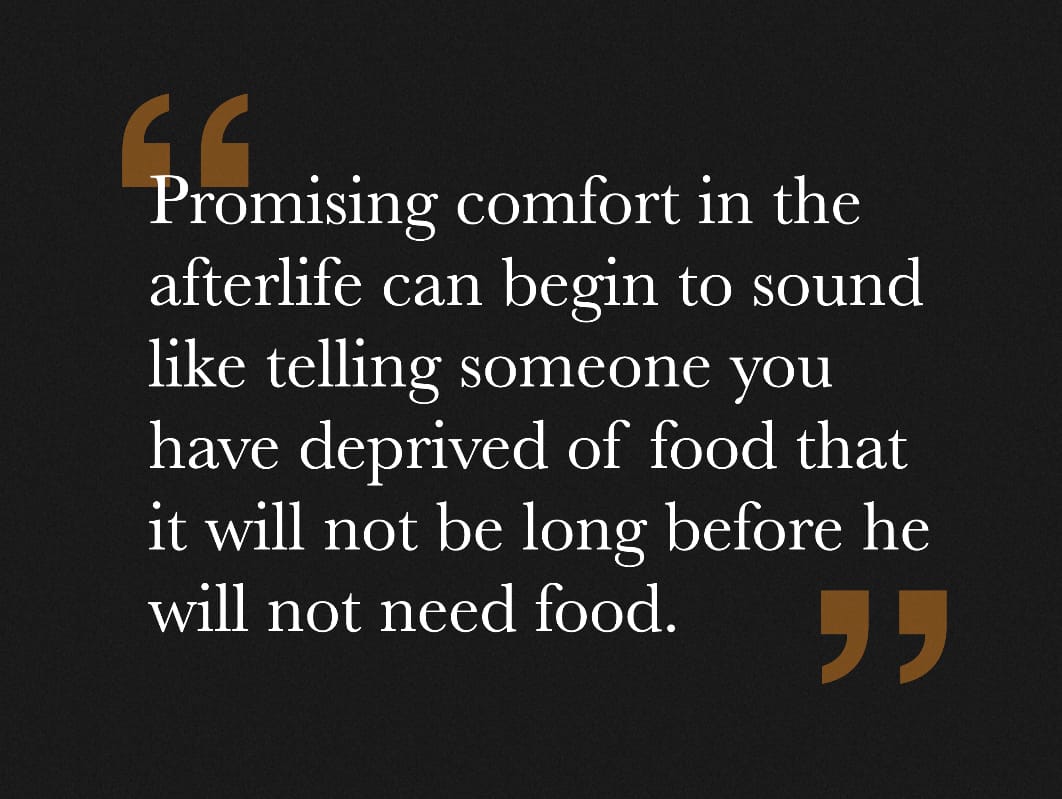
We live in a grieving, hungry, hope-deprived world. And promising comfort in the afterlife can begin to sound like telling someone you have denied food that it will not be long before he will not need food.
With a questioning eyebrow, I began to reread those daily devotionals. And the dissonance became clear: this is not how Jesus behaved.
Jesus's ethical center is anchored in the present tense. He spoke more about feeding the hungry, forgiving debts, reconciling enemies, economic injustice, daily anxiety than in describing heaven.
“Give us this day our daily bread.”
“Do not worry about tomorrow.”
“Whatever you did for the least of these, you did for me.”
Jesus wanted life to be less cruel, less heavy, and more capable of joy.
Before I had words for it
Years earlier, I had brushed against this without realizing it.
At the behest of a friend, Jess-Awana Curabo, then country director of Daily Bread, we developed a campaign for their devotional book. We wanted to present it to the young in a way that was easy to accept—without being preachy or pedagogic. We wanted them to look at the physical book in their hands, and to think about its role in their lives. To ask themselves what it was doing for them on a daily basis.
Only after revisiting the materials recently did I notice something quietly telling.
We never spoke of the afterlife.
THE MOOD VIDEO that we created in lieu of a storyboard. The jingle was composed by Jek Buenafe.
Instinctively, we treated the book as a companion through the day. Something to walk with people through ordinary hours, ordinary anxieties, ordinary hungers. A cane to help in walking or a handrail for the present rather than a ladder to eternity.
Unfortunately, the response from the U.S. office was that “the approach did not align with their branding preference,” Mr. Curabo said, a reply he found deeply disappointing.





COMPREHENSIVES created for the presentation
Afterlife as anesthetic
The problem is not the afterlife in Christian thought. The problem is when it becomes a substitute for justice rather than a horizon of hope. The over-marketing of the afterlife begins to look less like devotion and more like deflection—eclipsing hunger, grief, loneliness, and despair today.
Historically, religions tend to place heavier emphasis on the afterlife under empires, and under conditions of mass poverty, social immobility, and political powerlessness. When people believe they cannot realistically change their social order, religions often push a form of cosmic compensation: “You may lose now, but you will be repaid later.”
Promising heaven becomes convenient when fixing the present is difficult and costly.
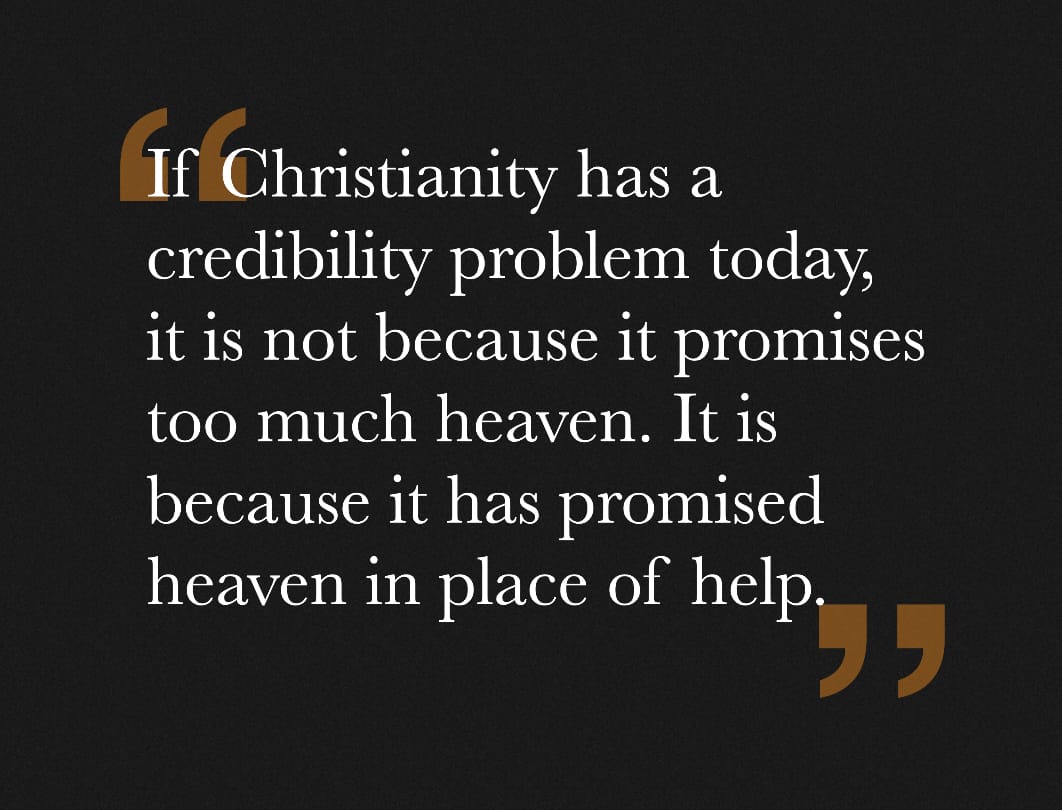
If Christianity, in the eyes of many, has a credibility problem today, it is because today's churches tend to promise heaven in place of help.
A different focus
If, by some remote chance, I were ever allowed to help solve the marketing problem of the church, I would focus on the day. On the woes and worries people wake up to. On steering minds not toward death, but toward repair:
Fix relationships. Feed each other. Protect each other. Make lives easier to bear.
A late realization
Perhaps this realization comes with age. Or with grief. Or with having witnessed enough suffering that postponement begins to feel cruel.
I realize I can expect pushback from people who equate Christianity primarily with getting into heaven. I am not a pastor or a theologian. Only a long-time reader and a communications practitioner of half a century, noticing late what has been quietly forming in me.
To re-center Christianity on present suffering is not to dilute it. It is to return it to its founder. Jesus did not ask us to wait well for death. He asked us to live well with one another.

Vincent R. Pozon
Koyang has been in advertising for more than half a century, in various agencies, multinational and local. He is known for aberrant strategic successes (e.g., Clusivol’s ‘Bawal Magkasakit’, Promil’s ‘The Gifted Child’, RiteMED’s ‘May RiteMED ba nito?', VP Binay's 'Ganito Kami sa Makati', JV Ejercito's 'The Good One', Akbayan's 'Pag Mahal Mo, Akbayan Mo')). He is chairman of Estima, an ad agency dedicated to helping local industrialists, causes and candidates.
If you liked what you just read and want more of Our Brew, subscribe to get notified. Just enter your email below.
Related Posts
The Stars Are Not Aligning
Mar 12, 2026
Thank you, Bong Suntay
Mar 09, 2026
Edsa, Ideally
Feb 26, 2026