

By Mark R. Thompson and Ronald D. Holmes
Abstract
Over three years after Ferdinand Marcos Jr. won the Philippine presidency by a landslide, attention has shifted from the nostalgia he invoked for the authoritarian rule of his father, Ferdinand Marcos Sr., to the power struggle between the Marcos and Duterte dynasties. The feud upended conventional wisdom about the nature of authoritarian nostalgia. It is no longer simply about yearning for a bygone dictator as support for a more liberal order waned, but has now become competitive between two “democratic” strongmen most longed for in their respective clans’ bailiwicks. It reveals how quickly public longing for a strongman can shift with new forms of historical revisionism and fresh political grievances. Since the Marcos-Duterte “UniTeam” collapsed, growing nostalgia for former President Rodrigo Duterte – magnified by his “kidnapping” to stand trial at the ICC for crimes against humanity – has diminished appreciation for Marcos Sr.'s legacy as support for his son's presidency declined.
Introduction
More than three years after Ferdinand “Bongbong” Romualdez Marcos Jr. (commonly referred to as “PBBM”) won the Philippine presidency by a landslide, public attention has shifted from the nostalgia he invoked for the dictatorial rule of his father, Ferdinand Emmanuel Edralin Marcos Sr., during his 2022 campaign to the power struggle between the Marcos and Duterte dynasties. This feud has upended conventional wisdom about the nature of authoritarian nostalgia in the Philippines. It reveals how quickly public longing for a strongman leader can shift, fueled by new forms of historical revisionism and fresh political grievances. This dynamic also illustrates that nostalgia is deeply localized—tied to the strongholds of each former ruler's clan. Despite past records of illiberal governance, these figures or their successors often claim democratic legitimacy. What was once seen as a nationwide yearning for a bygone dictator in the wake of waning support for the EDSA “people power” legacy is now evidently about which “democratic” strongman is most longed for in their respective clans’ bailiwicks.
Since their return from exile in 1991, Marcos Jr. and other members of the Marcos political clan have worked to rehabilitate the legacy of the former dictator, Marcos Sr., particularly in their Northern Luzon and Eastern Visayan strongholds. They portrayed his dictatorship as a “golden age” that safeguarded the country's democracy from chaos and revitalized the economy—only to be undermined by powerful elites who toppled the regime in 1986 under the banner of “people power.” Despite well-documented human rights violations and an economic collapse in the final years of Marcos Sr.'s rule, many Filipinos came to view his tenure as a time of peace and development. This romanticized narrative has been used not only to discredit critics of the Marcoses but also to cast the post-Marcos democratic era as a failure—fueling what two scholars have termed a “collective yearning for a mythic past” (Talamayan and Candelaria, 2024: 1; see also Tigno et al., 2024 and Talamayan, 2021).
Marcos Jr.'s presidential campaign also greatly benefited from his alliance with Sara Duterte-Carpio as his vice-presidential candidate with promised continuity with the presidency of her father, Rodrigo Roa Duterte (Arguelles, 2022; Dulay et al., 2022; Mendoza et al., 2024). This meant Marcos Jr.'s campaign was not only focused on his father's supposed grand accomplishments but also on the legacy of his predecessor Duterte whose illiberal populism had proved extremely popular (Mendoza et al., 2024). Yet after this “UniTeam” between Marcos Jr. and Sara Duterte collapsed, nostalgia for elder Duterte quickly overshadowed that for Marcos Sr. This shift was based on the Duterte clan's claim that criminality, and drug use in particular had increased under the Marcos administration despite official statistics showing it had declined significantly (Mangosing, 2024). Nostalgia for Duterte and his signature “war on drugs” in which tens of thousands of Filipinos were killed extrajudicially was not noticeably affected by Philippine congressional hearings in 2024 (which included sordid revelations of a bounty system of “cash for killings”), indicating many Filipinos remain supportive of the drug war even if they remain uneasy about its murderous consequences (United Nations High Commission on Human Rights, 2020; Evangelista, 2023; Palatino, 2022a; Gasgonia, 2024; Thompson and Agojo 2024).
This nostalgia was magnified by the 58% of Filipinos surveyed who disapproved of the arrest of the former President Duterte to stand trial at the International Criminal Court where he faces charges of crimes against humanity for the “war on drugs” (Pulse Asia, 2025b). Moreover, nearly two thirds of Filipinos surveyed in May 2025 said they trusted former president Duterte (ibid.). This was a major factor behind the weak performance of the Alyansa para sa Bagong Pilipinas (Alliance for a New Philippines, known as Alyansa) national senate slate fielded by the Marcos Jr. administration, despite its overwhelming advantage in political machinery. In contrast, pro-Duterte candidates were able to effectively mobilize voters along ethno-linguistic lines in Duterte family strongholds such as Mindanao and the Central Visayas (Quezon, 2025).
This paper employs opinion polling, election results and process tracing to establish pathways between a causal sequence of events (Collier, 2011). The first section involves a general discussion of authoritarian nostalgia, which argues it can be understood as a “missing-the-strongman” syndrome involving revisionism and fueled by grievance in the midst of democratic dissatisfaction. The cases of U.S. President Donald Trump and former Peruvian President Alberto Fujimori illustrate that such nostalgia is not necessarily only for politicians long dead but those still very much alive. The second section on authoritarian nostalgia in the Philippines shows how it has involved revisionist accounts and grievance politics rooted in dynastic bailiwicks which can lead to competing nostalgias among a country's different strongman rulers who claim democratic legitimacy despite their obvious illiberalism. The next part examines how after their return from exile, the Marcos clan employed a nostalgic discourse to reclaim control of their political heartland. It was this strategic alliance with the Duterte clan—with their bailiwicks in the southern Philippines- which expanded the coalition's reach and gave the Marcos-Duterte ticket its nationwide appeal. The paper's fourth section discusses the impact of the current competition between two previously conjoined authoritarian nostalgias, in which Sara Duterte has accused Marcos, Jr. of political betrayal while invoking memories of her father's “penal populism” amidst supposedly rising crime rates magnified by her father's arrest to face trial by the International Criminal Court (ICC) in The Hague. With nostalgia for Duterte's rule in the ascendancy, positive views of Marcos Sr. are now declining amidst a fall in support for his son Marcos Jr. as opinion polling and the administration slate's weak performance in recent midterm elections indicate.
Missing a (not Necessarily Dead) Strongman
Authoritarian nostalgia is understood here as a “missing-the-strongman” syndrome involving a revisionist account of past illiberal rule fueled by political grievance in the midst of growing dissatisfaction with more liberal contemporary politics (Betz and Johnson, 2004; Chang et al., 2007; Kang, 2010; Bonikowski and Stuhler, 2022; Elçi, 2022; Neundorf and Pardos-Prado, 2022; Kim-Leffingwell, 2022). These strongman leaders have often been (at least initially) elected. Yet they claim to be extraordinary leaders to which ordinary legal constraints do not apply (Ruud, 2023).
Revisionism about a strongman ruler plays down the excesses of illiberal rule while stressing the supposed peace and stability it brought about alongside economic prosperity in sharp contrast to the many problems of liberalizing polity (Jmal, 2025). This is part of a more general trend in countries undergoing democratic backsliding of strongman leaders claiming democratic legitimacy despite their obvious illiberalism (Mounk, 2018; Kenny and Holmes, 2020; Thompson, 2021; Williamson, 2025).
Grievance politics is a key driver of such nostalgia, as past authoritarian leaders and/or their family and supporters claim to be victims of a campaign of elite revenge against them (Capelos et al., 2024). Although much of the focus in the literature on authoritarian nostalgia has centered on newly democratizing countries, authoritarian nostalgia also exists in democracies without a recent dictatorial past (Versteegen, 2024). Authoritarian nostalgia can be for a dead strongman leader that has been relatively long in the making or it can arise quickly for a defeated or deposed strongman leader still very much alive (Goidel and Goidel, 2025)
Donald Trump's non-consecutive re-election, only the second time this had occurred in U.S. history, and Keiko Fujimori's invocation of the legacy of her imprisoned father, former Peruvian President Alberto Fujimori, during her repeated runs for the presidency, illustrate these points. A revisionist account of Trump's first term downplayed his instigation of the January 6th, 2021 insurrection after losing the 2020 election, which he falsely claimed had been stolen and his bungling of the COVID-19 pandemic, that contributed to a high death rate and severe economic downturn. Instead, the Trump campaign reminded voters of the country's strong economic growth from 2016 to 2019. Recasting this recent presidential history was eased by dissatisfaction with high inflation under the Biden administration despite growing signs of economic strength (Cox, 2025). As a result, when Trump had left office in 2021, only 41% of Americans polled considered his presidency a success; shortly before the 2024 election it had risen to 55% (Drutman, 2024). Trump claims that the popular will trumps liberal principles has been amplified by rightwing media, excusing his (past and present) transgressions against democratic institutions as “protecting American democracy from the deep state and the Democratic party” (Williamson, 2025). Fueling his already nostalgia-laden “Make America Great Again” (“MAGA”) brand were claims by Trump that his enemies were persecuting him through court cases and unfair media coverage (Goidel et al., 2024; Goidel and Goidel, 2025; Philbrick, 2024; Tomasky, 2024).
Keiko Fujimori invoked nostalgia for her father, former Peruvian President Alberto Fujimori, by selectively highlighting his successes in improving law and order by defeating a Maoist insurgency and his large-scale public works projects which benefitted the poor, particularly in rural areas. At the same time she played down human rights violations and corruption during his rule (Dargent and Muñoz, 2016). Despite the elder Fujimori's fall from power in 2000 and imprisonment on corruption charges in 2007, the legacy of “Fujimorismo” has been a if not the dominant force in Peruvian party politics since (De la Calle, 2024). In her presidential campaigns she has decried the failings of her father's successors as chief executive, calling the elder Fujimori “Peru's best president”, cultivating a personality cult around him while promising the same security-oriented, pro-poor policies he implemented. She claimed the elder Fujimori was a victim of an unjust prosecution and should be pardoned or freed after appeal (Associated Press, 2011). She created a new political party Fuerza Popular (Popular Force) in 2011 (hiring former New York mayor Rudy Guiliani as an advisor) to mobilize her father's existing network of sympathizers in order to make nostalgia for him the centerpoint of her campaign. With her father's image displayed prominently, she mentioned him in every campaign speech (Otis, 2016). Drawing on the appeal of her father's legacy, she reached the run off-stage in three presidential elections - in 2011, 2016, and 2021 - losing narrowly each time. After her father was released from prison in December 2023 on humanitarian grounds, she announced he planned to run for president in the 2026 general election. When he died at age 86 in 2024, she again decided to run again in his stead, with polls showing her among the frontrunners in the upcoming 2026 election (The Dialogue, 2025).
In the Asian regional literature, it has been influentially argued that authoritarian nostalgia is most likely to occur in newly democratized countries in which dictators made significant economic progress (Chang et al., 2007). Kim-Leffingwell (2022) found voters exhibit a “pro-dictator bias” when there had been high growth during dictatorship and regime “exit” was orderly. Nostalgia for Park Chung-Hee's “miracle on the Han river” or rapid industrialization grew during the democratic transition as many Koreans remembered him as the country's best president. This was key to his daughter, Park Geun-hye's election as president in 2012 and, even after she was removed from office following a scandal, authoritarian nostalgia for her father's rule continues to be prevalent in Korea (Kang, 2010; Kang, 2016; Han and Hundt, 2021; Kim-Leffingwell, 2022).
Authoritarian Nostalgia, Philippine Style
Yet, in contrast to South Korea, in the Philippines, authoritarian nostalgia arose despite the dictatorship collapsing amidst economic crisis in the face of a popular protest movement (Punongbayan, 2023). The Philippine economy, already slowing by the late 1970s, nosedived after the assassination of opposition leader Benigno “Ninoy” Simeón Aquino Jr. in 1983. Revelations that the Central Bank had falsified the country's financial records led to capital flight, the Philippine peso to plummet, inflation to skyrocket, and the government to ask for a debt moratorium. The crisis ejected the Philippines from “the industrial catch-up club” to which it has never returned (Williamson and de Dios, 2014: 50). Gross domestic product (GDP) fell 10%, with per capita income falling even faster (Boyce, 1993: 39). It took two decades before pre-crisis income levels were regained (Bautista, 2003).
The Philippine case demonstrates how effective revisionism can be even in the face of stubborn facts of economic collapse and political instability. This shows that, on the one hand, economic “success” must be relativized, going beyond mere macro data into the realm of disinformation in which revisionist narratives arise (Punongbayan, 2023). On the other hand, it suggests a more rudimentary phenomenon is at play in which there is popular yearning not specifically for economically high achieving dictators of the past but for strongman rule more generally.
It is beyond the scope of this paper to discuss the popularity of strongman rule in the Philippines and beyond. It is sufficient to our purposes here to point to the growing academic literature - often drawing on World Values, Asian Barometer and other comparative surveys - which, although showing most Filipinos’ support procedural aspects of liberal democracy, also demonstrate there is considerable support for strongman oriented, “disciplinarian” leadership alongside a high level of intolerance of human rights-oriented perspectives (Pernia, 2019, 2022; Regilme, 2021; Garrido, 2021; Ordoñez and Borja, 2022; Kasuya and Calimbahin, 2022; Borja, 2023).
This shows that like illiberal populists around the world who have effectively played off democratic legitimacy against civil liberties, Philippine strongmen have asserted that they retain democratic credentials even as they engage in backsliding that undermines civil liberties (Mounk, 2018; Ordoñez and Borja, 2022). Modifying this claim somewhat, Kenny and Holmes argue that the Philippine case shows that citizens “can be attached to liberal democracy and liberal democratic institutions, but still favor some particular illiberal policies” (2020: 15). Marcos Sr. called his declaration of martial law in 1972 a “democratic revolution” designed to save democracy from dual threats from the extreme right and left (Marcos, 1979). Shortly after his election as president in September 2022 campaign, Marcos Jr. claimed his father “was not a dictator” (Palatino, 2022b). Regarding Duterte, Ordoñez and Borja (2018: 1) argue that his open disdain for liberal principles while still claiming democratic legitimacy contributed significantly to his “meteoric rise.” This helps clarify why authoritarian nostalgia has been so successfully involved invidious comparisons between a demonized liberal democratic present and a glorified illiberal past (e.g., Kang, 2010; Kang, 2016; Kimura et al., 2024; Pernia and Panao, 2025). A simple comparison between a past dictatorship and democracy is eschewed in favor of the contrast between a “disciplined” and a chaotic democratic order (Garrido, 2021).
In the Philippines, nostalgic messaging has stressed strongmen's economic successes and efforts to establish political order while downplaying their authoritarianism. Yet they portray their strongman opponents as dangerously dictatorial. Marcos Jr. emphasized the legal democratic period of his father's presidency and its developmental accomplishments and political stability during the early martial law period while eliding its authoritarian character and ultimate economic collapse. Marcos Jr. has attempted to use his presidency as an exercise in political “redemption” to clear his father's name of charges of corruption and human rights violations through good governance and greater regard for civil liberties (Teehankee, 2023a, 2023b). After the political feud with the Duterte clan began, Marcos Jr.'s congressional allies began investigating former President Rodrigo Duterte's bloody “war on drugs”, uncovering “cash for killings” among the police and giving voice to human rights advocates and victims (Gasgonia, 2024; Palatino, 2024).
The senior Duterte countered by calling Marcos Jr. a would-be dictator like his father, Marcos Sr., who had declared martial law in 1972 (Santos, 2025). Also, similar to Keiko Fujimori in Peru, Vice President Sara Duterte has defended her father's record, while also attempting to soften the image of his illiberal politics by playing the role of dutiful daughter and defender of the family legacy (Parmanand and Thompson, 2025).
Authoritarian nostalgia in the Philippines has been rooted in a strongman ruler's dynastic bailiwicks. Political dynasties are by nature nostalgic. By evoking nostalgia for former leaders or co-leaders of the clan, successors may gain what Max Weber called “inherited charisma” (Swedberg, 2005: 32–32). In Asia, this has been referred to as “filiation,” which is “the belief that, along with physical characteristics, personal qualities such as courage, assertiveness and shrewdness are transmitted from generation to generation rather than dying with the individuals who manifested them at a particular time” (Becket, 1993: 289).
The Philippines is perhaps the most dynastic polity in the world, with 70% of national legislators (and many presidents) being spouses, sons, daughters, brothers or sisters of other or previous holders of these positions (Mendoza et al., 2012). In mid-2025 at the time midterm elections were held, 75% of the country's 149 cities were run by dynasties while 71 of 82 provincial governors belonged to political clans (Latoza, 2025). Philippine politics is organized around political dynasties with most localities having a dominant political clan or rival families competing for power. Using their local familial influence as “building blocks,” ambitious dynasties attempt to expand their influence to an entire region (Teehankee, 2018). Thus, in the Philippines, authoritarian (and other forms of political) nostalgia has often, at least initially, been confined to particular localities or regions.
Dynastic political narratives are characteristically constructed around a family's purported past governance accomplishments and/or distribution of patronage, which have been of supposed service to the local community or region. Thus this perspective does not discount the importance of political patronage/clientelism in the Philippines in which vote buying is seen as commonplace, with private inducements often channeled through family networks (Ravanilla et al., 2022). It also encompasses the use of coercion by bossist-style politicians to “persuade” voters to back a dynasties’ candidates in “subnational authoritarianism” (Rocamora, 1995; Sidel, 1999, 2014). In fact, many Filipino voters are said to wish for most is “a patron-strongman who delivers” (Kreuzer, 2020). But it does suggest that alongside coercive threats backed by material incentives, dynastic politicians also tout their family brand as a key form of electoral mobilization. As Baquisal and Arugay (2023) argue: “Political pedigree remain[s] a crucial political asset as Filipinos tend to vote for trusted brands offered by political dynasties.”
As will be discussed in more detail below, after the Marcos-Duterte political divorce, nostalgic narratives for the respective strongman rulers have been used to mobilize voter support largely along ethno-linguistic lines. For the Marcos clan, it was their Northern Luzon bastion of the loyalista (loyalist) support (Presto, 2019). By contrast, trust in former President Duterte was highest in Duterte's regional stronghold of Mindanao and in Cebuano speaking areas stretching from parts of Mindanao through the Central Visayas (Pulse Asia, 2025a, 2025b).
The Rise of the Marcos “Golden Age” Discourse and Fall of the EDSA “People Power” Narrative
This section is concerned with how a narrative of authoritarian nostalgia for Marcos Sr.'s martial law rule eventually eclipsed the EDSA “people power” democratic discourse dominant for several decades after the fall of the dictator. After their homecoming, the Marcos clan first consolidated their hold over their bailiwicks. This regionally-rooted nostalgia was not as decisive in Marcos Jr.'s presidential victory as is often assumed. Rather, it was his coalition with the Duterte clan that gave the Marcos-Duterte ticket its broad, nationwide appeal (Arguelles, 2022; Dulay et al., 2022; Mendoza et al., 2024).
Upon returning from exile beginning in 1991 (the ex-dictator had died in Hawaiian exile in 1989), the Marcoses, through trial and error, realized that their nostalgic appeal was largely confined to their local bailiwicks in Ilocos Norte province (from which Marcos, Sr. had hailed) and elsewhere in Northern Luzon where Ilocano is spoken and Leyte province (home of Imelda Romualdez Marcos, the dictator's wife) in the Eastern Visayas. Imelda Marcos ran but lost for president in 1992 (coming in fifth among seven major candidates). Marcos Jr., the dictator's son, lost his race for the nationally elected senate in 1995 despite opinion polling initially showing him among the “winners’ circle” of the top 12 candidates (Holmes, 2023; Teehankee, 2002). His false assertions during the campaign - that his family was not linked to the Aquino assassination in 1983 and that it had entered into a compromise agreement with the government on their ill-gotten wealth – ultimately backfired (Holmes, 2023). Such claims re-energized the anti-Marcos forces and indicated his re-entry to national politics had been premature.
By contrast, the Marcos clan successfully consolidated their local bases in both Leyte in the Eastern Visayas (where two of Imelda Marcos's nephews won congressional seats) and in Ilocos Norte in Northern Luzon, where Marcos, Jr. was elected governor in 1998 and his sister, Maria Imelda Josefa Remedios “Imee” Romualdez Marcos-Manotoc, served several terms in the House before being elected governor multiple times. Authoritarian nostalgia was evident in these campaigns as “I love McCoy” (a reference to Marcos Sr.) signs were displayed. A Marcos museum and heritage trail were built in Ilocos Norte, the heartland of “Marcos loyalists” (Adriano, 2013). This indicated that “the Marcoses had always stood on solid Ilocandia ground…actively participating in remolding the interpretation of the past and enjoying the malleability of collective memory” in their revisionist narratives about the Marcos dictatorship (Presto, 2019).
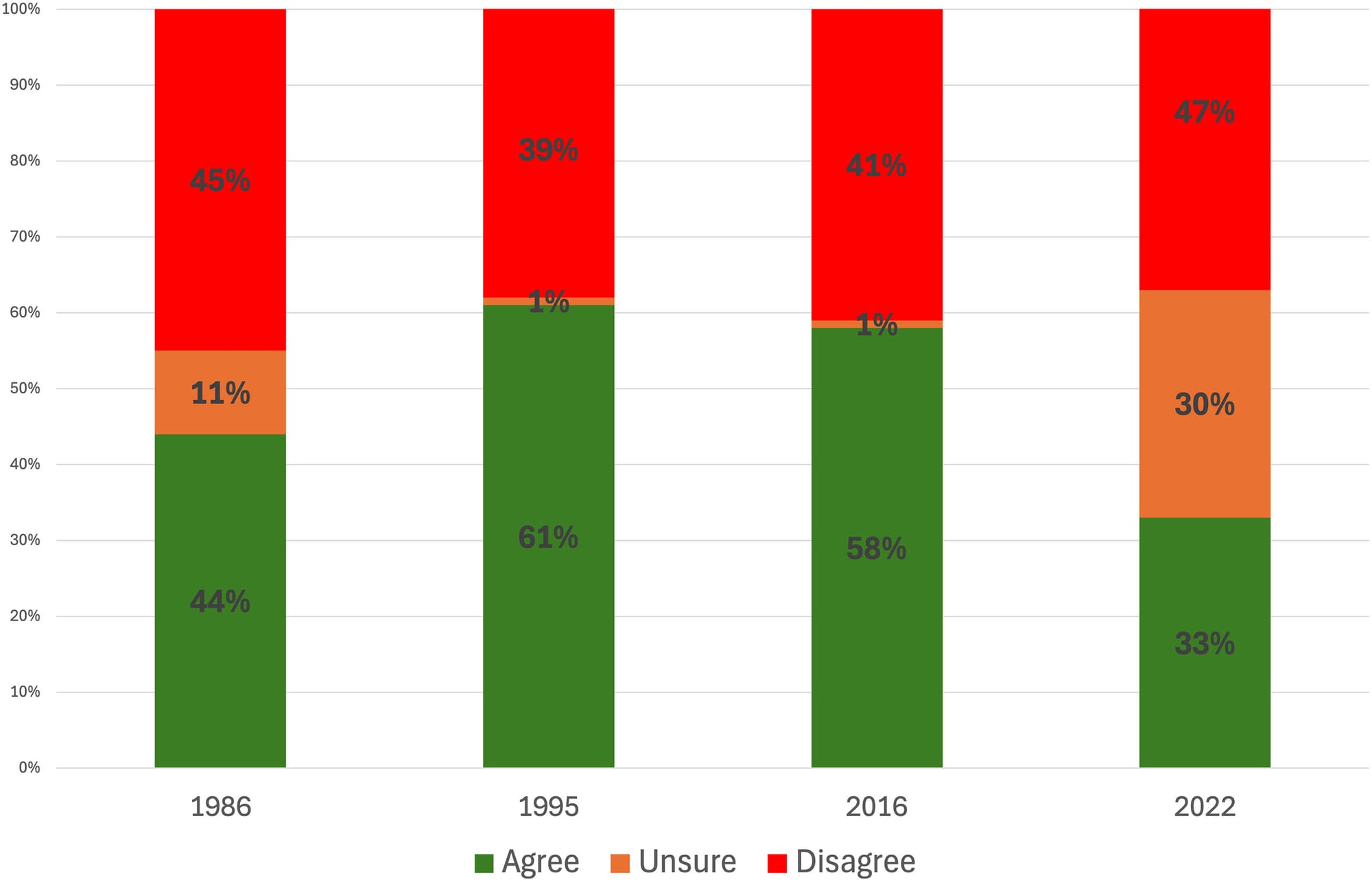
Marcos Jr. finally ran and won at the national level when he was victorious in his 2010 national senate race. While Marcos Jr. distanced himself somewhat from his father by not running under the banner of the old ruling and now authoritarian successor party and by emphasizing his accomplishments as governor of Ilocos Norte, his electoral success in 2010 can also be attributed to a softening of public opinion towards the rule of Marcos Sr. (Holmes, 2023). According to surveys by Social Weather Stations (SWS) in 1986, a majority of survey respondents believed that the late dictator was a “thief of the nation's wealth” (see Figure 1 below; for a similar discussion see Tigno et al., 2024). In that same year respondents were divided (45% agreeing and 44% disagreeing) as to whether he had been a “brutal or oppressive president” (Figure 2). As early as 1995, less than a decade after “people power” overthrew his regime, SWS surveys showed Filipinos now almost evenly split on whether Marcos had stolen from the country's patrimony. At the same time, 61% did not view him as having been an oppressive president.
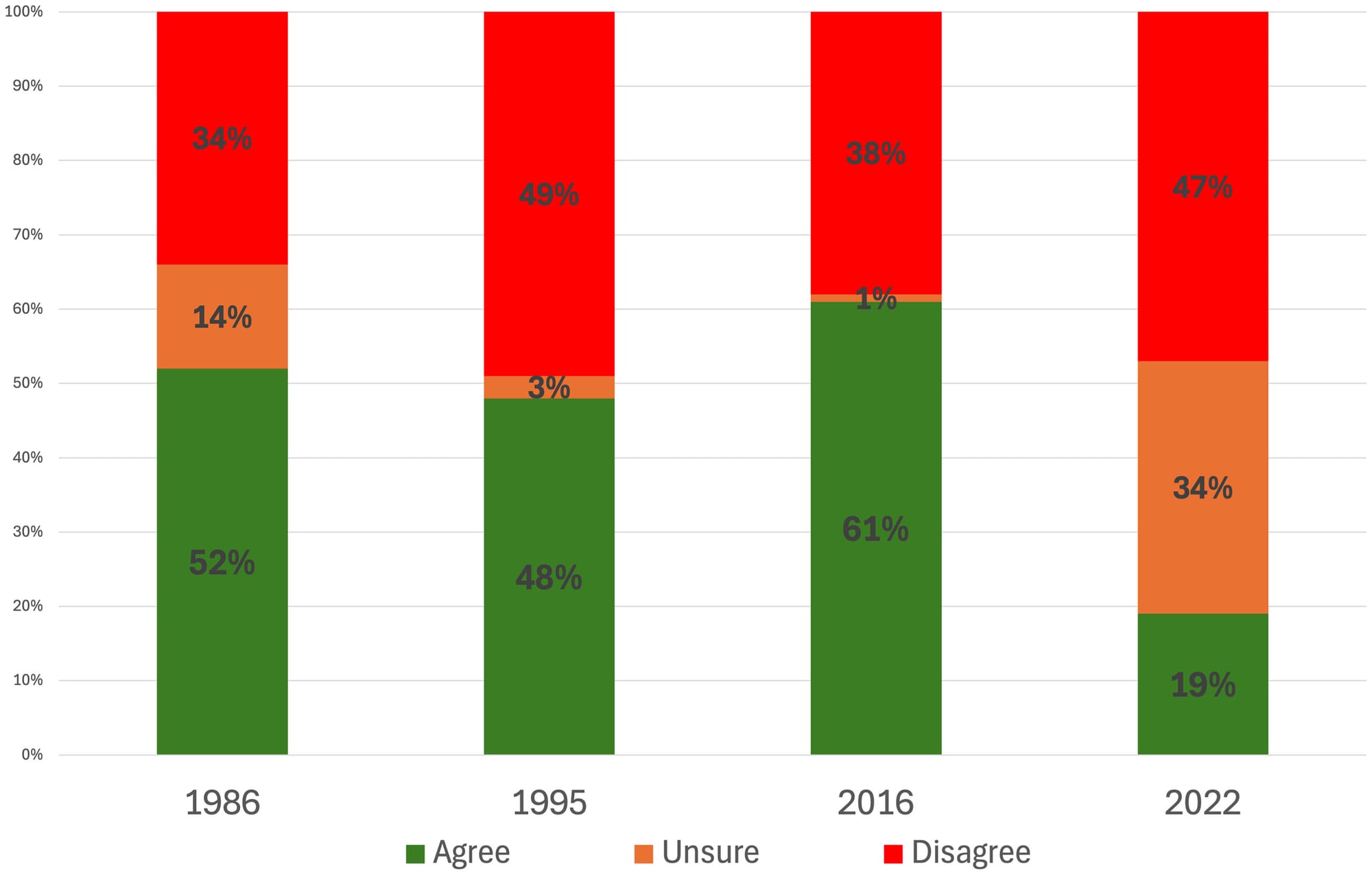
Yet, the continued decline in negative sentiment toward the late dictator by 2016 (with only 38% now viewing him as a thief of the nation's wealth) was not enough for Marcos Jr. to win the (separately elected) vice presidency in that year. As in past national elections in which members of the Marcos clan had run, their support had been regionally skewed, with Marcos Jr. again performing well in his family's Northern Luzon and Eastern Visayas’ bailiwicks against his opponent Maria Leonor “Leni” Gerona Robredo (who won narrowly) and the third and fourth placers, Alan Peter Schramm Cayetano and Francis Joseph “Chiz” Guevara Escudero, but less well elsewhere in the country (see Figure 3).
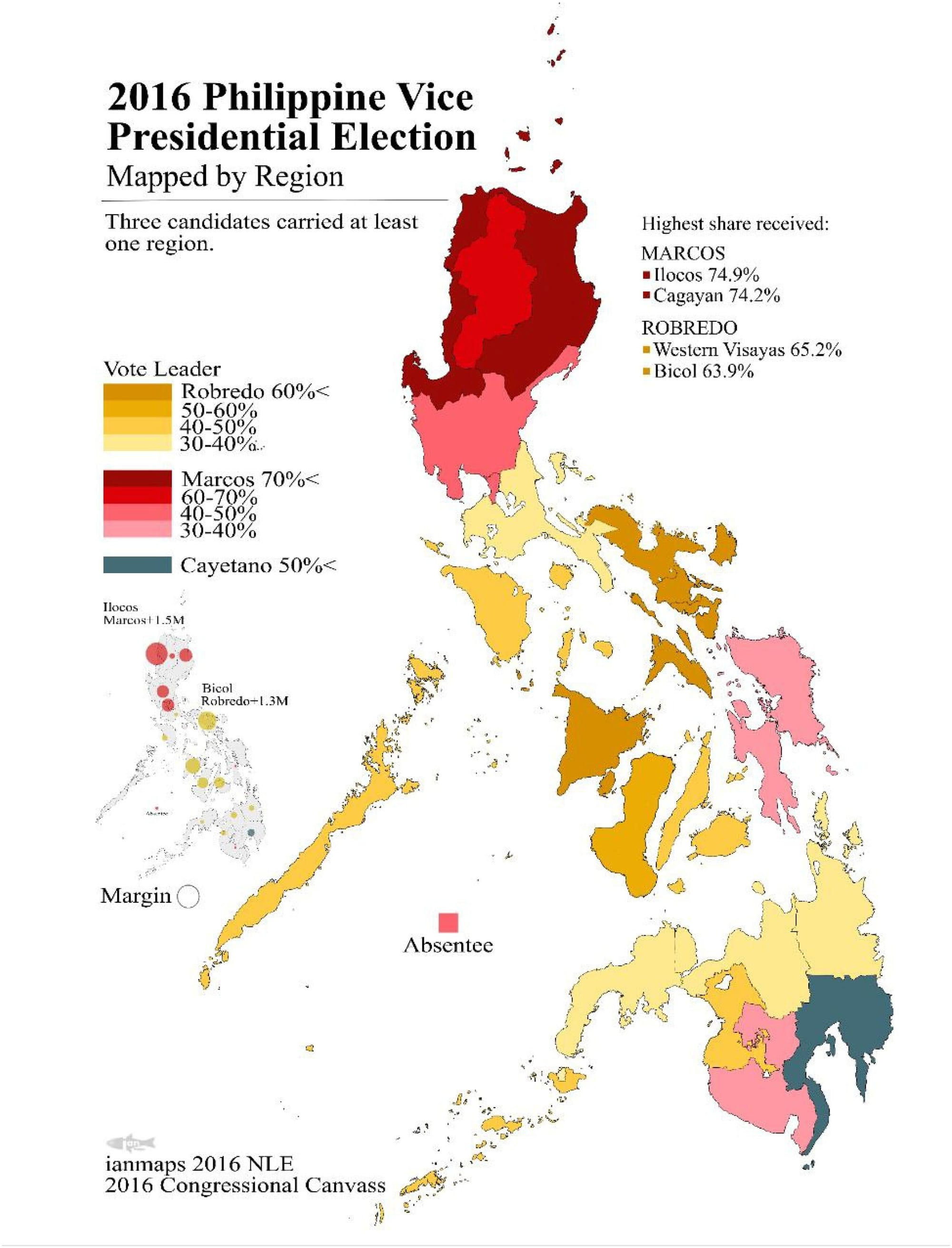
Despite public attitudes warming toward his father, Marcos Jr. had again cautiously de-emphasized Marcos Sr.'s martial law rule with his campaign slogan of “hindi ikaw ang nakaraan, tayo ang bukas” (you are not the past, we are the future). It was a transparent attempt by Marcos Jr. to distance himself from his family's political history, urging voters to judge him based on his own political program (Holmes, 2023). Marcos Jr. hoped this would deflect from criticisms of the corruption, human rights violations, and economic crisis that plagued his father's rule. But it did not prevent his opponents from piling on about these issues in the only vice-presidential debate in April 2016 (Pasion, 2016). Despite Marcos Jr.'s narrow loss in 2016, his sister, Imee Marcos, allied with then president Rodrigo Duterte, won a Senate seat in 2019.
Marcos, Jr.'s 2022 presidential campaign took place during (and may well have contributed to) a further decline in negative views of Marcos Sr., with only 19% saying he stole the nation's wealth (Figure 1 above) and 23% saying he had been a brutal leader (Figure 2 above). With public opinion at his back, the “golden age” narrative of Marcos Sr.'s rule - once confined to darker corners of the internet - now became prominent in social media postings by pro-Marcos influencers (Arugay, 2022; Ong, 2022; Talamayan and Candelaria, 2024). Marcos supporters increasingly believed “historical narratives of corruption, cronyism and economic decay of the Marcos era were concocted by political rivals” (Morales and dela Cruz, 2022).
The mythology around EDSA “people power” had fueled the Aquino clan's quarter century of electoral success, reaching its zenith after the death in 2009 of Cory Aquino which proved decisive in her son's successful 2010 nostalgia-tinged presidential race (Thompson, 2023). Yet the “official story” of EDSA deemphasized ordinary Filipinos’ role in the overthrow Marcos in favor of the “God given-miracle” of EDSA. Supposedly overcoming class differences in the Philippines, it became a divisive discourse that justified the elite-led overthrow of the movie star-turned populist president Joseph Ejercito Estrada in 2001, misleadingly called “EDSA dos” as it was launched against a freely and fairly elected president (Claudio, 2013; Thompson, 2016). Estrada's downfall was followed by a “long legitimacy” crisis: the vote fraud (“Hello Garci”) and corruption scandals during the administration of Estrada's successor, Gloria Macapagal Arroyo, which led to large protests and coup attempts (Teehankee, 2006; Hutchcroft, 2008). Under her successor, Benigno “Noynoy” Simeon Cojuangco Aquino III, there was failed crisis management after super typhoon Yolanda (known as Haiyan in the Philippines), a major pork barrel scandal and a bungled anti-terrorist military operation in early 2015 known as the Mamasapano massacre. The final straw was Duterte's turn against the EDSA narrative, particularly his giving Marcos Sr. a “hero's burial” denied by previous presidents (Holmes, 2023). In short, Marcos, Jr.'s landslide win in the 2022 presidential can be understood in a context in which his father's rule was generally seen positively while the legacy of EDSA people power was no longer perceived as beneficial by a majority of Filipinos.
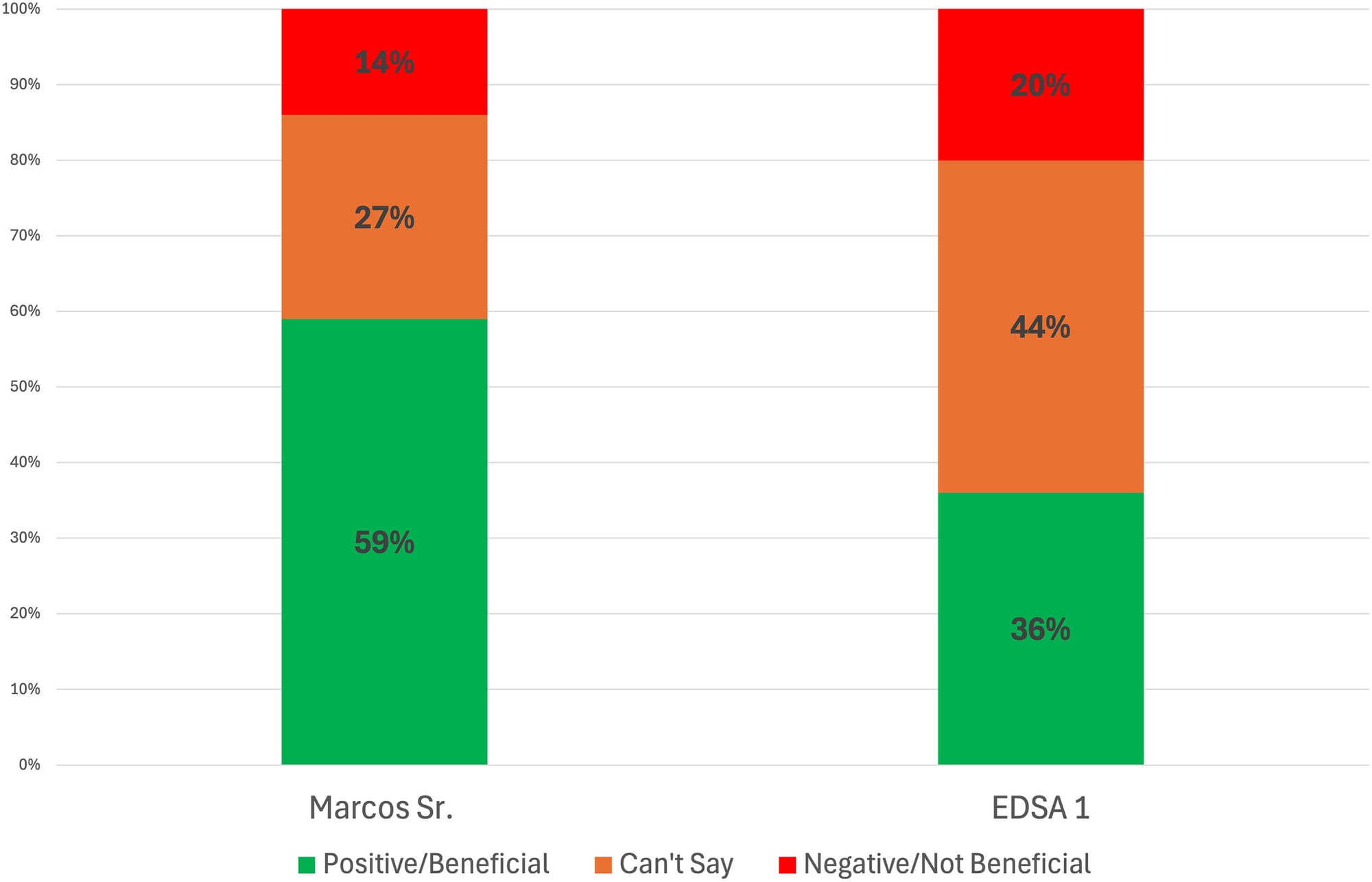
Survey data from Pulse Asia in 2022 shows a correlation between positive views of Marcos Sr.'s martial law rule and increasingly critical views of the EDSA “people power” uprising of 1986 and its subsequent impact on the country's democratization. In February 2022, shortly before the May presidential elections, 59% of respondents had a positive view of Marcos Sr.'s rule, with 27% unsure and only 14% viewing him negatively. Meanwhile, at the same time only 36% of those Filipinos surveyed saw EDSA “people power” as “beneficial” with the rest of respondents unsure or believing it had a negative impact (see Figure 4 below).
Revisionism about the authoritarian past while popular views of the legacy of the country's democratization soured was instensified by political grievance. The Marcos clan portrayed themselves as victims of the 1986 EDSA “people power” revolution, which they alleged was orchestrated by the United States, oligarchs, the Roman Catholic Church, and enemies of the state (Teehankee, 2023b). This narrative of victimhood became central to the Marcos family's dynastic story, intertwined with a quest for political “redemption” by restoring what they claimed was the Philippines’ lost “golden age” (ibid.).
After much backroom negotiation, Sara Duterte decided to run as Marcos Jr.'s running mate as vice-president in 2021 although she had been ahead of him in opinion polls for the 2022 presidential election by nearly a two to one margin when polling began for the race in late 2020 (Tomacruz, 2020).2 But once the UniTeam with Sara Duterte as his vice presidential running mate was announced, Marcos Jr.'s support shot up to 53% as he now also enjoyed strong backing in the Dutertes’ bailiwicks (Holmes, 2023).
Although pro-Marcos, Jr. online influencers promoted the “golden age” myth of Marcos Sr.'s rule, the Marcos-Duterte campaign instead adopted a “UniTeam” slogan (Ong, 2022). The Marcos-Duterte alliance had primarily been strategic move to unite the clans’ political bailiwicks: Marcos Jr. sought Duterte's support to gain votes in areas where he had failed to mobilize support in his 2016 vice-presidential run (e.g., Cebuano speaking areas of the Central Visayas and much of Mindanao). A careful study of the electoral results showed that these ethno-linguistic, dynastically linked regional bases of support were the crucial factor in the Marcos-Duterte landslide victory for president and vice president respectively (Dulay et al., 2022; also see Mendoza et al., 2024). Other commentators have stressed that through the UniTeam voters were promised a continuation of the status quo, with a survey showing 85% of voters wanted “continuity” or “partial continuity” with the Duterte administration while only 16% of those surveyed wanted a candidate who represented a change from the outgoing and still popular Duterte administration (Arguelles, 2022). This further demonstrated that while public opinion of his dictator father had grown more favorable, it was the combined strength of the pro-Marcos and pro-Duterte strongholds that was most decisive in the 2022 victory.
From Conjoined to Competing Authoritarian Nostalgias
After the Marcos-Duterte “UniTeam” breakup, a new form of authoritarian nostalgia emerged. It centered around claimed political betrayal of, and a “penal populist” yearning for the illiberal former president Rodrigo Duterte (Curato, 2016; Kenny and Holmes, 2020; Amestoso, 2024; Royandoyan, 2024). While the Marcos and Duterte authoritarian brands were conjoined in the 2022 elections, they had now become fierce competitors, with appreciation of the Marcos Sr. legacy decreasing as opinion poll ratings of the Marcos, Jr. administration slid. This was the latest chapter in a decades-long melodrama of alternating political alliance-making and intense rivalry between the two clans.
A central theme in Sara Duterte's criticism of President Marcos Jr. and his administration was their failure to honor the political agreements underpinning the coalition—most notably, her expectation of being appointed Defense Secretary. Instead she was assigned the Department of Education despite her lack of experience in the education sector. In mid-2023, after the removal of her ally, and kingmaker of the UniTeam, former president Gloria Macapagal-Arroyo as deputy speaker in the House of Representatives, Sara Duterte resigned from the majority party Lakas-Christian Muslim Democrats (Lakas-CMD). Her resignation from the Cabinet as Education Secretary followed a series of perceived slights against her key allies, as well as investigations initiated by Marcos-aligned lawmakers in the House of Representatives into the alleged misuse of her confidential funds as vice president. This culminated in the House's decision to remove the Office of the Vice President's proposed confidential and intelligence funds for 2024 and, eventually, to impeach her in early 2025—revealing the extent to which this national political feud had escalated (Panti, 2023; Tamase and Presto, 2025)
Sara Duterte complained that Marcos, Jr. seemed to have forgotten all that her father had done for the Marcoses, including burying Marcos Sr. in the country's Heroes’ Cemetery, a longstanding request of the family which had been denied by previous presidents. Yet her father had earlier admitted that Imee Marcos had financially supported his 2016 campaign during which he had made the controversial pledge to give the Marcos clan the burial they had long sought for their patriarch (Viray, 2016; Matsuzawa, 2016). It also represented a figurative burying of past bad blood between the clans (Reyes 2019).
Using rhetoric more characteristic of her father, Sara Duterte told a press conference that after congressional investigations and impeachment proceedings she had imagined “cutting [off] Marcos, Jr.'s head” over these many betrayals (Robles, 2024). This claim of victimhood resonated with many “ordinary Filipinos” who “see Duterte as a victim of political persecution, betrayed by those who leveraged her family's influence to seize power” (David, 2025). This story of victimization went into overdrive after the elder Duterte's transfer to The Hague on an Interpol warrant to face an ICC trial in March 2025. The narrative promoted by Duterte's allies—that he had been extra-judicially rendered or even kidnapped— won broad support nationally and provided new purpose to the Duterte clan's efforts to reclaim political supremacy.
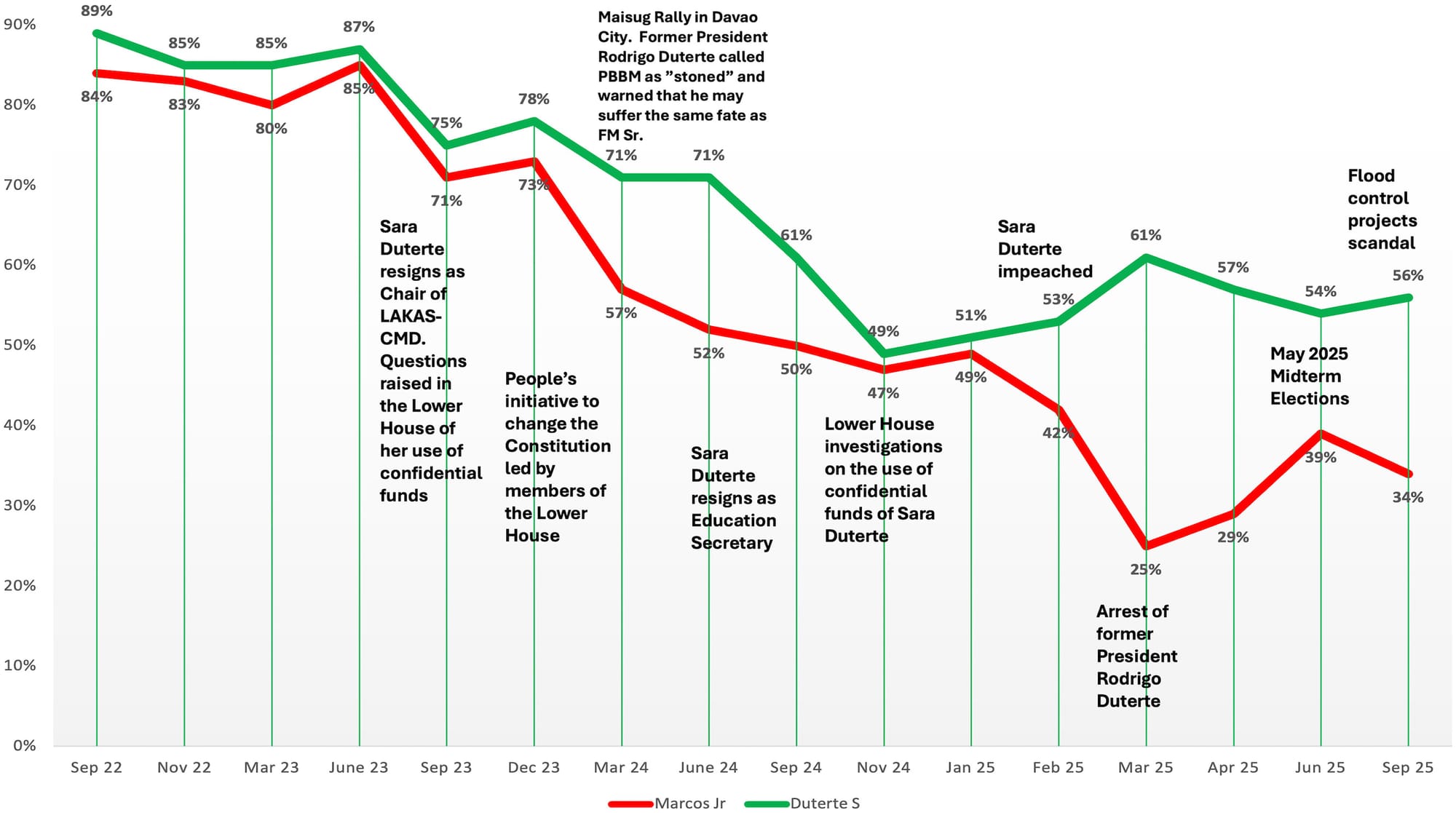
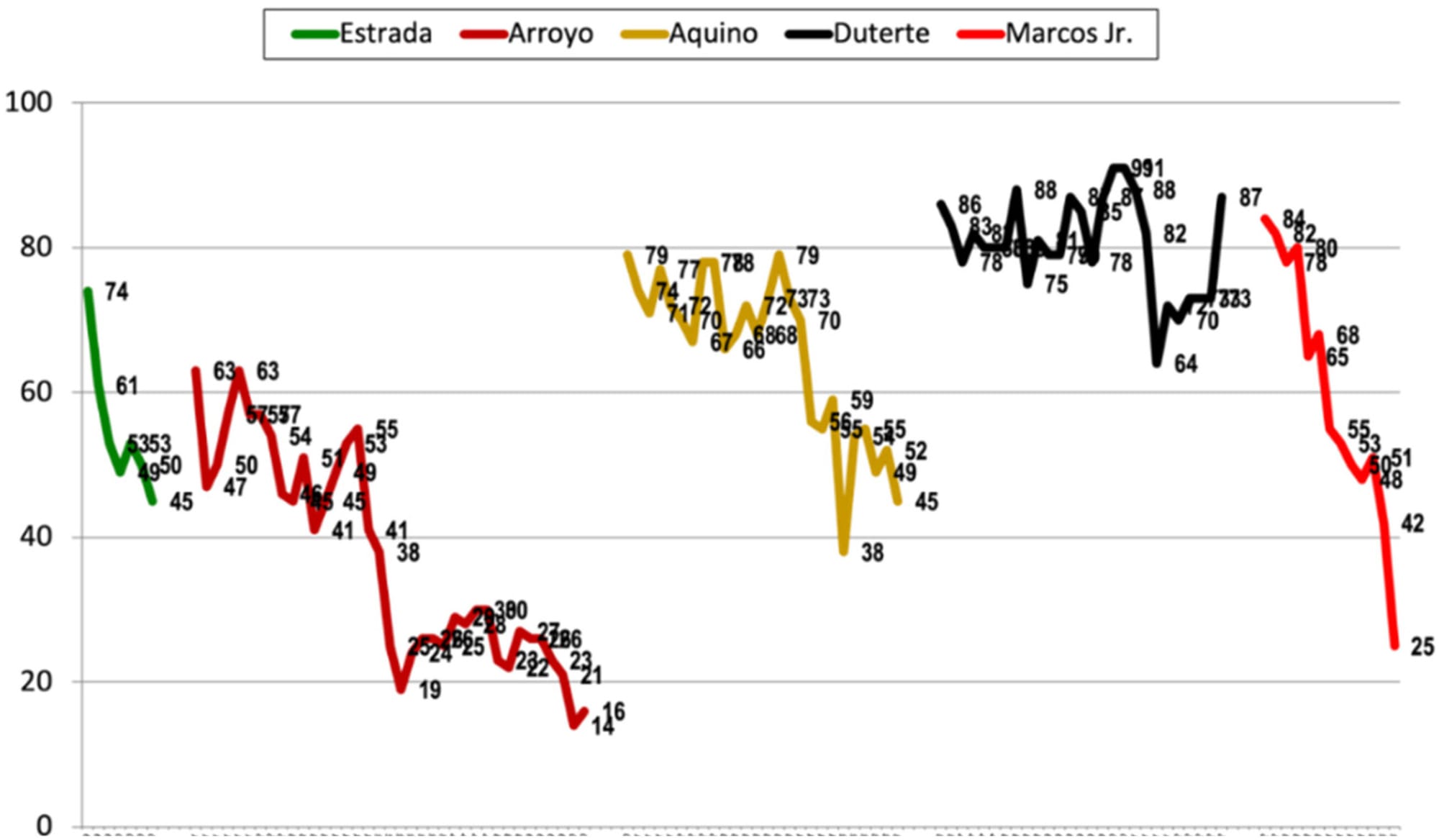
While public opinion soured somewhat on both Marcos Jr. and Sara Duterte after the feud began, the extent of opinion poll declines was now asymmetrical with Marcos Jr.'s popularity falling from a high of over 80% at the beginning of his presidency to a low of 25% after elder Duterte's arrest, from which it has only recovered slightly since. By contrast, while Sara Duterte's popularity did decline from nearly 90% to just over 50% when she was impeached by the lower house in February 2025, it went back up to nearly 60% after her father's arrest (see Figure 5 below).
Nostalgia for Duterte's presidency is also fueled by a revival of the “penal populist” narrative the elder Duterte had used to justify his murderous “war on drugs” which has been revived by the Duterte clan that has decried the rise in criminality under the Marcos administration despite official statistics showing it had declined (Mangosing, 2024). In an October 2024 senate hearing, former President Duterte claimed drug-related crimes were surging: “Every day, you can read about children being raped, people getting killed and robbed, and just recently, a drug den was raided within the Malacañang complex [the presidential palace]” (Bajo and Casilao, 2024). Such claims have fueled growing public concern over criminality. A Pulse Asia survey showed an increase in Filipinos identifying criminality as a top concern - from 15% in November 2024 to 23% in January 2025. This was reminiscent of the traction Duterte had gained during his 2016 presidential campaign with his violent populist messaging, with the fight against illegal drugs going from a lower-level worry to a top concern in Pulse Asia (Holmes, 2016: 32).
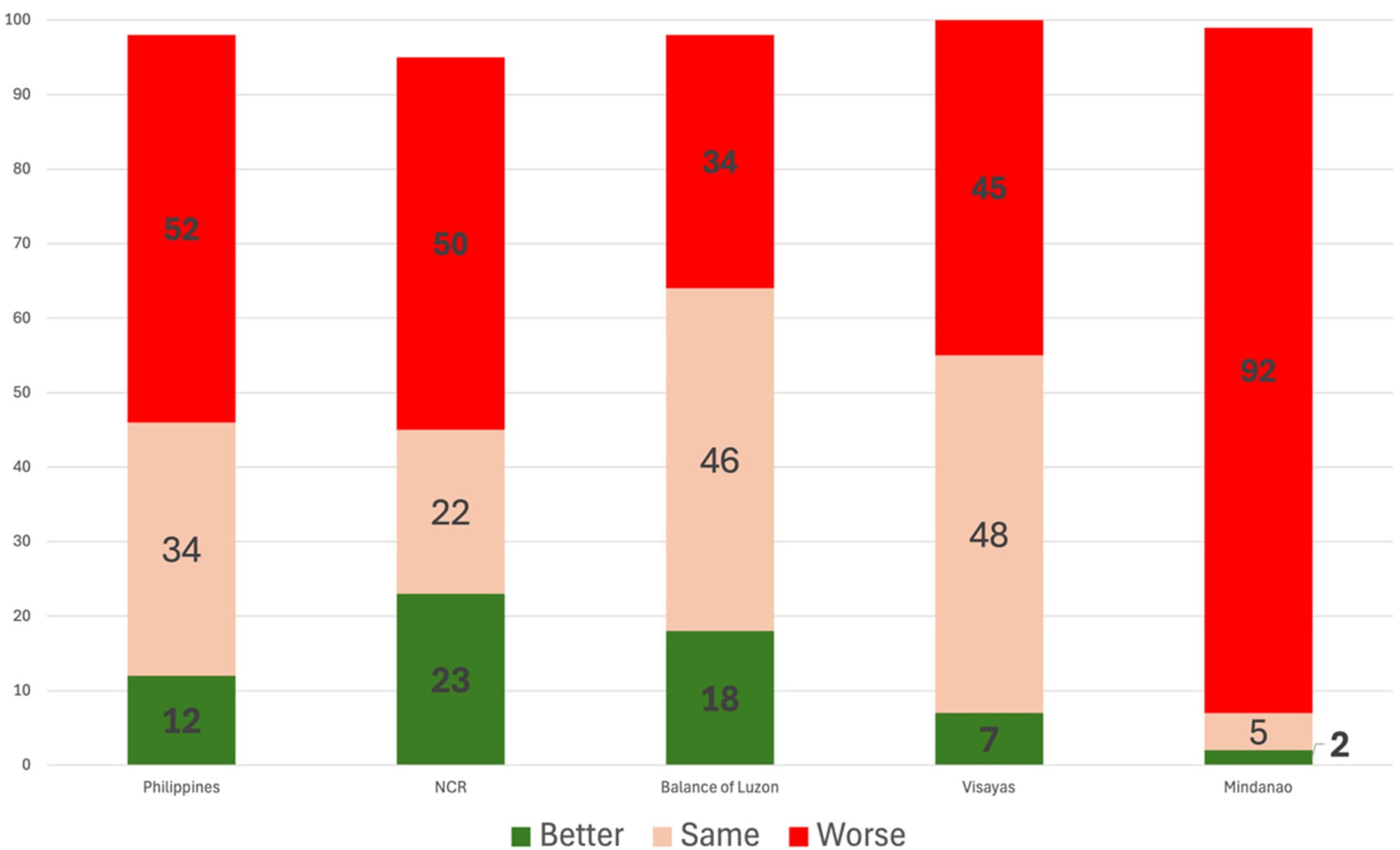
The effectiveness of the revival of such anti-drugs messaging against the Marcos presidency by the Dutertes was evident in a May 2025 survey taken shortly before the midterm elections, showing that a majority of Filipinos believed that peace and order conditions have worsened under Marcos Jr., with 50% in the National Capital Region (NCR), only about a third in the remainder of Luzon (which included the Marcos bailiwick in the Ilocos region) but 92% of Mindanaons saying the security conditions had deteriorated under the current administration(Pulse Asia, 2025b, see Figure 6).
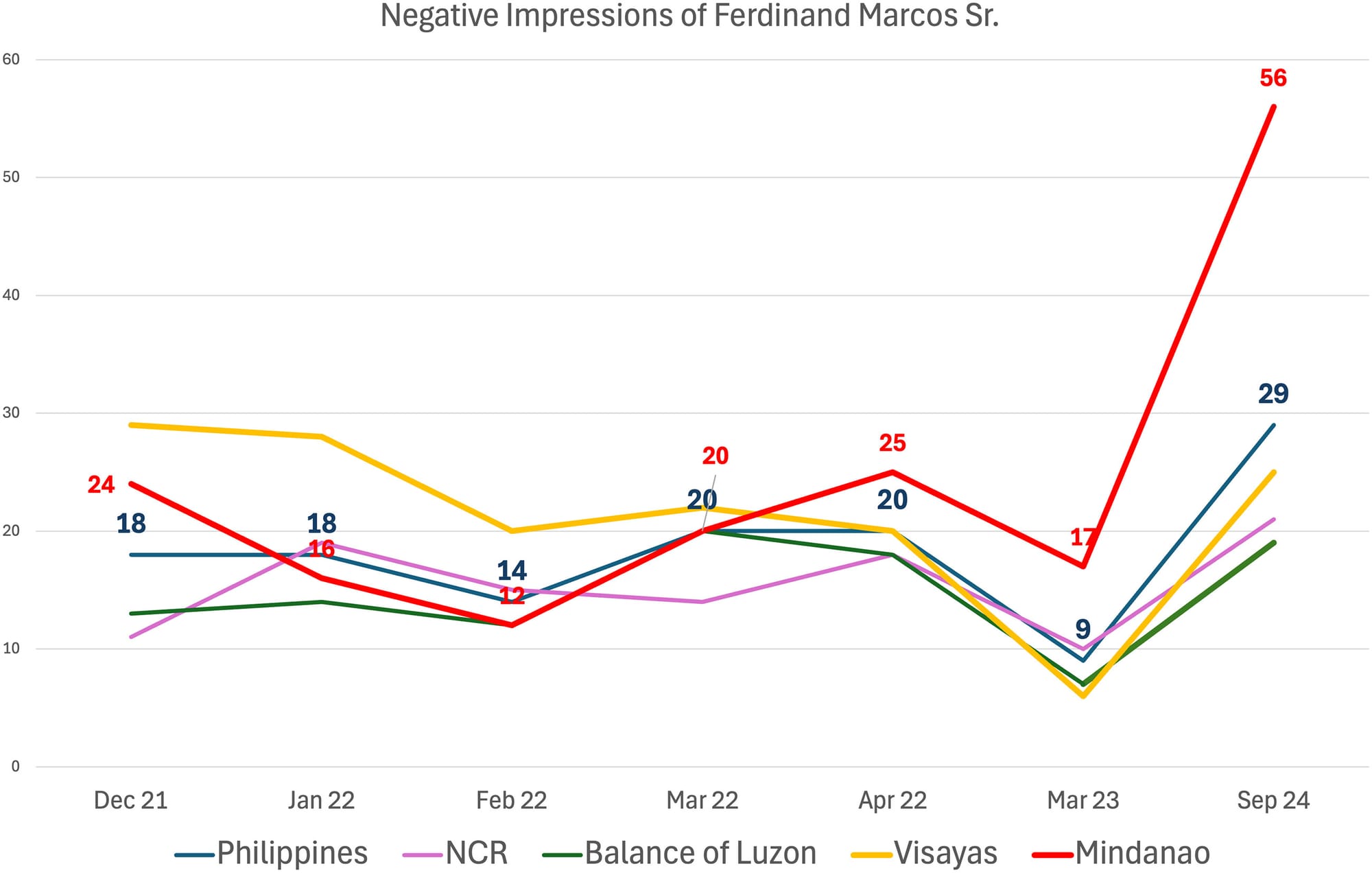
At the same time concerns for crime rose, public perception of Marcos Sr. shifted significantly. While Pulse Asia surveys from December 2021 to March 2023 showed a majority of Filipinos with a positive view of the late dictator, the September 2024 survey revealed a sharp decline in favorable opinions - from 67% in March 2023 to 42% in September 2024. Meanwhile, negative impressions rose by 20 percentage points. This shift occurred nationally but unsurprisingly was strongest in Mindanao, the Duterte's regional bailiwick, where negative views rose dramatically from 17% to 56% (see Figure 7 below).
This decline in nostalgia for Marcos Sr. was clearly correlated with dissatisfaction with his son's administration. Marcos Jr. has suffered a sharper decline in approval and trust ratings than his predecessors. His approval rating fell from 84% in September 2022 to 55% in March 2024 and further to 25% in March 2025 (see Figure 8 below). The most significant erosion of support has occurred in Mindanao, a Duterte clan stronghold. His approval rating there fell from 40% in March 2024 to just 5% in November 2024, with 55% of Mindanao residents expressing disapproval. Moreover, in March 2025, a majority of Filipinos (53%) expressed disapproval of President Marcos Jr.'s performance (Pulse Asia, 2025b).
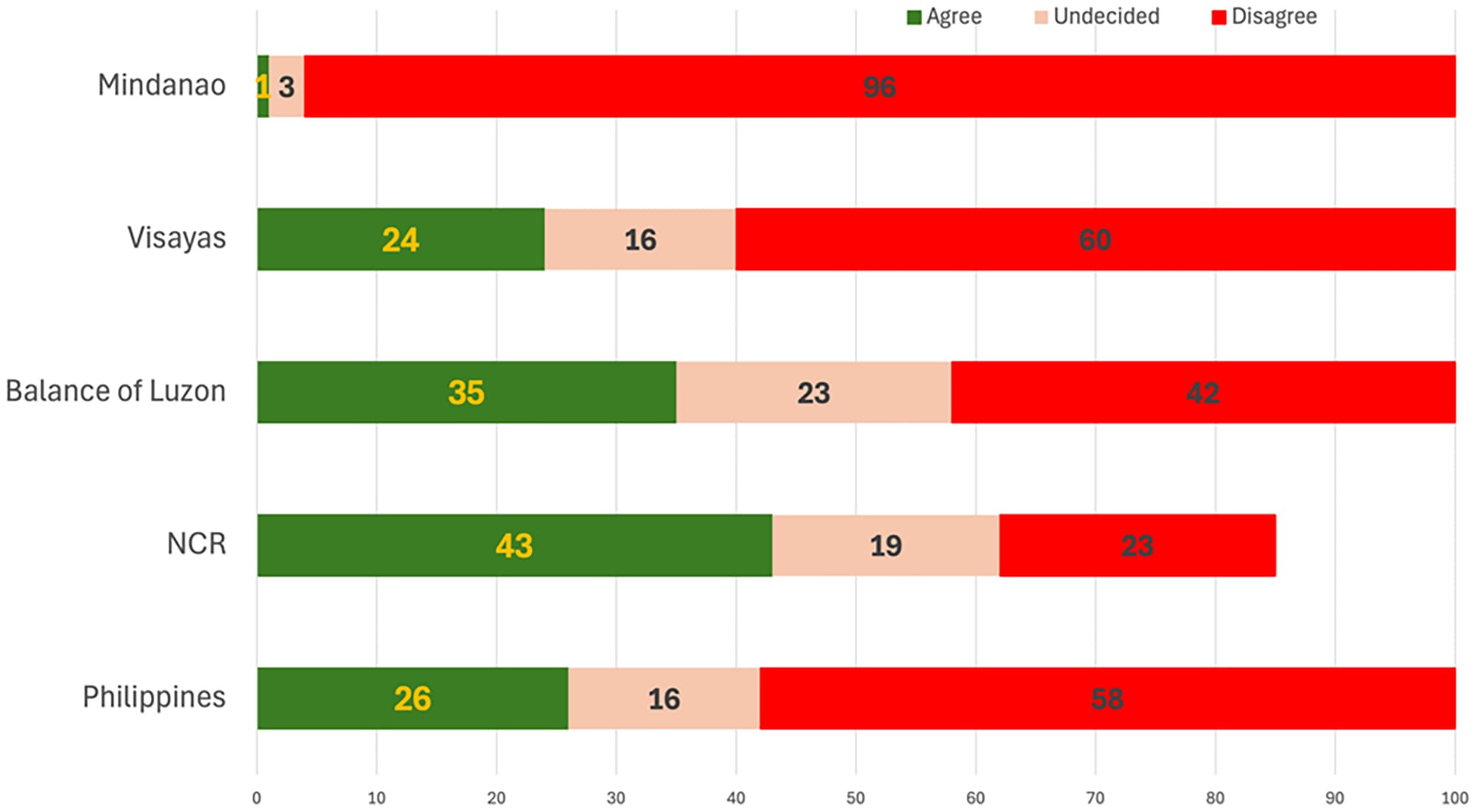
This abrupt decline in approval can largely be attributed to public reaction over the administration's handling of former President Rodrigo Duterte's transfer to The Hague to face an ICC trial. The narrative promoted by Duterte's allies—that he had been extra-judicially rendered or even kidnapped (Mendoza, 2025)—won broad support nationally, with 58% of Filipinos surveyed disagreeing with the arrest. In Duterte's regional bailiwick Mindanao only 1% supported the arrest with 96% opposing it (see Figure 9 below).
Having won more votes than Marcos for president in the (separately elected) vice presidency in the 2022 election, as shown in Figure 5 above, public trust in Sara Duterte had declined somewhat following the fallout of the political divorce and accusations of corruption against her that resulted in her impeachment in early 2025. But her support rebounded after the arrest of her father in March 2025 while trust in Marcos, Jr. plunged (Pulse Asia, 2025a, 2025b). Very much like the case of Peru's Keiko Fujimori who channeled “Fujimorismo” in presidential campaigns to invoke her father's bloody legacy on security issues, Sara Duterte was drawing on what observers had long termed “Dutertismo”, defined as the promise to “restore order and respect for authority” by targeting “criminals, drug peddlers, and corrupt public officials” (David, 2016) Moreover, Sara Duterte's grievance-fueled messaging about the persecution of the Duterte clan (her father's ICC arrest and her own impeachment) turned the midterms into a referendum on the administration's supposed injustices, with her even comparing the “kidnapping” of her father to the assassination of Ninoy Aquino in 1983, much to the chagrin of the Aquino family (Clapano, 2025).
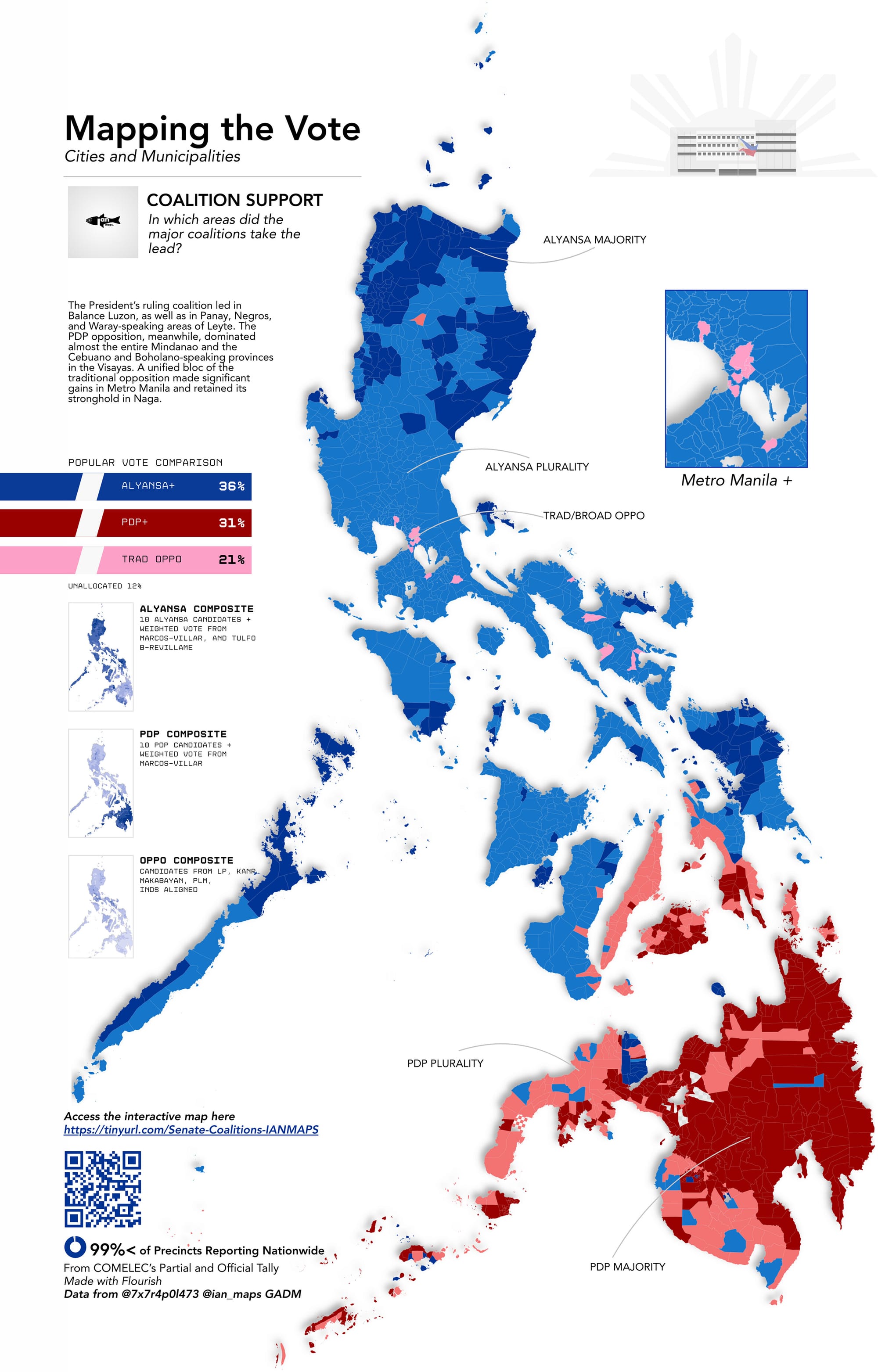
In the 2025 midterm elections, Sara Duterte led the “Duter-Ten” senatorial slate to a standoff with the pro-administration bloc, with each camp securing five seats, while two reformist candidates—one from the Aquino political clan—won the remaining spots. Given limited resources and the fact that many of the country's most prominent and ambitious politicians had aligned themselves with the pro-Marcos Jr. administration's Alyansa ticket, Sara Duterte could only manage to assemble a slate composed largely of political “unknowns,” a reality she openly acknowledged (Domingo, 2025). At campaign rallies, but also in appearances among overseas Duterte supporters in The Hague, she made “bring him home” (demanding the release of the elder Duterte from ICC detention) the centerpiece of her campaign. Her sharp critiques of the Marcos Jr. fueled affective polarization in the country (Mallari, 2025). In particular, though it successfully mobilized the Duterte dynasty's ethno-linguistic strongholds with the pro-Duterte Partido Demokratikong Pilipino (PDP) gaining their strongest voter support from Mindanao and Cebuano-speaking areas in Central Visayas (Macaraeg, 2025; see Figure 10 below). The Alyansa coalition was so weakened in Mindanao after the elder Duterte's arrest that they did not stage a single major rally in the region thereafter, limiting their barnstorming to the Visayas and Luzon (Daily Tribune, 2025).
Thus, despite enjoying the incumbent advantage in political machinery (including reports of widespread vote buying), the predicted easy victory for the pro-Marcos slate of carefully curated candidates with celebrity politicians and backed by powerful clans proved inaccurate, with most opinion polls not picking up a late pro-Duterte surge (Pulse Asia, 2025b). In the 13 midterm senatorial elections since 1947, the opposition slate has only won three times (1951, 1971 and 2007) and tied once (1963). In other midterms, the administration slate has either won overwhelmingly, often with thrice the number of seats, or handily, with a clear majority (Quezon, 2025). Thus the 2025 midterm result can be interpreted as a vindication of the Dutertes’ effective electoral branding around nostalgia for the former president.
Sara Duterte's willingness, despite skepticism by her father's allies to adopt two estranged candidates from the Alyansa, most dramatically Imee Marcos - the president's sister who had helped arranged the UniTeam political marriage in the 2022 polls but then publicly broke with her brother and held senate hearings critical of the Duterte arrest - proved a political masterstroke (Robles, 2025). After trailing in previous polling, Imee Marcos made it into the senate “winner's circle” (finishing twelfth) and was the top placer in the Marcos clan's northern Luzon bailiwick despite openly criticizing her brother during the campaign claiming he was not the true representative of Marcos Sr., she was (Presto, 2025). Her victory was seen as a blow to the unity of the Marcos clan while the Dutertes had pulled together under threat.
Conclusion
The Marcos-Duterte feud has demonstrated the limits of conventional wisdom about the nature of authoritarian nostalgia in the Philippines. No longer just a story about how disappointment in the legacy of EDSA “people power” made a revisionist account of the disgraced dictator appealing to Filipinos, it now involves tall tales about two past illiberal rulers with supposed democratic aims most missed in their respective regional strongholds. Arguing that authoritarian nostalgia in the Philippines of leaders long dead or very much alive is best conceptualized as involving revisionism and grievance rooted in an illiberal clan's regional stronghold, the paper has shown how new heterodox historical accounts and fresh claims of victimhood led to competing nostalgias about past strongman rulers in an effort to mobilize voters in their dynastic bailiwicks.
Upon returning from exile beginning in 1991, the Marcos clan came to realize through initial failed national election campaigns that their nostalgic appeals about Marcos Sr.'s rule were most effective in their political heartlands of Northern Luzon and the Eastern Visayas. While this facilitated the Marcos clans’ re-consolidation of their bailiwicks, regionally-centered nostalgia did not prove decisive in Marcos Jr.'s 2022 presidential victory. Rather, it was his alliance with Sara Duterte as his vice-presidential candidate which enabled Marcos Jr. to achieve nationwide appeal.
The Marcoses and Dutertes drew on distinct reservoirs of nostalgia rooted in their respective regional bailiwicks and political legacies. During the UniTeam alliance, these sentiments briefly fused into a moment of conjoined nostalgias, enabling the conservative restoration that brought Marcos Jr. to power. After the alliance collapsed, however, these sentiments diverged into competing authoritarian nostalgias, each pairing revisionist memory with a distinctive grievance narrative: Marcosian nostalgia framed the dictatorship as a “golden age” undermined by elite conspiracy, while Duterte nostalgia invoked the supposed order of the drug war and the unjust persecution of its architect.
Appreciation of Marcos Sr.'s legacy decreased as opinion poll ratings of the Marcos Jr. administration slid. In the current competition between two previously allied authoritarian nostalgias, Sara Duterte has accused the Marcos administration of political betrayal for having her impeached and her father “kidnapped” to face an ICC trial. Memories of her father's “penal populism” amidst supposedly rising crime rates have also been invoked to mobilize support, with polls showing that as during Duterte's presidential campaign in 2016, this has led Filipinos to focus more on concerns about “peace and security”. Marcos Jr.'s discursive weakness in the face of the Duterte camp's nostalgic narrative—built around victimhood and penal populism—is evident in opinion polling in which his popularity fell to only a quarter of those surveyed, one of the lowest among recent presidents. With nostalgia for Duterte's rule in the ascendancy, the Dutertes were able to mobilize support in the 2025 senate midterms along ethno-linguistic lines as they fought the pro-administration slate to a tie despite its advantages of incumbency.
In response, President Marcos Jr. has sought to redefine his image, presenting himself as a “normal” chief executive who respects the rule of law and adheres to institutional processes. He has downplayed the controversial “war on drugs” and shifted Philippine foreign policy from a pro-China orientation toward a more pro-U.S. stance, particularly in defense of the country's interests in the West Philippine Sea (Claudio, 2023; Heydarian, 2024). More recently, he has also attempted to rebrand himself as a political reformer. He opened a political pandora's box by using his fourth State of the Nation (SONA) address in July 2025 to accuse leading politicians of profiting from substandard or even “ghost” (i.e., unbuilt) flood control projects undertaken by corrupt contractors in a year in which typhoons have caused particularly great damage in the country (Hilotin, 2025). Yet accusations are now increasingly focused on members of his own ruling circle, particularly his cousin and former house speaker Martin Romualdez (Heydarian, 2025;
Yet, as earlier advocates of the EDSA “people power” legacy also discovered, appeals to democratic norms and procedural governance have limited persuasive power when confronted by resurgent authoritarian nostalgia constructed around historical revisionism, fueled by grievance, grounded in regional identity, and intensified through the allure of decisive, punitive leadership.
Declaration of Conflicting Interests
The authors declared no potential conflicts of interest with respect to the research, authorship, and/or publication of this article.
Funding
The authors disclosed receipt of the following financial support for the research, authorship, and/or publication of this article: This work was supported by the University Grants Committee, (grant number 11600524).
Originally published in Sage Journal. You can read the original article here.
Author biographies
Mark R. Thompson, He is chair professor in the Department of Public and International Affairs at the City University of Hong Kong and specializes in comparative politics, social movements, and gender politics, with a regional focus on Southeast Asia. He is among the world's top 2% most-cited scientists in the subfield of “Political Science & Public Administration” according to the 2024 Stanford/Elsevier annual report. The author or editor of 12 books and over 150 articles and chapters, his most recent single-authored book is The Philippines: From “People Power” to Democratic Backsliding (Cambridge 2023). The senior co-editor of the Routledge/City University of Hong Kong Southeast Asia Series, his research has been funded through external grants, with five awarded by the Hong Kong Research Grants Council. At CityUHK he was Director of the Southeast Asia Research Centre, 2011–2024, and Head of the Department of Asian and International Studies, 2015–2022. He was Lee Kong Chian Distinguished Fellow for Southeast Asian Studies at the National University of Singapore (2008) and Stanford University (2009) as well as a visiting fellow at the Center for Southeast Asian Studies (CSEAS), Kyoto University in winter/spring 2024.
Ronald D. Holmes, Professor Holmes has been a member of the Department of Political Science and Development Studies of De La Salle University since 1985. He served as Chair of the Department from 1990 to 1996 and has held various administrative positions in the College, the University, and other La Salle schools in the Philippines. Since 2008, he has concurrently served as president of the independent research organization, Pulse Asia Research Inc., a leading survey institution in the Philippines. His areas of research cover concerns or issues in comparative politics (particularly in Southeast Asia), elections and parties, public finance, and public opinion. He obtained his Bachelor's degree in History-Political Science from De La Salle University, his Master of Arts in Political Science from the University of the Philippines, Diliman, and his Doctor of Philosophy in International, Political, and Strategic Studies from the Australian National University.
If you liked what you just read and want more of Our Brew, subscribe to get notified. Just enter your email below.
Related Posts
Numbers vs. Influence: My Take on the Philippine Evangelical Church Today
Feb 23, 2026
The Sorrowful Mystery of Cabral’s Death
Dec 20, 2025
Delotavo, 71
Dec 08, 2025