



By Pulse Asia
Disapproval and distrust are the plurality sentiments toward the President (45% and 44%, respectively) while the Vice-President registers small majority approval and trust ratings (55% and 54%, respectively)
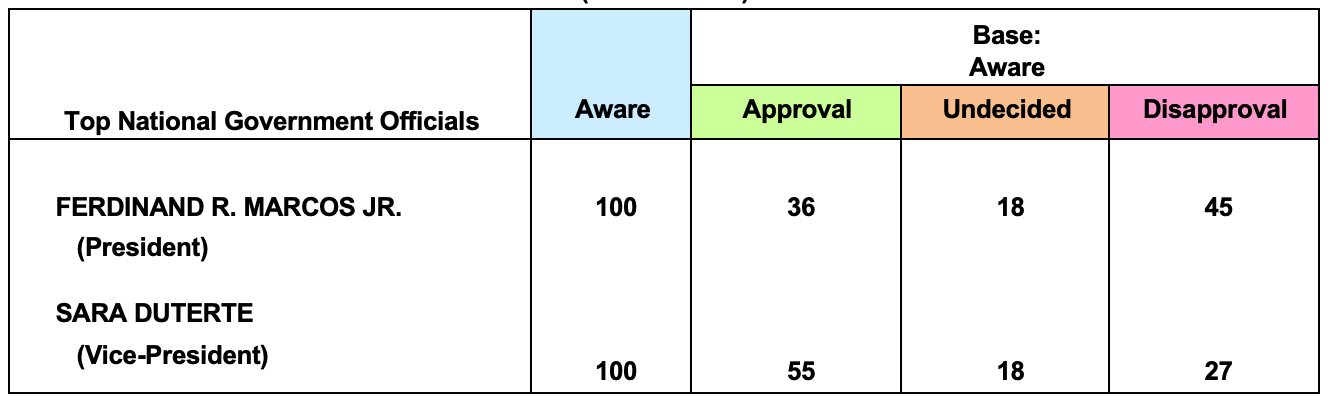
Less than half of Filipino adults (45%) express appreciation for the work done in the past three (3) months by the President while approval is the predominant sentiment regarding the Vice-President’s quarterly performance (55%). Approval for the President’s work is more pronounced than indecision on the matter (36% versus 18%). Conversely, disapproval for vice-presidential performance is more marked than ambivalence toward it (27% versus 18%). (Please refer to Table 1.)
Table 1
AWARENESS & PERFORMANCE RATINGS OF
PRESIDENT FERDINAND MARCOS JR. AND VICE-PRESIDENT SARA DUTERTE
February 27 - March 2, 2026 / Philippines
(In Percent)
Across geographic and socioeconomic subgroupings, the only majority approval score of the President is recorded in the rest of Luzon (54%). In contrast, disapproval for the latter’s work prevails in the Visayas (61%), Mindanao (73%), and Class E (60%). Almost half of those belonging to Class D (47%) also have a negative assessment of presidential performance. While the same approval and disapproval ratings are posted by the President in Metro Manila (both at 42%), a three-way divide may be observed in Class
ABC (41% approval, 29% indecision, and 30% disapproval). (Please refer to Table 2.)
Table 2
PERFORMANCE RATINGS OF
PRESIDENT FERDINAND MARCOS JR. AND VICE-PRESIDENT SARA DUTERTE
February 27 - March 2, 2026 / Philippines
(In Percent)
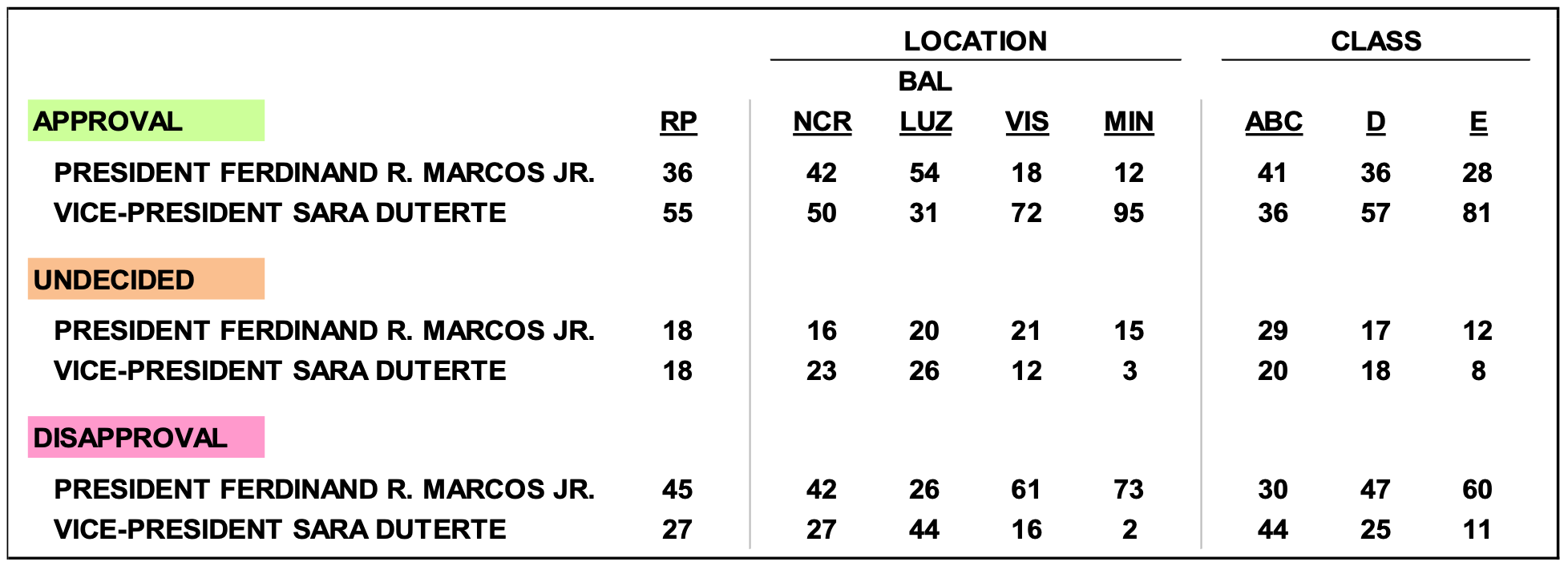
The Vice-President enjoys small to big majority approval ratings in the Visayas (72%), Mindanao (95%), Class D (57%), and Class E (81%). Half of Metro Manilans (50%) are appreciative of the latter’s work while a big plurality of those in the rest of Luzon (44%) disapprove of the same. Practically the same approval and disapproval figures are recorded in Class ABC (36% versus 44%).
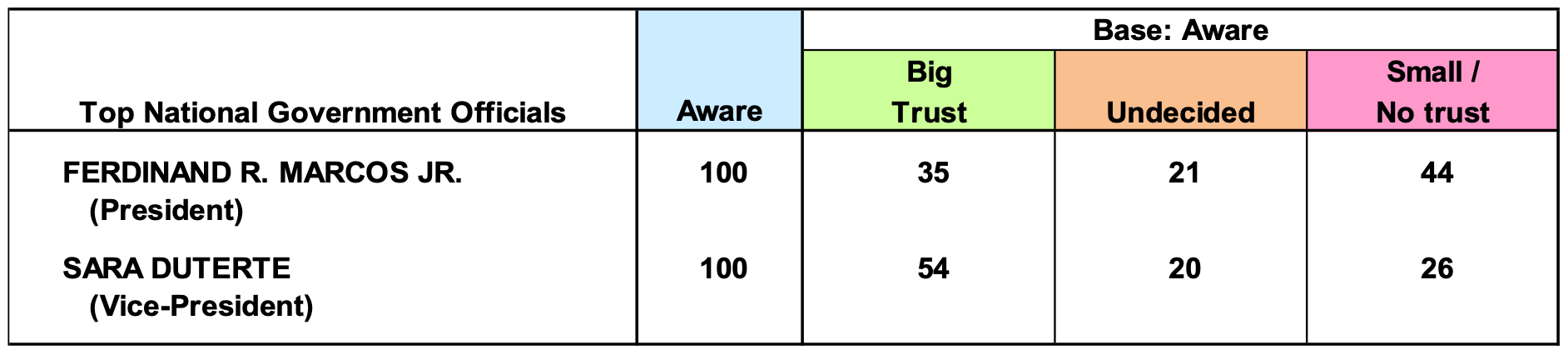
At the national level, the plurality sentiment toward the President is one of distrust (44%). The rest of the country’s adult population either trust the latter (35%) or is unable to say if they trust or distrust him (21%). In the case of the Vice-President, most adults trust her (54%). Distrust in the latter is slightly more notable than ambivalence on the matter (26% versus 20%). (Please refer to Table 3.)
Table 3
AWARENESS & TRUST RATINGS OF
PRESIDENT FERDINAND MARCOS JR. AND VICE-PRESIDENT SARA DUTERTE
February 27 - March 2, 2026 / Philippines
(Row Percent)
Only those in the rest of Luzon grant a majority trust rating to the President (54%). On the other hand, majority distrust figures are given to the latter by Visayans (61%), Mindanawons (77%), and those in Class E (64%). Distrust in the President is expressed by a big plurality of those belonging to Class D (43%). Basically the same trust and distrust figures are recorded in Metro Manila (38% versus 45%) and Class ABC (36% versus 43%). (Please refer to Table 4.)
Table 4
TRUST RATINGS OF
PRESIDENT FERDINAND MARCOS JR. AND VICE-PRESIDENT SARA DUTERTE
February 27 - March 2, 2026 / Philippines
(In Percent)
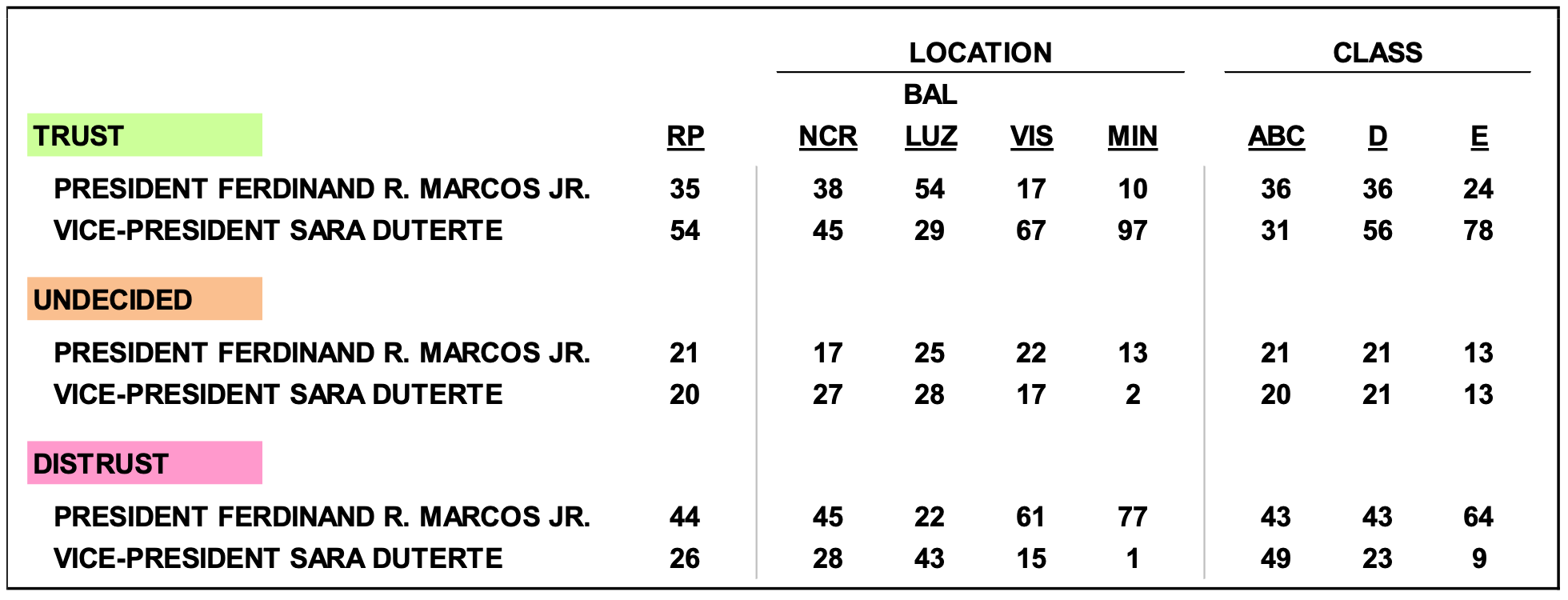
Most Visayans (67%), Mindanawons (97%), and those in Classes D and E (56% and 78%, respectively) trust the Vice-President. While the latter has a big plurality trust rating in Metro Manila (45%), she receives big plurality to near majority distrust ratings from those in the rest of Luzon (43%) and those in Class ABC (49%).
Overall public assessment of the performance and trustworthiness of the President and the Vice-President is essentially constant between December 2025 and March 2026 but notable changes occur year-on-year
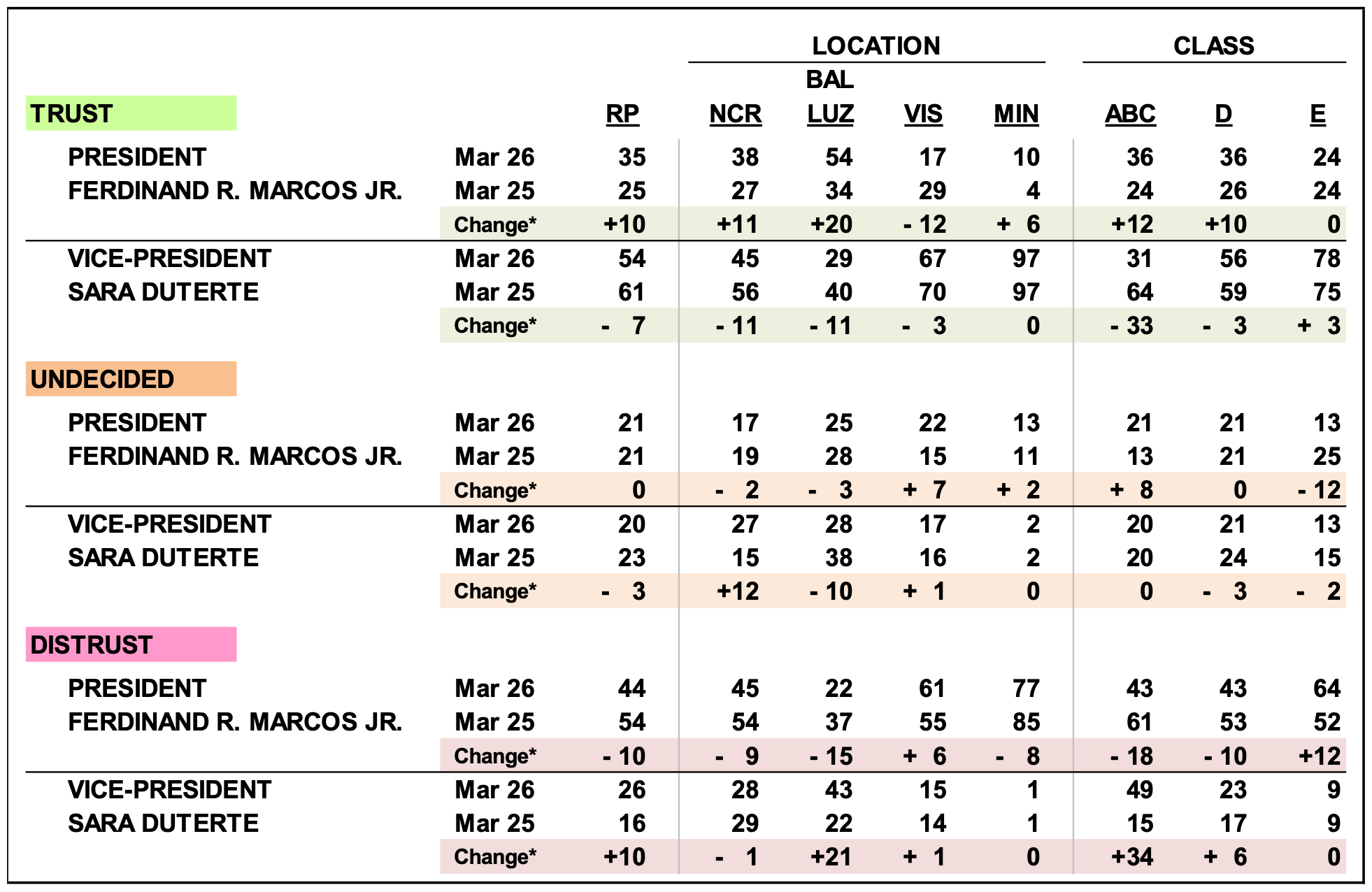
The March 2026 national performance and trust ratings of the President and the VicePresident do not differ significantly from the December 2025 figures. However, there are several marked movements between March 2025 and March 2026. The President’s overall approval rating goes up (+11 percentage points) while his disapproval score drops (-8 percentage points). As for the Vice-President, she experiences an increase in her disapproval figure (+11 percentage points) and a decrease in her indecision rating (-7 percentage points). Similarly, trust in the President becomes more notable year-on-year (+10 percentage points) while distrust in him eases (-10 percentage points). The reverse occurs in the case of the VicePresident, with distrust in her becoming more pronounced (+10 percentage points) while her trust rating drops (-7 percentage points). (Please refer to Tables 5 and 6.)
Table 5
COMPARATIVE PERFORMANCE RATINGS OF
PRESIDENT FERDINAND MARCOS JR. AND
VICE-PRESIDENT SARA DUTERTE (YEAR-ON-YEAR)
March 2025 and March 2026 / Philippines
(In Percent)
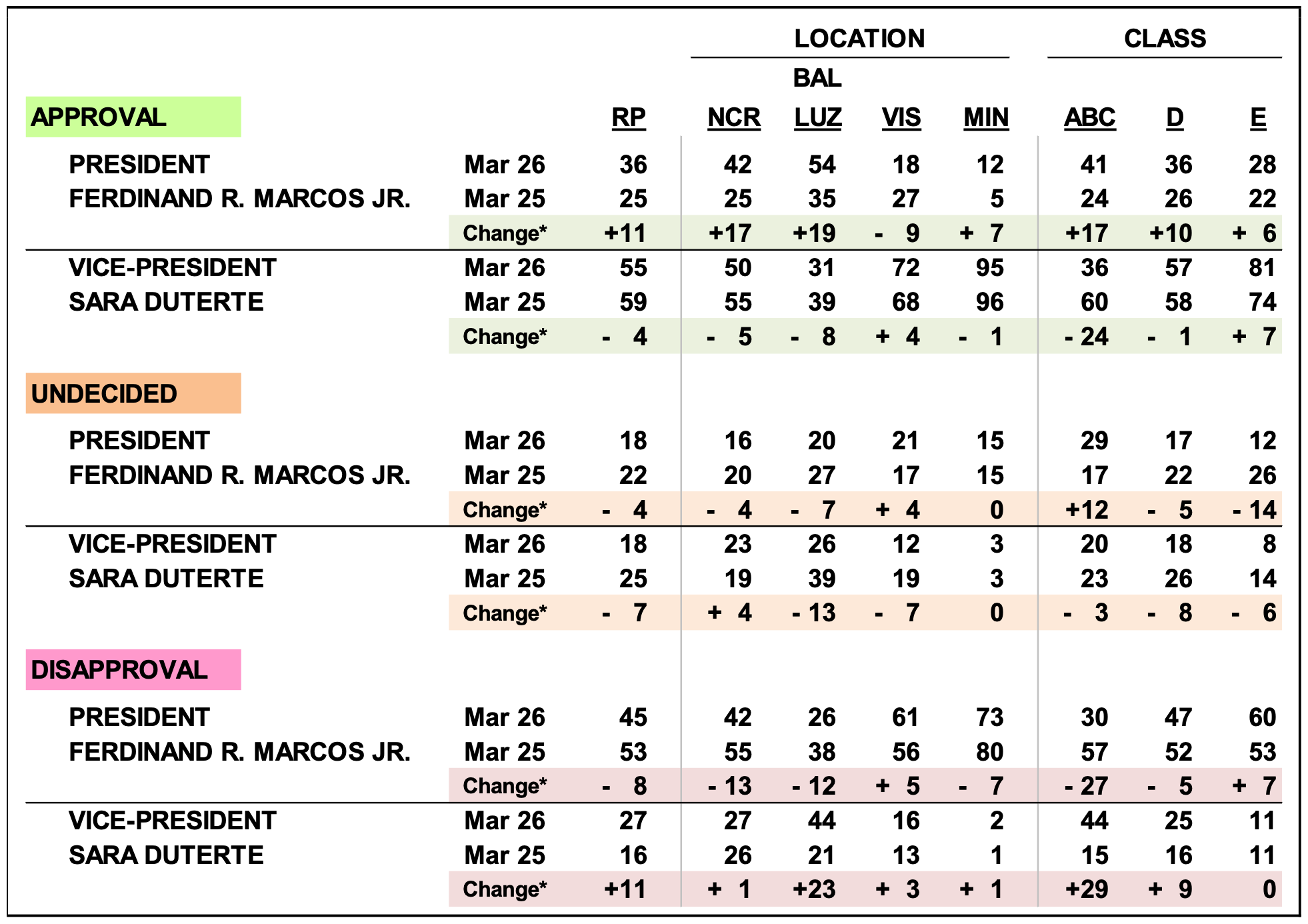
Table 6
COMPARATIVE TRUST RATINGS OF
PRESIDENT FERDINAND MARCOS JR. AND
VICE-PRESIDENT SARA DUTERTE (YEAR-ON-YEAR)
March 2025 and March 2026 / Philippines
(In Percent)
In the various areas and classes, a few changes are recorded between December 2025 and March 2026. Disapproval toward presidential performance becomes less manifest in
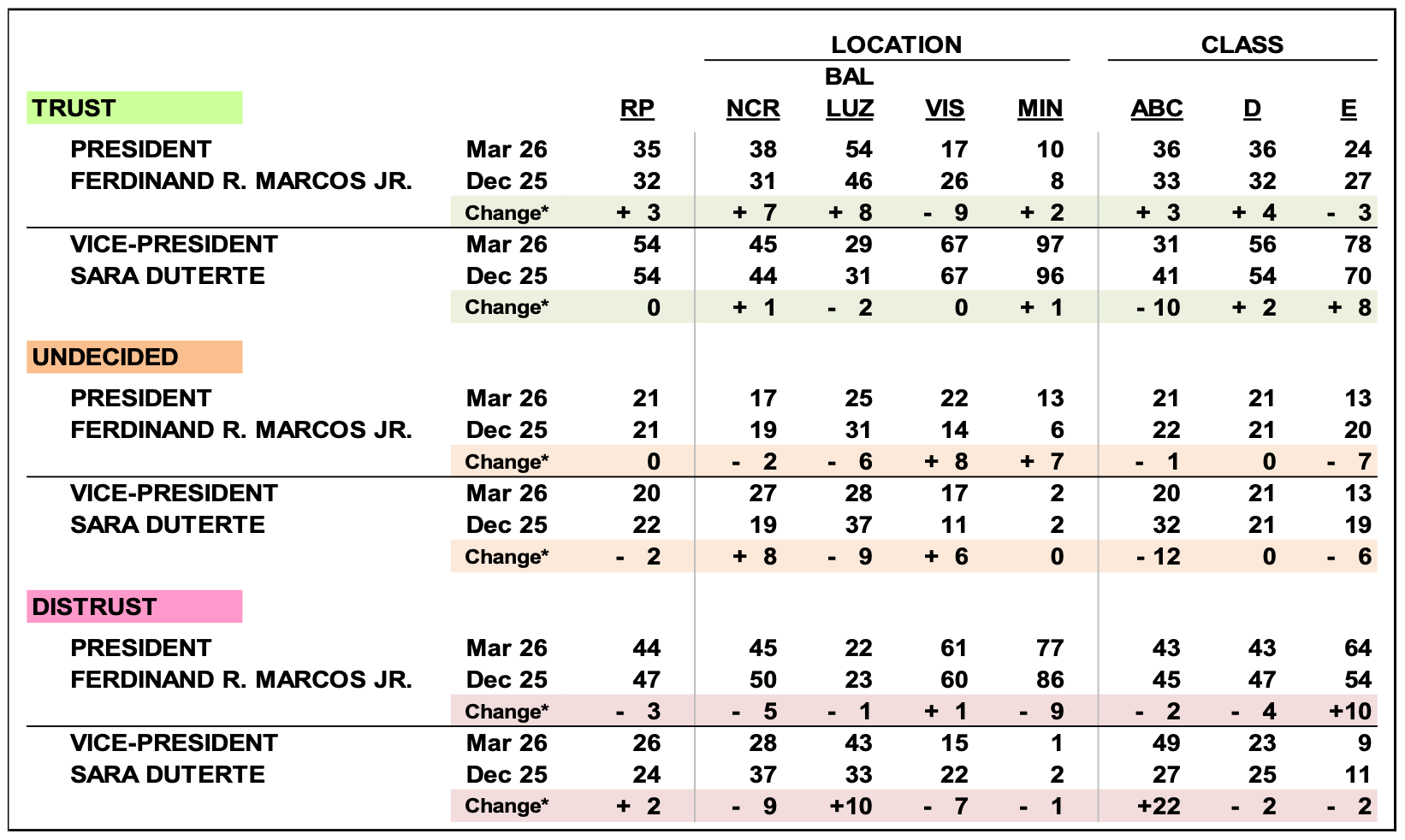
Mindanao (-12 percentage points). The Vice-President’s approval rating goes up in Class E (+20 percentage points) while indecision on the matter becomes less pronounced in the same subgrouping (-19 percentage points). As regards these government officials’ trustworthiness ratings, the only notable change during this period is the rise in the level of distrust in the Vice-President among those belonging to Class ABC (+22 percentage points). (Please refer to Tables 7 and 8.)
Table 7
COMPARATIVE PERFORMANCE RATINGS OF
PRESIDENT FERDINAND MARCOS JR. AND VICE-PRESIDENT SARA DUTERTE
December 2025 and March 2026 / Philippines
(In Percent)
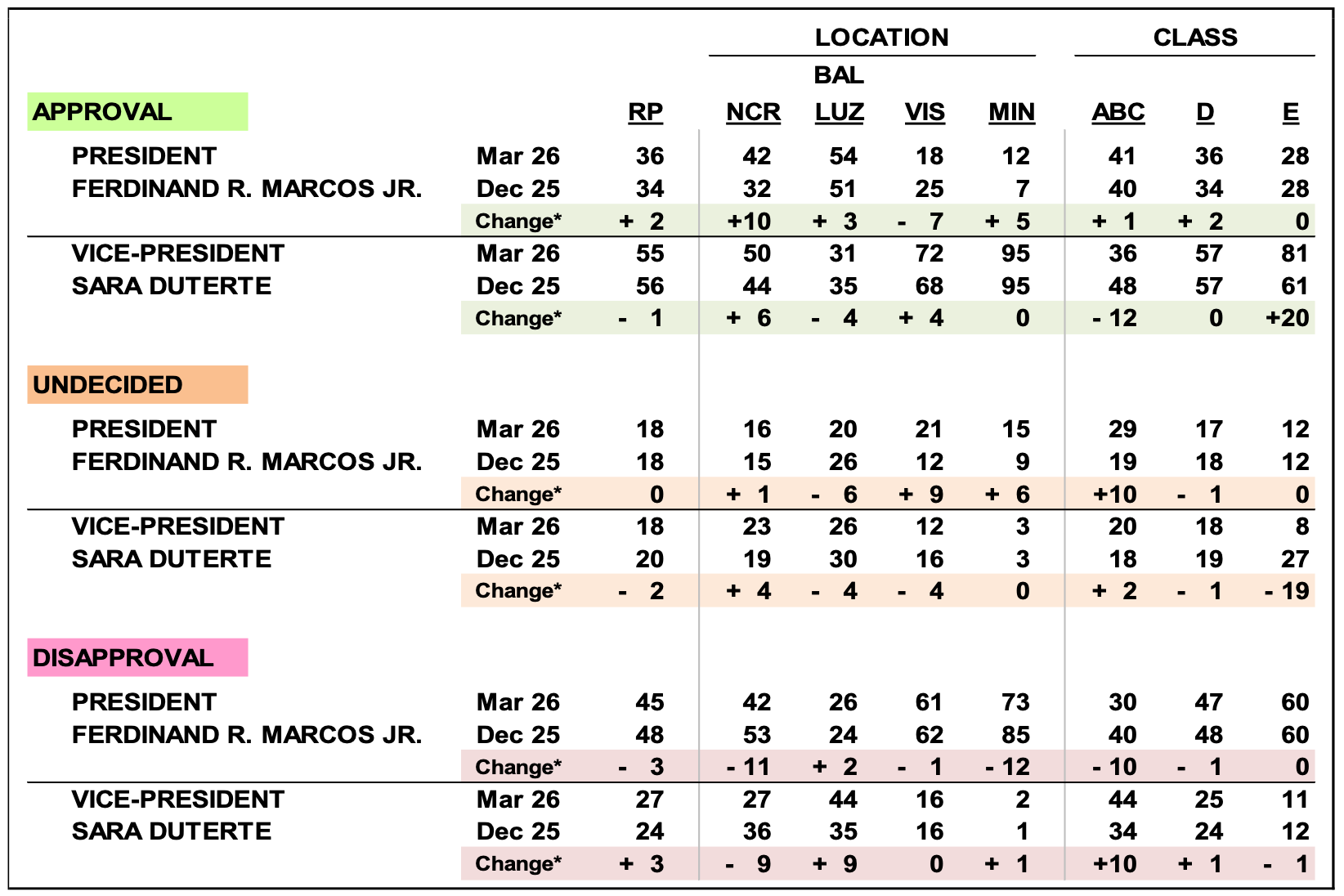
Table 8
COMPARATIVE TRUST RATINGS OF
PRESIDENT FERDINAND MARCOS JR. AND VICE-PRESIDENT SARA DUTERTE
December 2025 and March 2026 / Philippines
(In Percent)
Appreciation for the President’s work becomes more marked year-on-year in Metro Manila (+17 percentage point), the rest of Luzon (+19 percentage points), Class ABC (+17 percentage points), and Class D (+10 percentage points). On the other hand, the latter’s disapproval figures decrease in Metro Manila (-13 percentage points), the rest of Luzon (-12 percentage point), and Class ABC (-27 percentage points). (Please refer to Table 5.)
The only change in the Vice-President’s approval rating is recorded in Class ABC (-24 percentage points). Ambivalence toward the latter’s performance eases in the rest of Luzon (-13 percentage points) and Class D (-8 percentage points). Disapproval for the VicePresident’s work becomes more pronounced in the rest of Luzon (+23 percentage points), Class ABC (+29 percentage points), and Class D (+9 percentage points).
Levels of trust in the President go up year-on-year in the rest of Luzon (+20 percentage points) and Class D (+10 percentage points) while the reverse occurs in the Visayas (-12 percentage points). In terms of distrust in the President, it becomes less manifest in the rest of Luzon (-15 percentage points), Class ABC (-18 percentage points), and Class D (-10 percentage points). (Please refer to Table 6.)
From March 2025 to March 2026, the Vice-President experiences a drop in her trust ratings in the rest of Luzon (-11 percentage points) and Class ABC (-33 percentage points). While ambivalence toward the latter’s trustworthiness becomes more notable in Metro Manila (+12 percentage points), it eases in the rest of Luzon (-10 percentage points). Distrust figures go up in the rest of Luzon (+21 percentage points), Class ABC (+34 percentage points), and Class D (+6 percentage points).
The need to control inflation continues to be the leading urgent national concern of Filipinos (59%); the public’s sense of urgency across 18 selected issues is virtually unchanged between December 2025 and March 2026
A small majority of Filipino adults (59%) opine that the national administration should immediately take steps to control inflation. This is the top first- and second-mentioned urgent national concern in March 2026 (26% and 23%, respectively). Inflation is followed by graft and corruption in government (47%) and workers’ pay (36%). Corruption is the leading
Table 9
MOST URGENT NATIONAL CONCERNS
February 27 - March 2, 2026 / Philippines
(In Percent / Multiple Response, up to 3 allowed)
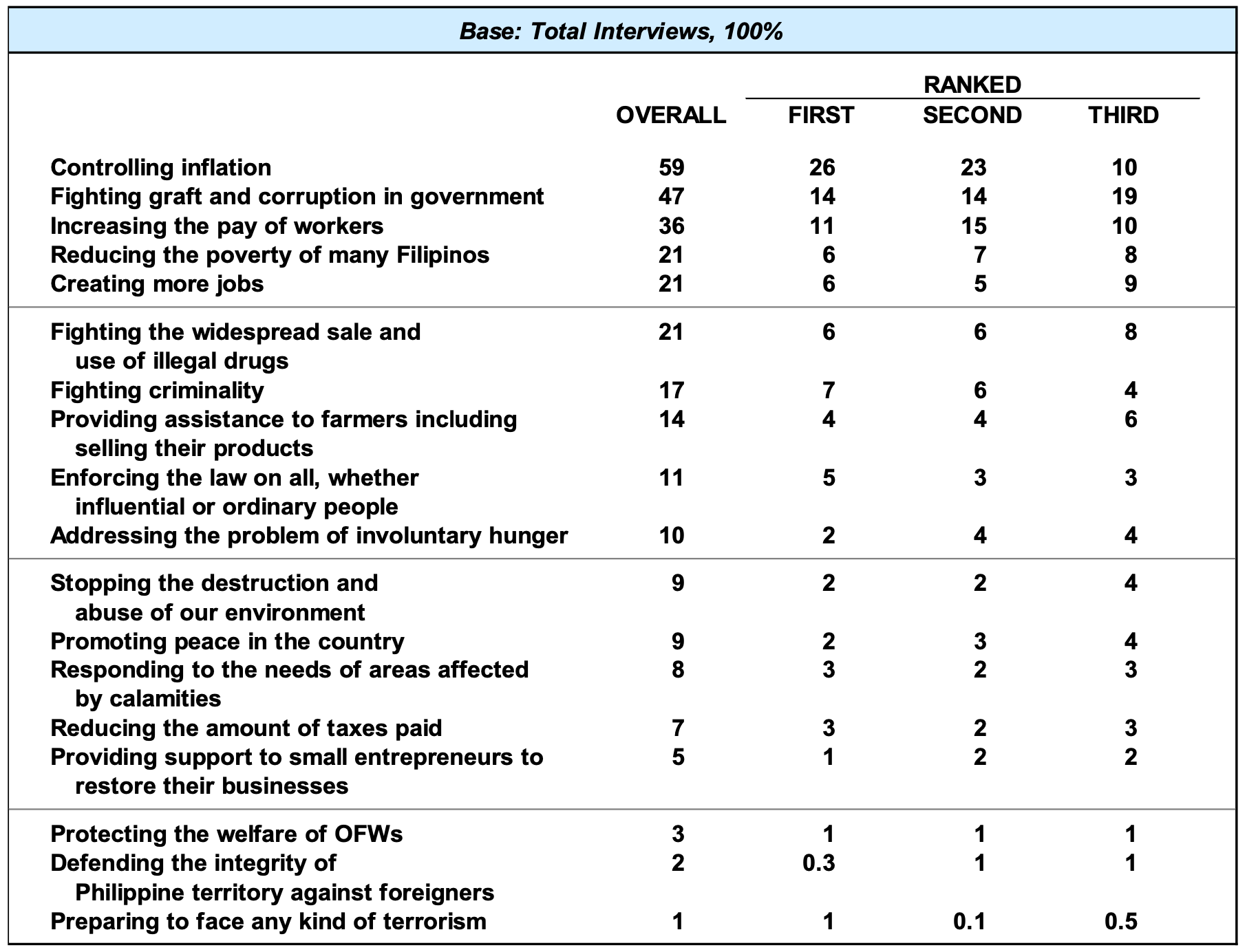
In fourth place is a group of urgent national concerns that includes reducing poverty (21%), creating more jobs (21%), fighting the sale and use of illegal drugs (21%), and fighting criminality (17%). Meanwhile, helping farmers (14%), enforcing the rule of law (11%), addressing the problem of involuntary hunger (10%), protecting the environment (9%), and promoting peace (9%) comprise another set of responses. On the other hand, Filipinos are least concerned about responding to the needs of calamity-hit areas (8%), reducing taxes (7%), helping small entrepreneurs (5%), protecting the welfare of overseas Filipino workers (3%), defending national territorial integrity (2%), and preparing to face terrorist threats (1%).
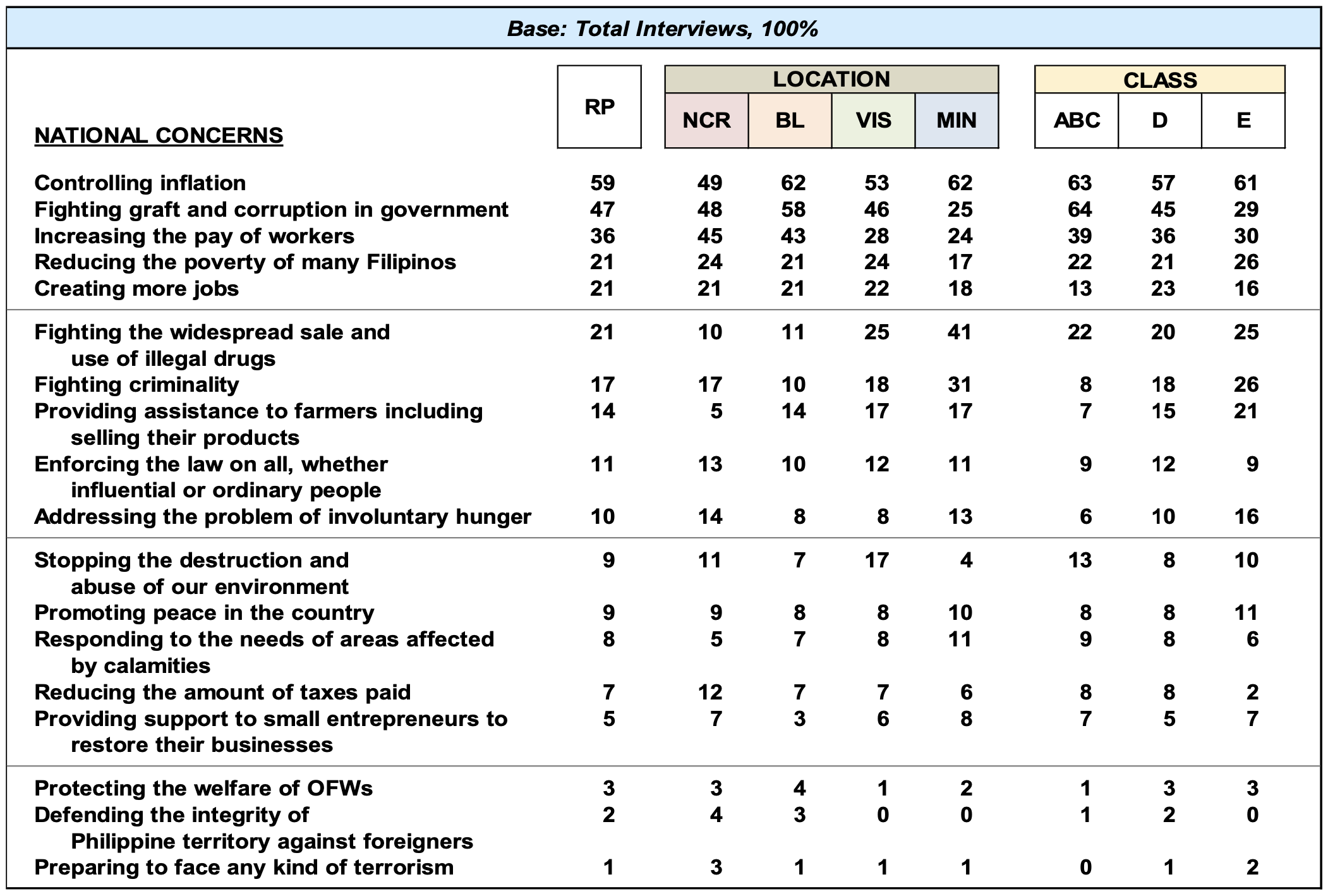
The only majority urgent national concerns across areas and classes are inflation (53% in the Visayas, 62% in the rest of Luzon and Mindanao, and 57% to 63% in all classes) and graft and corruption in government (58% in the rest of Luzon and 64% in Class ABC). On the other hand, the least often cited issues in the different geographic and socioeconomic subgroupings are welfare of overseas Filipino workers (1% to 4% and 1% to 3%, respectively), national territorial integrity (virtually nil to 4% and practically none to 2%, respectively), and terrorism (1% to 3% and almost nil to 2%, respectively). (Please refer to Table 10.)
Table 10
MOST URGENT NATIONAL CONCERNS: OVERALL
February 27 - March 2, 2026 / Philippines
(In Percent / Multiple Response, up to 3 allowed)
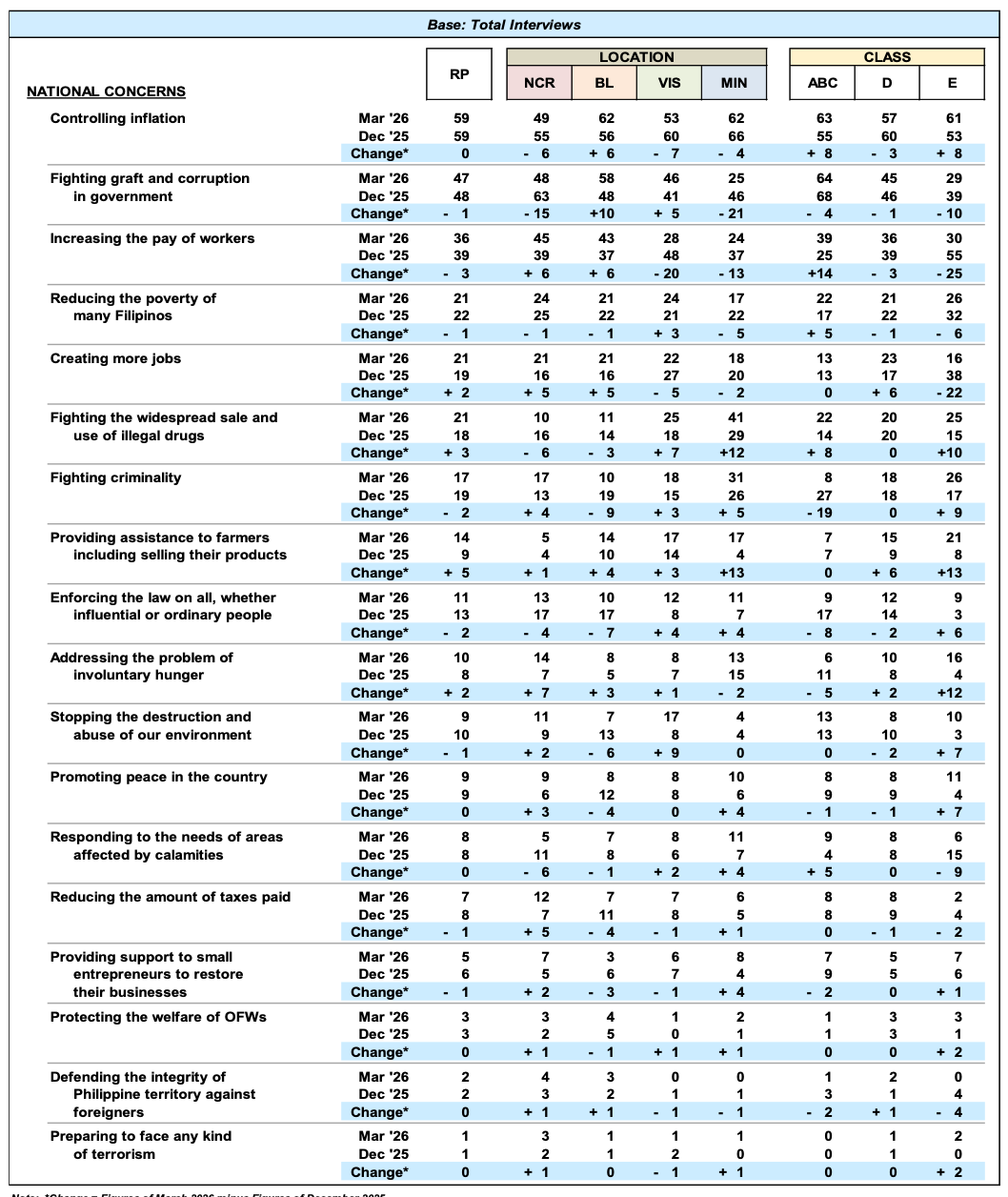
For the most part, the March 2026 figures do not differ markedly from those recorded in the December 2025 Ulat ng Bayan survey. This observation holds true at the national level as well as across areas and classes. The only exceptions are the: (1) increase in the levels of concern about dealing with the problem of illegal drugs and giving assistance to farmers among Mindanawons (+12 and +13 percentage points, respectively); (2) drop in Mindanao in the level of concern regarding corruption and workers’ pay (-21 and -13 percentage points, respectively); (3) decline in Metro Manilans’ sense of urgency as regards the need to fight corruption in government (-15 percentage points); (4) decrease in the level of concern about increasing the pay of workers as expressed by Visayans (-20 percentage points); (5) easing in the sense of urgency among those belonging to Class ABC as regards the need to fight criminality (-19 percentage points); and (6) erosion in Class E in the level of concern toward the need to increase workers’ pay and create more jobs (-25 and -22 percentage points, respectively). (Please refer to Table 11.)
Table 11
MOST URGENT NATIONAL CONCERNS
December 2025 and March 2026 / Philippines
(In Percent / Multiple Response, up to 3 allowed)
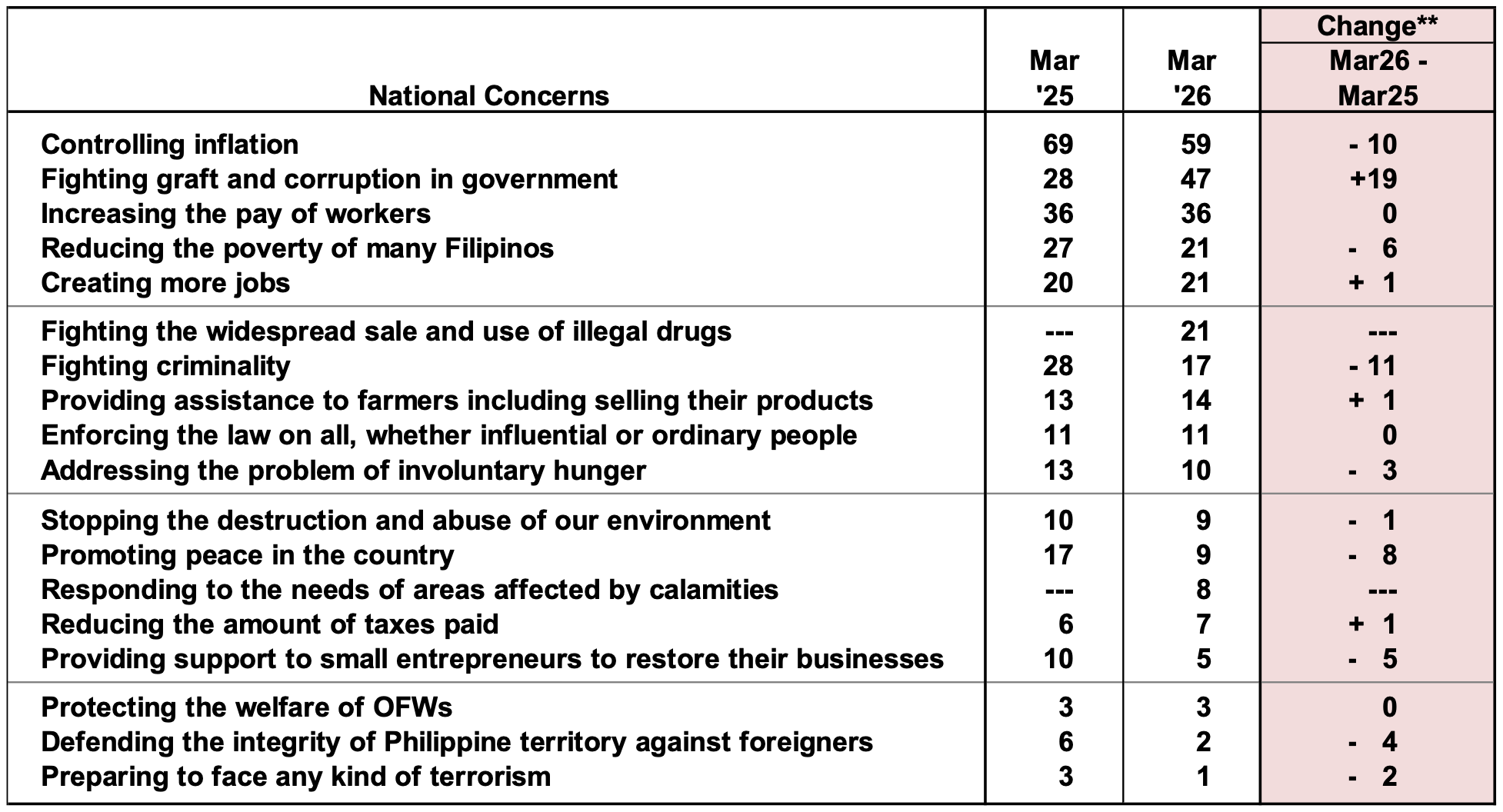
At the national level, it may be noted that from March 2025 to March 2026, Filipinos become more concerned about the issue of corruption in government (+19 percentage points). Conversely, the public’s sense of concern regarding the following issues become less notable during this period: (1) helping small entrepreneurs (-5 percentage points); (2) reducing poverty (-6 percentage points); (3) promoting peace (-8 percentage points); (4) controlling inflation (-10 percentage points); and (5) fighting criminality (-11 percentage points). (Please refer to Table 12.)
Table 12
MOST URGENT NATIONAL CONCERNS (YEAR-ON-YEAR)
March 2025 and March 2026 / Philippines
(In Percent / Multiple Response, up to 3 allowed)
The national administration scores its only majority approval rating for its work in protecting the welfare of overseas Filipino workers (53%); small to big majorities are critical of its efforts to reduce poverty (53%), fight corruption in government (67%), deal with the problem of illegal drugs (68%), and control inflation (73%)
Out of 18 issues on which the performance of the incumbent national administration is assessed by its constituents, it is only on the issue of protecting the welfare of overseas Filipino workers (OFWs) that a majority approval rating is recorded (53%). This is an issue considered as an urgent national concern by 3% of adults in the country. In contrast, most Filipino adults (73%) are critical of the administration’s handling of the only issue identified as an urgent national concern by a small majority of adults – controlling inflation (59%). Furthermore, majority disapproval ratings are also obtained by the administration on the issues of reducing poverty (53%), fighting corruption (67%), and fighting the widespread sale and use of illegal drugs (68%). These issues are deemed as urgent by 21% to 47% of the adult population. (Please refer to Table 13.)
Table 13
PERCEIVED URGENCY OF SELECTED NATIONAL ISSUES AND
THE NATIONAL ADMINISTRATION'S PERFORMANCE RATINGS
February 27 - March 2, 2026 / Philippines
(Row Percent)
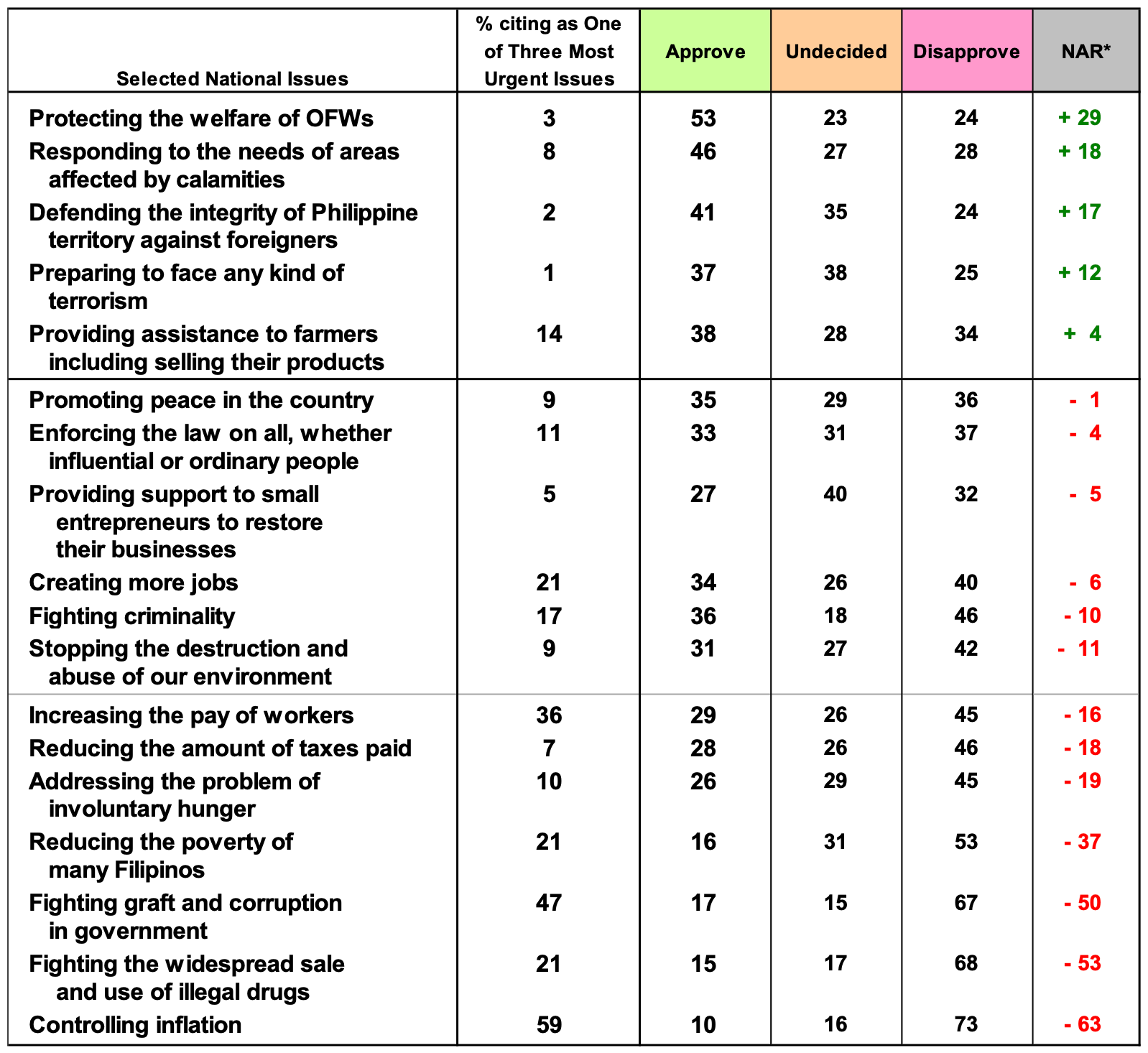
Big plurality to near majority approval figures are enjoyed by the administration on the issues of defending national territorial integrity (41%) and responding to the needs of calamity-hit areas (46%). Around the same approval and indecision ratings are posted on the issue of dealing with terrorist threats (37% versus 38%). Meanwhile, the present dispensation obtains virtually the same approval and disapproval ratings for its handling of three (3) issues, namely, helping farmers (38% versus 34%), promoting peace (35% versus 36%), and enforcing the rule of law (33% versus 37%).
While a big plurality of Filipino adults (40%) cannot say if they approve or disapprove of the administration’s initiatives to help small entrepreneurs restore their businesses, big pluralities to near majorities are critical of its work in creating more jobs (40%), protecting the environment (42%), increasing the pay of workers (45%), addressing the problem of involuntary hunger (45%), fighting criminality (46%), and reducing taxes (46%).
For the period December 2025 to March 2026, the only marked movements in the administration’s national performance ratings are recorded on six (6) issues. These are protecting the welfare of OFWs (+6 percentage points in disapproval), fighting criminality (-11 percentage points in indecision), enforcing the rule of law (-6 percentage points in indecision), protecting the environment (-10 percentage points in indecision and +7 percentage points in disapproval), increasing workers’ pay (-8 percentage points in approval and +6 percentage points in disapproval), and reducing taxes (-7 percentage points in indecision). (Please refer to Table 14.)
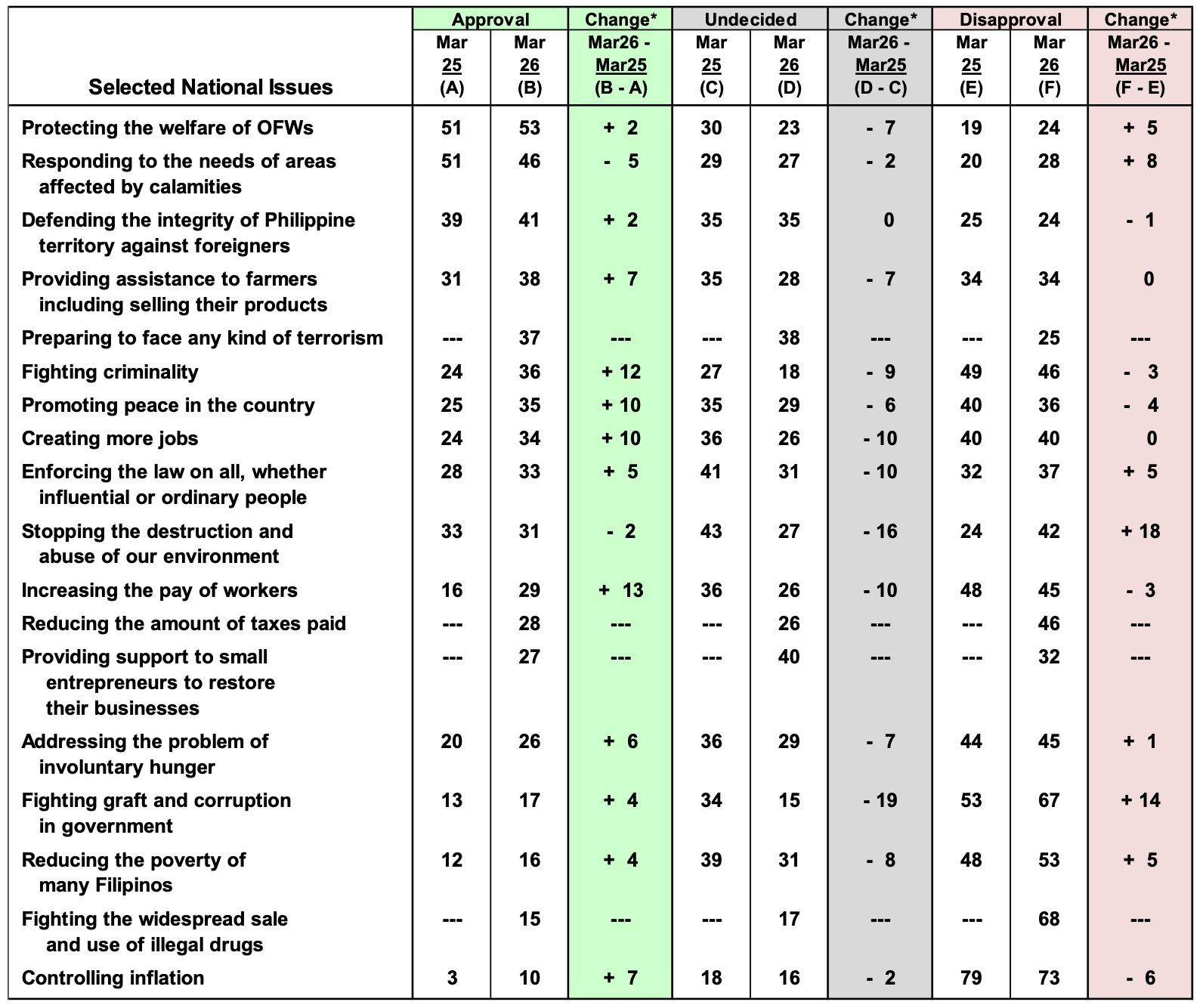
More significant changes in the administration’s overall performance ratings occur between March 2025 and March 2026. Approval for the latter’s handling of eight (8) issues becomes more manifest. These issues are: (1) rule of law (+5 percentage points); (2) involuntary hunger (+6 percentage points); (3) inflation (+7 percentage points); (4) agricultural assistance (+7 percentage points); (5) peace (+10 percentage points); (6) jobs (+10 percentage points); (7) criminality (+12 percentage points); and (8) workers’ pay (+13 percentage points). (Please refer to Table 15.)
On the other hand, levels of disapproval for the administration’s work rise on the issues of welfare of OFWs (+5 percentage points), rule of law (+5 percentage points), poverty (+5 percentage points), disaster response (+8 percentage points), corruption in government (+14 percentage points), and environmental destruction (+18 percentage points). On the issue of inflation, disapproval eases (-6 percentage points).
Regarding ambivalence toward the administration’s performance, it becomes less pronounced year-on-year on 11 issues (out of 14 issues for which comparative data are available), with changes ranging from -6 percentage points on the issue of peace promotion to -19 percentage points on the issue of corruption in government.[1]
[1] Comparative data for the period March 2025 to March 2026 are not available for four (4) issues because these are not included in the March 2025 survey’s national administration performance probe – terrorism, taxes, agricultural assistance, and illegal drugs.
Table 14
COMPARATIVE PERFORMANCE RATINGS OF THE NATIONAL
ADMINISTRATION ON SELECTED NATIONAL ISSUES
December 2025 and March 2026 / Philippines
(In Percent)
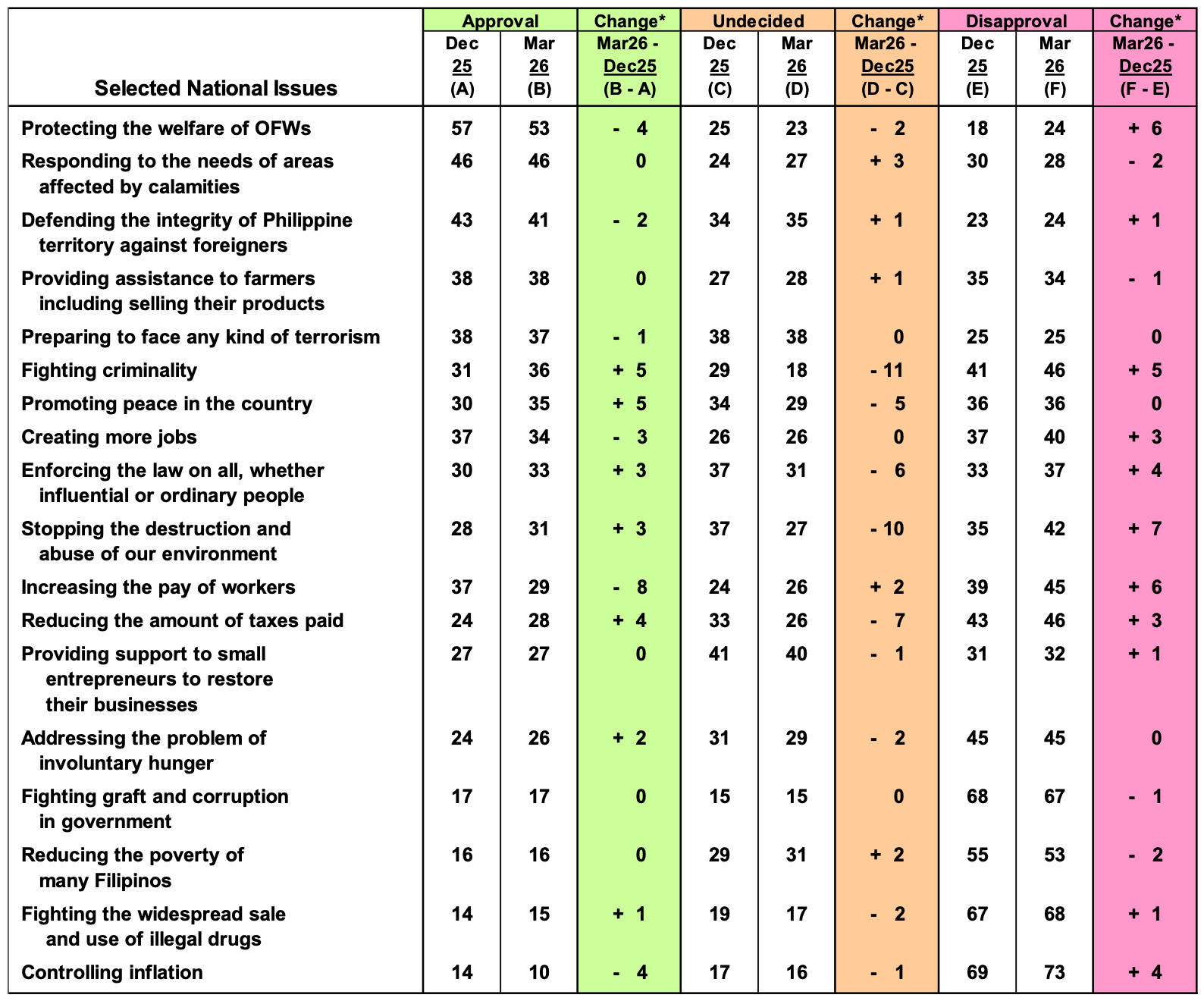
Table 15
COMPARATIVE PERFORMANCE RATINGS OF THE NATIONAL
ADMINISTRATION ON SELECTED NATIONAL ISSUES (YEAR-ON-YEAR)
March 2025 and March 2026 / Philippines
(In Percent)
If you liked what you just read and want more of Our Brew, subscribe to get notified. Just enter your email below.
Related Posts
Social Weather Report | 83% of Filipinos say a woman’s role is to look after the home and family; Public opinion on the role of women has been conservative for many years
Mar 06, 2026
The ICC Case against Rodrigo Duterte: Questions and Answers
Feb 18, 2026
‘Record-low’ 46% of Filipino Adults ‘Very Happy’ With Love Life - SWS
Feb 13, 2026