

By Pulse Asia
Most Filipino adults (85%) are internet users, with eight (8) in 10 of them (80%) going online more than once a day; these figures do not differ significantly from those recorded by Pulse Asia Research in March 2026
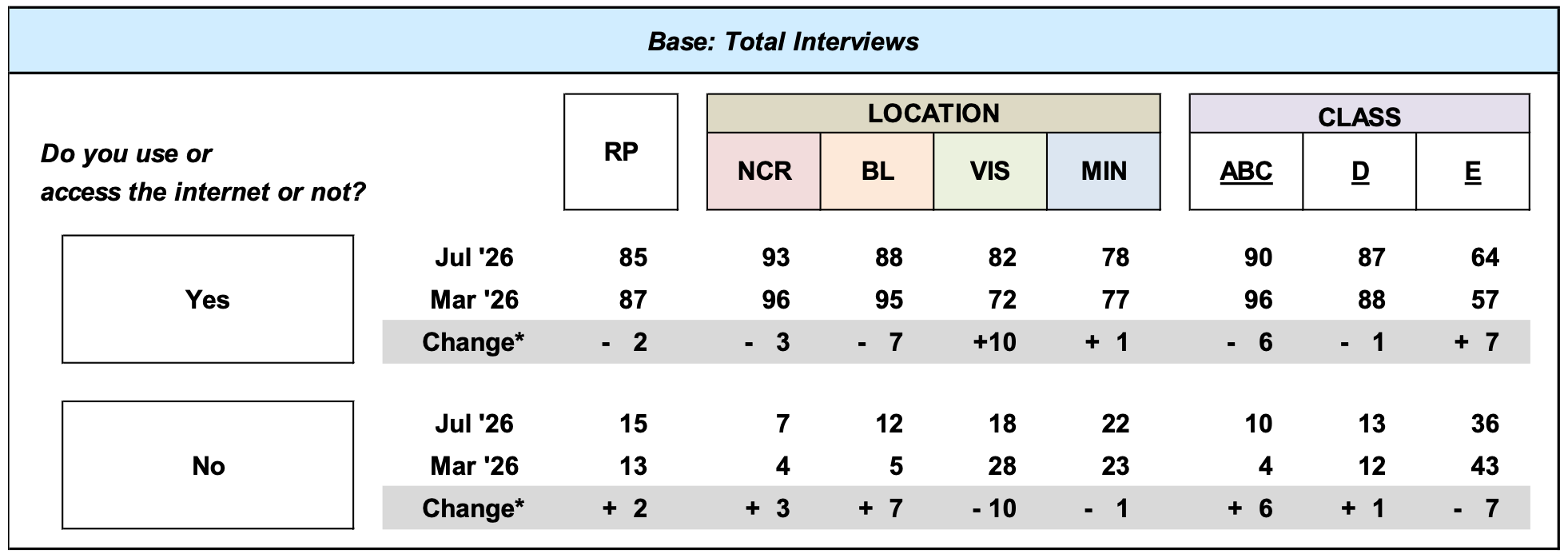
A huge majority of the adult population (85%) reports using the internet, with most adults in every area and class being internet users (78% to 93% and 64% to 90%, respectively). From March 2026 to July 2026, the only notable change in internet usage may be observed in the Visayas (+10 percentage points). (Please refer to Table 1.)
Table 1
INTERNET USE
March and July 2026 / Philippines
(In Percent)
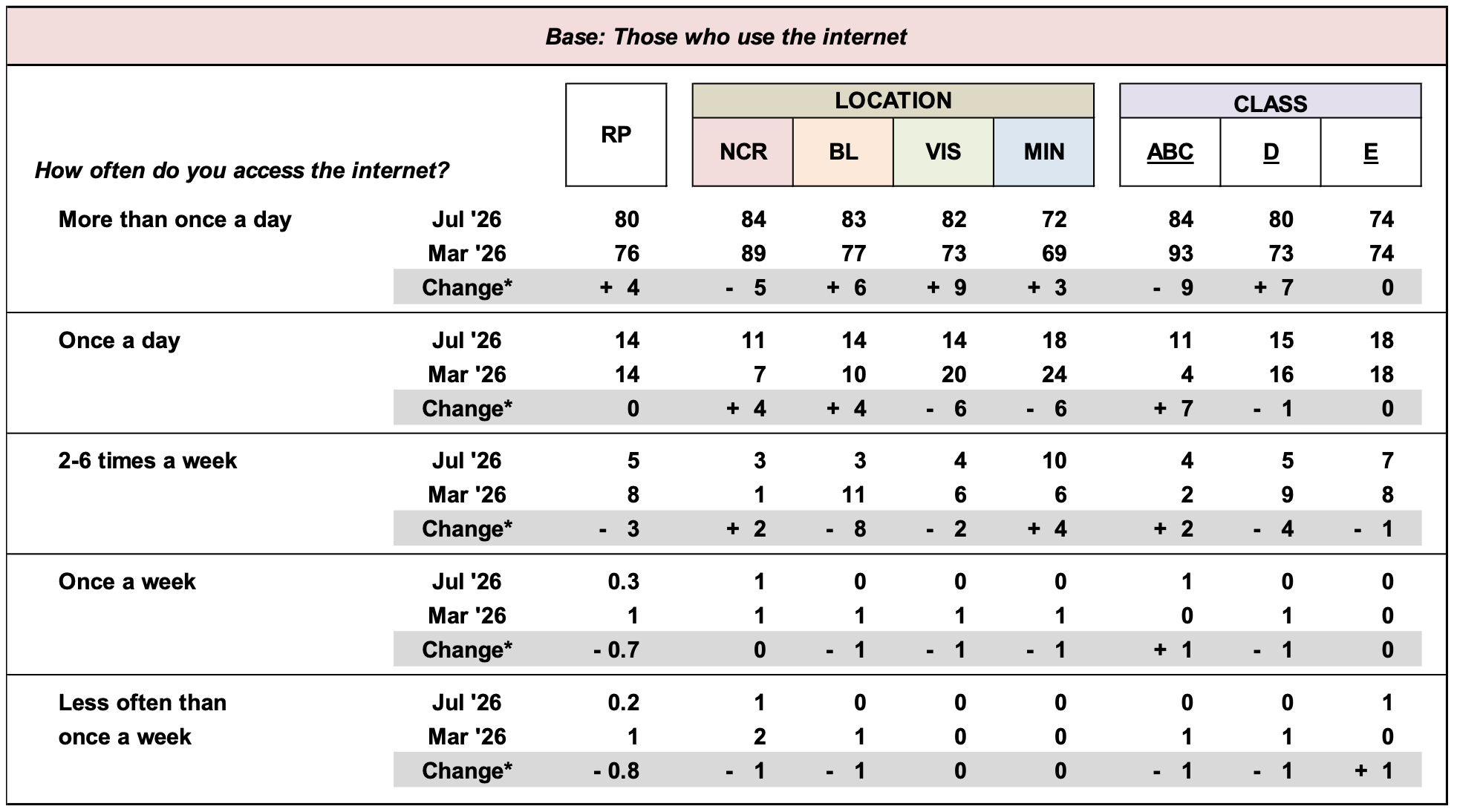
Among internet users, 80% access the internet more than once daily. The same is reported by big majorities across geographic and socioeconomic subgroupings (72% to 84% and 74% to 84%, respectively). Between March 2026 and July 2026, there is an increase in the percentage of those belonging to Class D who go online more than once a day (+7 percentage points). Meanwhile, the rest of internet users access the web once a day (14%), twice to six (6) times a week (5%), once a week (0.3%), or less often than once a week (0.2%). (Please refer to Table 2.)
Table 2
FREQUENCY OF INTERNET USE
March and July 2026 / Philippines
(In Percent)
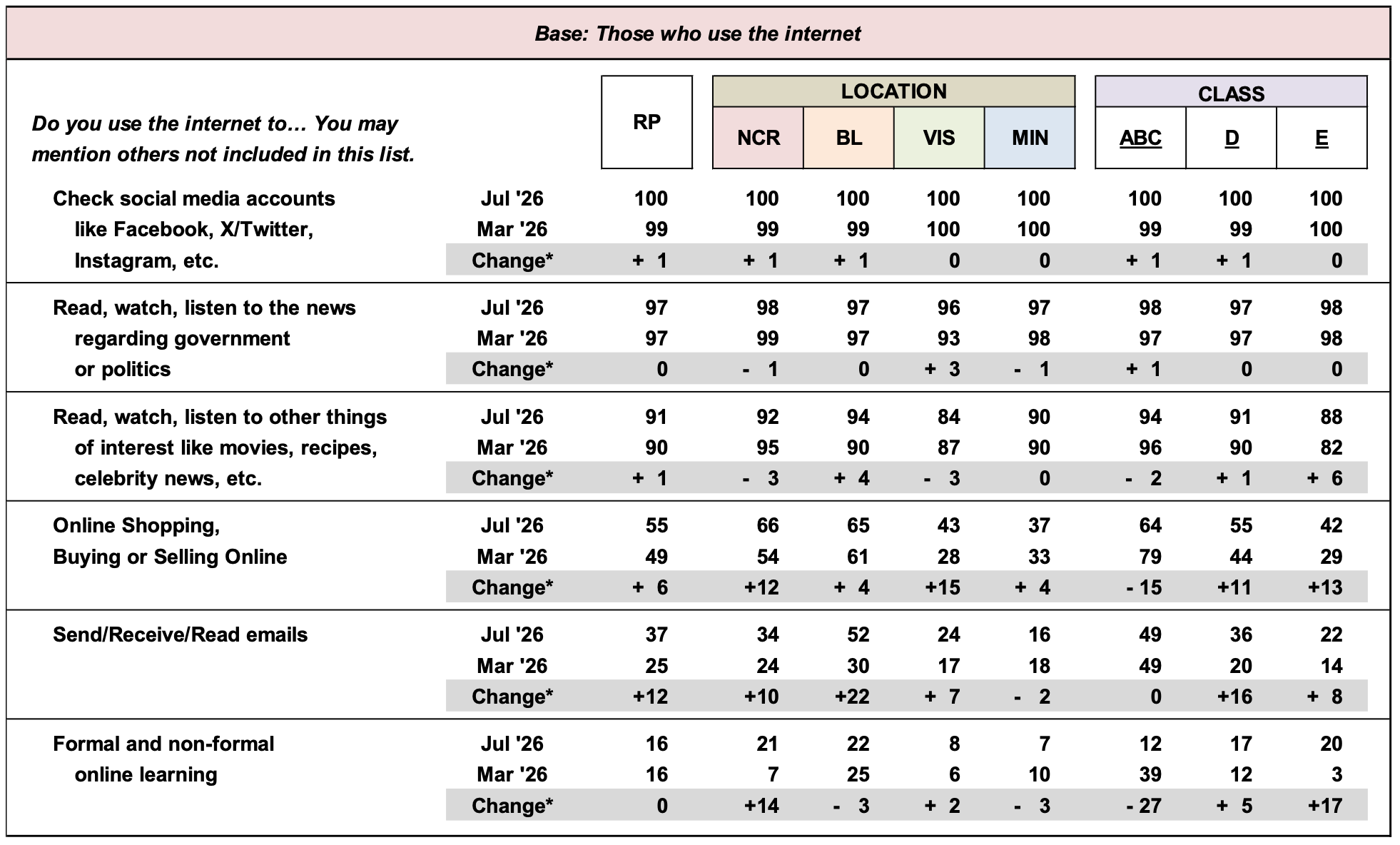
Use of the internet to check social media accounts is virtually universal (100%); quarter-toquarter, the percentages of internet users who go online to buy/sell or send/receive/read electronic mail go up (+6 and +12 percentage points, respectively)
In addition to checking one’s social media accounts, the other purposes for using the internet mentioned by most internet users in the Philippines are reading, watching, and/or listening either to political news (97%) or other things of interest to them (91%), and online buying and/or selling (55%). A little more than a third of internet users (37%) go online to send, receive, and/or read emails while less than a fifth (16%) use it for formal and/or non-formal learning. (Please refer to Table 3.)
In the various areas and classes, essentially all internet users access the web to check their social media accounts (all at 100%). Nearly every internet user across these same subgroupings go online to read, watch, and/or listen either to political news (96% to 98% and 97% to 98%, respectively) or to other things that interest them (84% to 94% and 88% to 94%, respectively). The only other activity reported by most internet users is online buying and/or selling (i.e., 66% in Metro Manila, 65% in the rest of Luzon, 64% in Class ABC, and 55% in Class D).
During the period March 2026 to July 2026, the following movements may be noted at the national level and in the different areas and classes:
1. online buying and/or selling — +6 percentage points in the Philippines, +12 percentage points in Metro Manila, +15 percentage points in the Visayas, +11 percentage points in Class D, and -15 percentage points in Class ABC;
2. sending, receiving, and/or reading emails — +12 percentage points in the Philippines, +10 percentage points in Metro Manila, +22 percentage points in the rest of Luzon, and +16 percentage points in Class D; and
3. formal and/or non-formal learning — +14 percentage points in Metro Manila, +17 percentage points in Class E, and -27 percentage points in Class ABC.
Table 3
PURPOSES FOR USING THE INTERNET
March and July 2026 / Philippines
(In Percent)
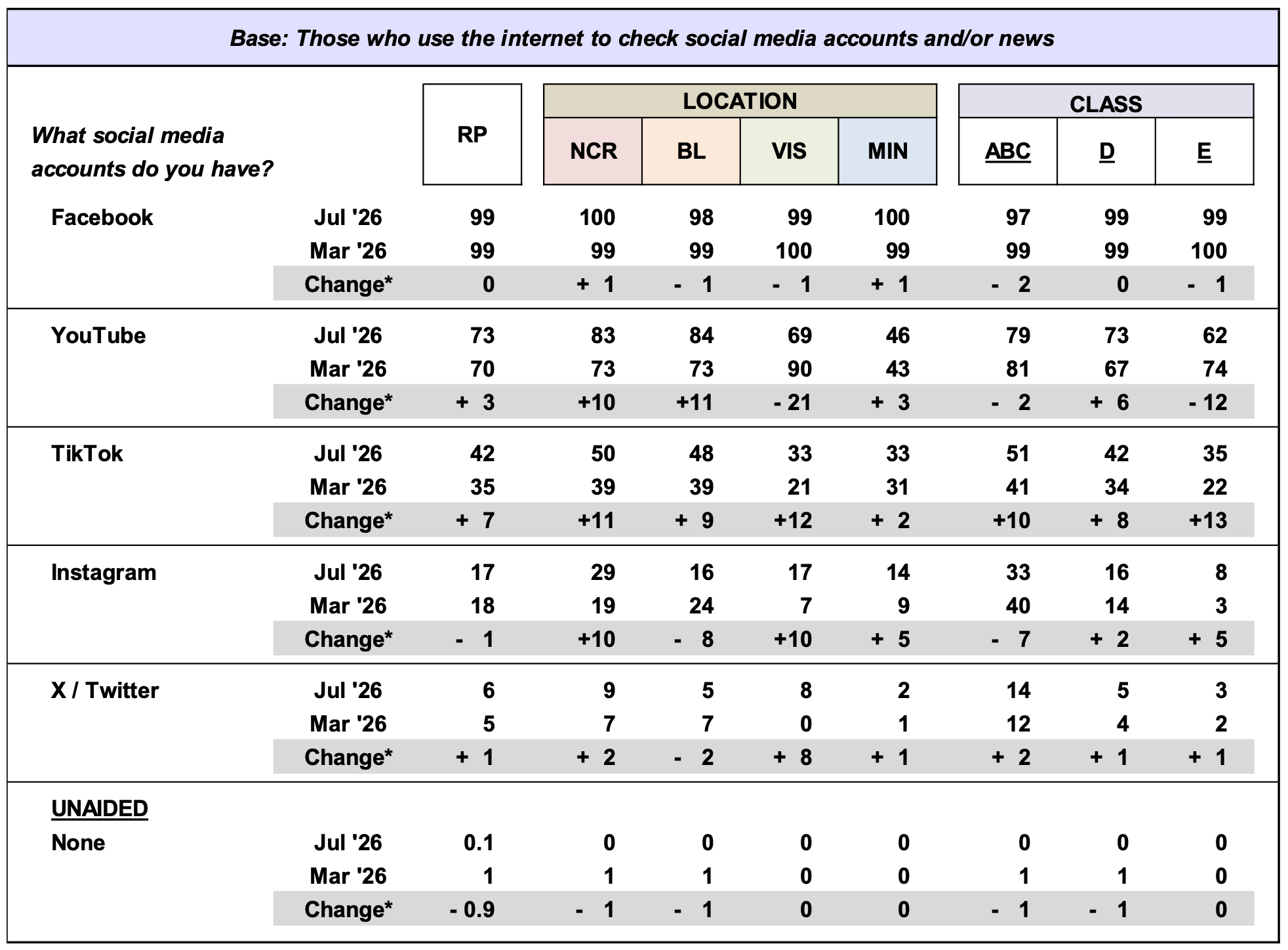
Practically all Filipino internet users (99%) are on Facebook while most have a YouTube account (73%); overall, the only marked movement in social media account ownership between March 2026 and July 2026 is the rise in self-reported ownership of a TikTok account (+7 percentage points)
Facebook continues to top the list of social media accounts that internet users in the country have (99%), with ownership being basically universal across areas and classes (98% to 100% and 97% to 99%, respectively). Meanwhile, around three-fourths of internet users (73%) have a YouTube account, with majority figures also being recorded in most areas and all classes (69% to 84% and 62% to 79%, respectively). At the national level, the other social media accounts of internet users are TikTok (42%), Instagram (17%), and X/Twitter (6%). Aside from Facebook and YouTube, TikTok is the only other social media account owned by a majority in any subgrouping (i.e., 51% in Class ABC). (Please refer to Table 4.)
Table 4
OWNERSHIP OF SOCIAL MEDIA ACCOUNTS
March and July 2026 / Philippines
(In Percent)
Some changes from March 2026 to July 2026 across geographic and socioeconomic subgroupings are the following:
1. YouTube — +10 percentage points in Metro Manila, +11 percentage points in the rest of Luzon, +6 percentage points in Class D, and -21 percentage points in the Visayas;
2. TikTok — +11 percentage points in Metro Manila, +12 percentage points in the Visayas, and +8 percentage points in Class D; and
3. Instagram — +10 percentage points in Metro Manila and the Visayas.
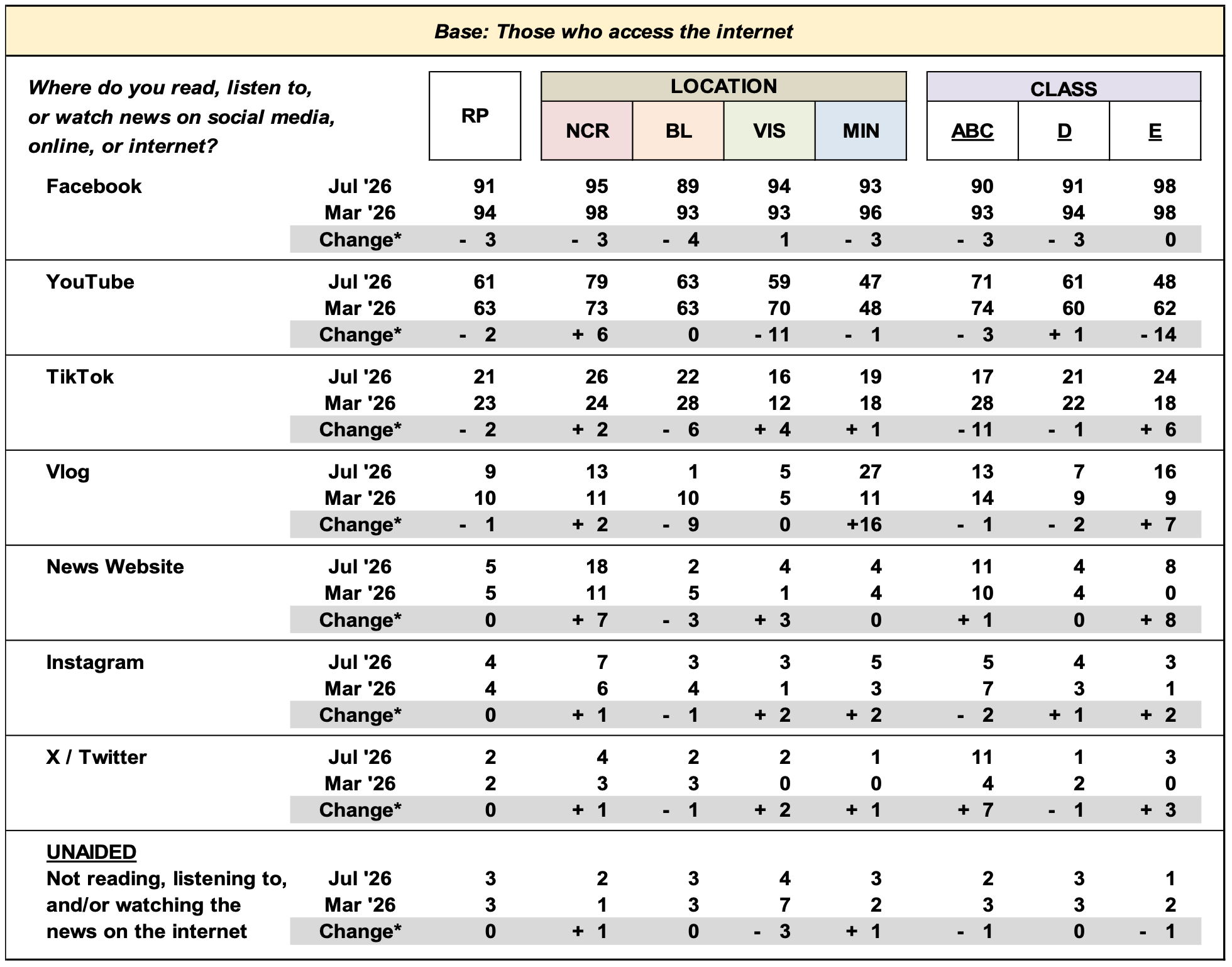
Facebook is the leading online source of news of internet users (91%), with YouTube a distant second (61%); national figures are constant from March 2026 to July 2026
Just as nearly all internet users have a Facebook account (99%), this platform is also their most often cited online news source (91%). A sizeable majority of internet users (61%) get their online news from YouTube. Other online sources of news in the Philippines are TikTok (21%), vlogs (9%), news websites (5%), Instagram (4%), and X/Twitter (2%). The rest of internet users (3%) do not read, listen to, and/or watch online news. These figures do not differ significantly from those recorded in March 2026. (Please refer to Table 5.)
Facebook is the online news source of most, if not nearly all, internet users across the different areas and classes (89% to 95% and 90% to 98%, respectively). As for YouTube, it is also mentioned by small to huge majorities in most areas and classes (59% to 79% and 61% to 71%, respectively). The only marked movements from March 2026 to July 2026 are the decrease in the percentage of Visayans citing YouTube (-11 percentage points) and the rise in the percentage of Mindanawons getting their online news from vlogs (+16 percentage points).
Table 5
SOURCES OF ONLINE NEWS
March and July 2026 / Philippines
(In Percent)
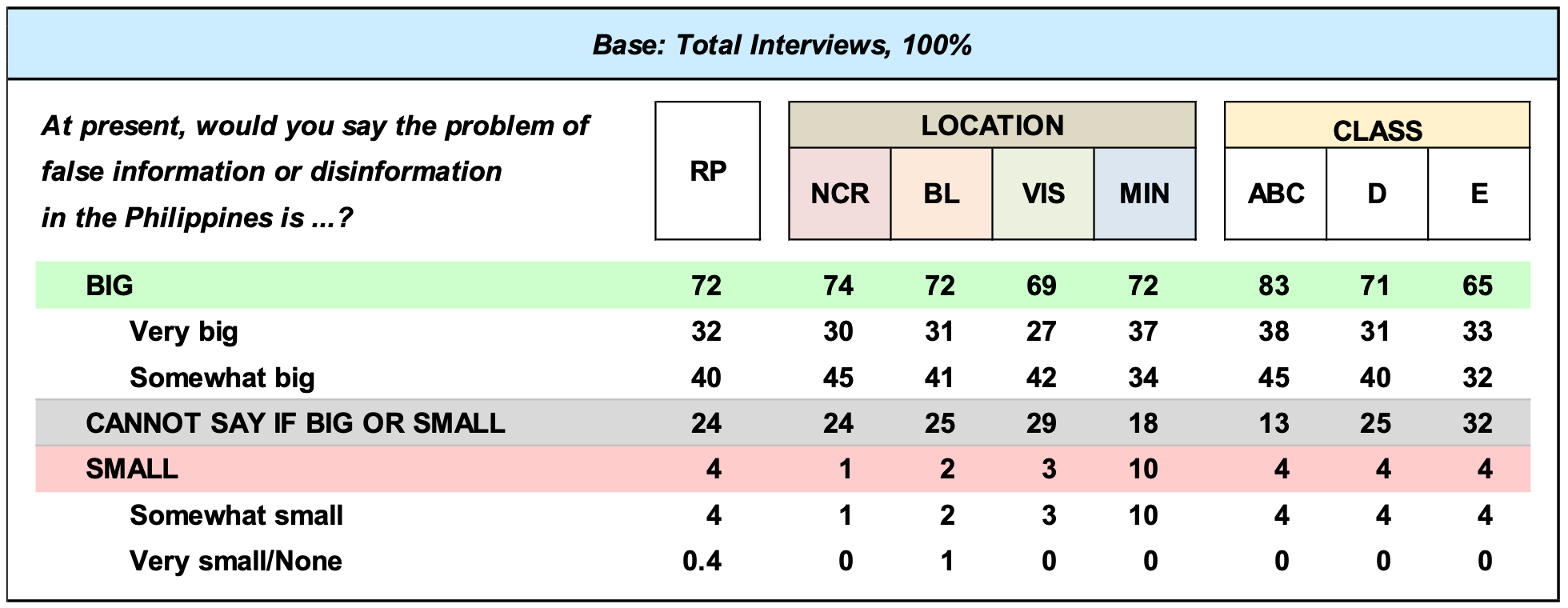
Almost three-fourths of Filipino adults (72%) consider disinformation a big problem in the country
The spread of false information is a big problem in the Philippines, according to 72% of adults. This sentiment is shared by majorities in every area and class (69% to 74% and 65% to 83%, respectively). Nearly a quarter of the adult population (24%) expresses indecision on the matter while less than a tenth (4%) are of the view that disinformation is only a small problem. (Please refer to Table 6.)
Table 6
SEVERITY OF FALSE INFORMATION OR
DISINFORMATION IN THE PHILIPPINES
June 28 - July 3, 6, 2026 / Philippines / PR1&2
(In Percent)
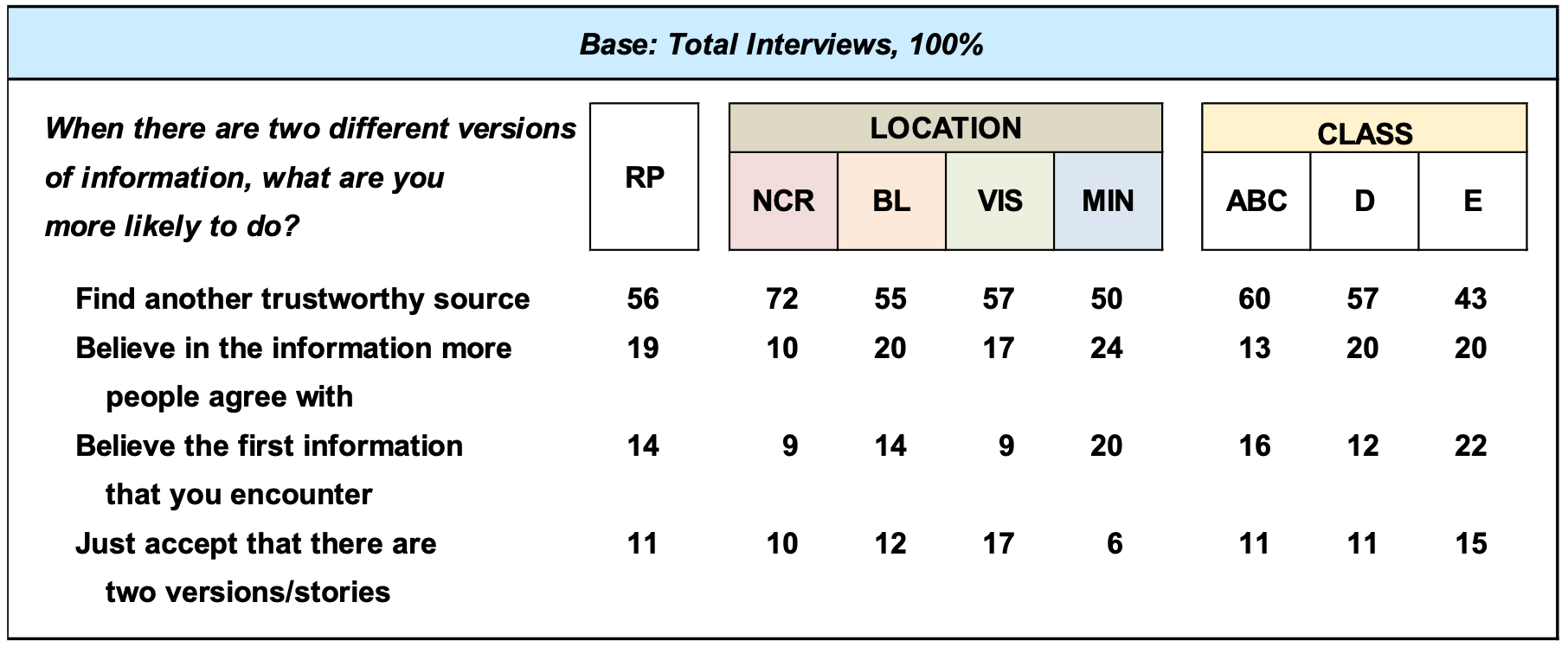
A small majority (56%) would find another trustworthy source to verify which of two (2) different versions of information is true
Out of four (4) options, most adults (56%) opt to find a trustworthy source to determine which of varying versions of a piece of information is correct. Big pluralities to huge majorities across areas and classes echo this view (50% to 72% and 43% to 60%, respectively). (Please refer to Table 7.)
At the national level, the other options preferred by Filipino adults are to believe the information most people agree with (19%), believe the first information they encounter (14%), and simply accept that there are always two (2) sides to every story (11%).
Table 7
INFORMATION VERIFICATION PRACTICES
June 28 - July 3, 6, 2026 / Philippines / PR1&2
(In Percent)
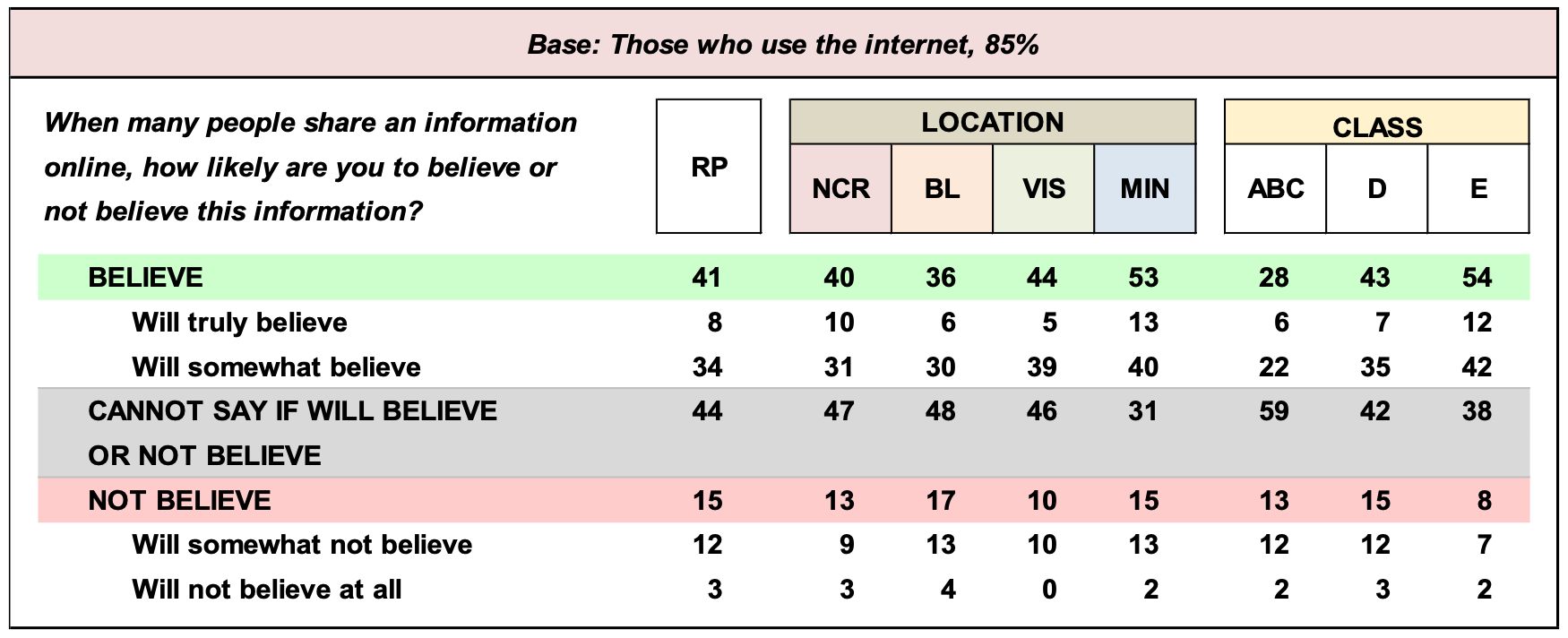
About the same percentages of internet users will either believe a piece of online information shared by many people (41%) or express indecision on the matter (44%)
While 41% of Filipino adults who access the web are inclined to believe something they encounter online that is shared by many people, 44% cannot say if they will believe or not believe such a piece of information. The same pattern of public opinion may be observed in Metro Manila (40% versus 47%), the Visayas (44% versus 46%), and Class D (43% versus 42%). The predominant sentiment in Mindanao (53%) and Class E (54%) is one of believability of such information while near to small majorities in the rest of Luzon (48%) and Class ABC (59%) are ambivalent on the matter. (Please refer to Table 8.)
Table 8
BELIEVABILITY OF WIDELY SHARED ONLINE INFORMATION
June 28 - July 3, 6, 2026 / Philippines / PR1&2
(In Percent)
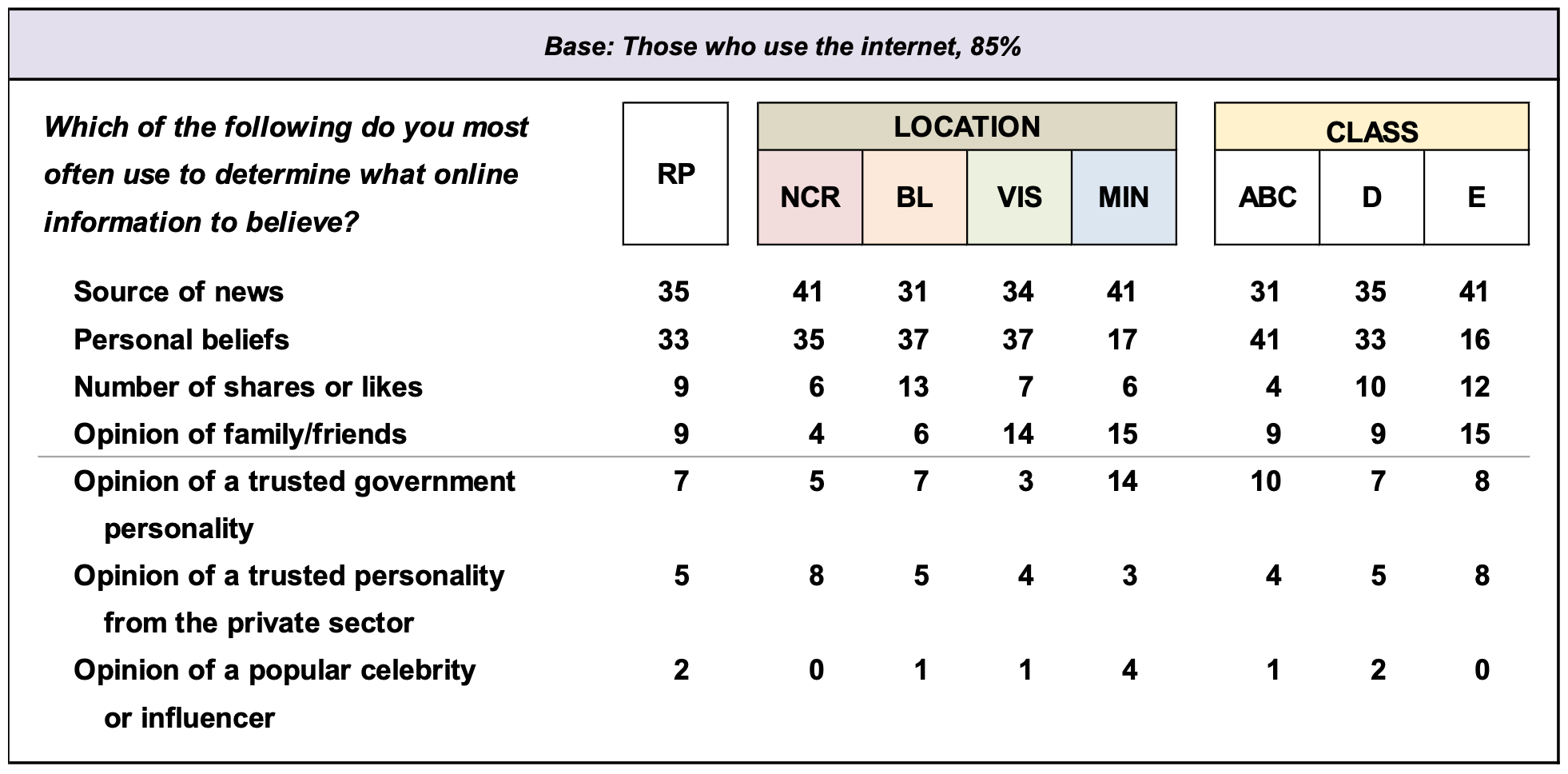
A third of Filipino adults who access the web use either the source of news (35%) or their personal beliefs (33%) as a guide to determine which online information to believe
When they come across conflicting pieces of online information, essentially the same percentages of Filipino internet users determine which piece of information to believe based on either the source of such information (35%) or their own beliefs about an issue (33%) – a pattern that also exists in Metro Manila (41% versus 35%), the rest of Luzon (31% versus 37%), the Visayas (34% versus 37%), Class ABC (31% versus 41%), and Class D (35% versus 33%). Big pluralities in Mindanao and Class E (both at 41%) cite source of news as the means by which they decide which piece of online information to believe. (Please refer to Table 9.)
Overall, the other options mentioned by internet users are number of shares or likes (9%), opinion of their relatives and/or friends (9%), opinion of a trusted government personality (7%), opinion of a trusted personality from the private sector (5%), and opinion of a popular celebrity or influencer (2%).
Table 9
MOST OFTEN MEANS TO DETERMINE WHAT ONLINE INFORMATION TO BELIEVE
June 28 - July 3, 6, 2026 / Philippines / PR1&2
(In Percent)
If you liked what you just read and want more of Our Brew, subscribe to get notified. Just enter your email below.
Related Posts
Meralco Nears Full Power Restoration
Sep 02, 2026
When a Mountain Falls: How Ice and Rock Triggered Nepal’s Catastrophic Flood – And Why Climate Change is Raising the Risks
Sep 01, 2026
Lower Meralco Rates This August
Aug 16, 2026