

By Pulse Asia
A big majority of Filipino adults (89%) is interested in the May 2028 elections
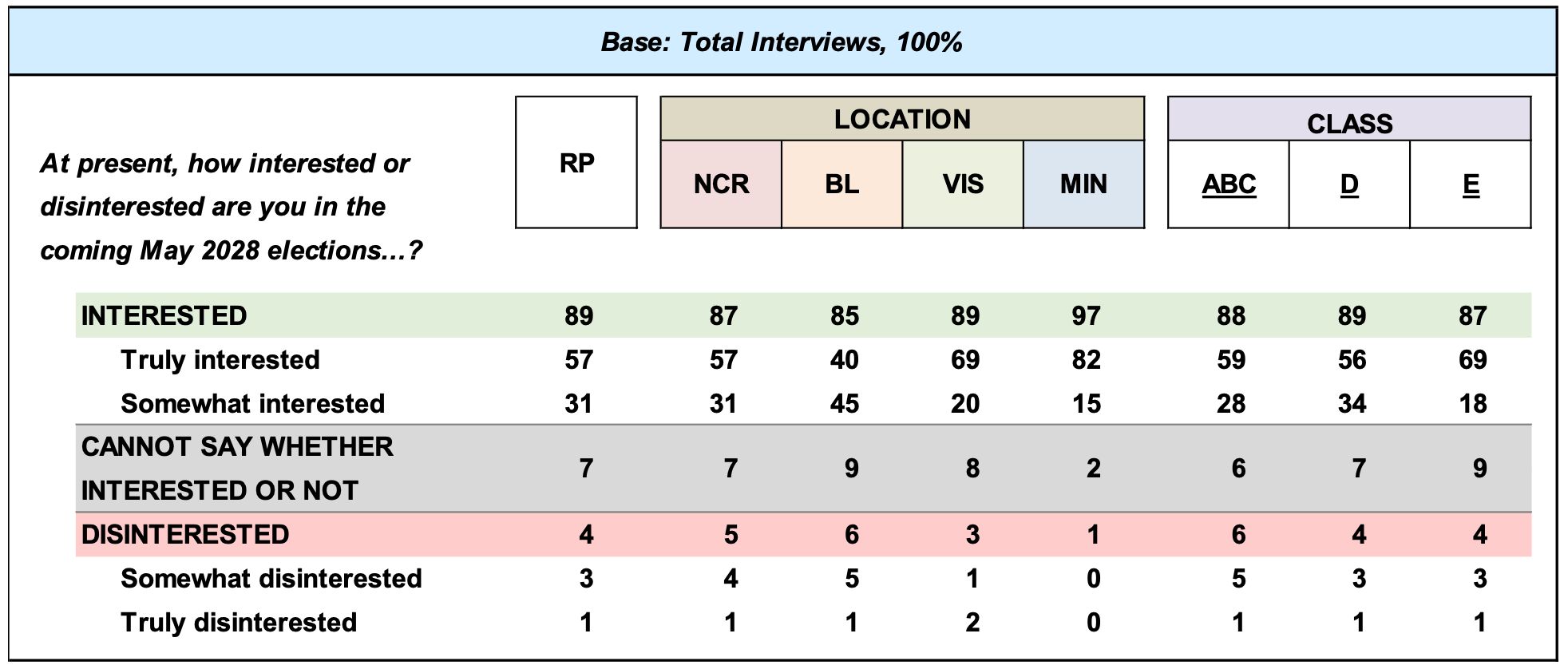
Although the next national and local elections are still around 20 months away, most Filipino adults (89%) say they are interested in the coming electoral exercise – a sentiment shared by most, if not nearly all, adults across geographic and socioeconomic subgroupings (85% to 97% and 87% to 89%, respectively). In particular, small to huge majorities at the national level (57%) and in most areas and all classes (57% to 82% and 56% to 69%, respectively) are truly interested in the May 2028 elections. The rest of Luzon is the exception, with 40% being truly interested and 45% being somewhat interested. Disinterest in the May 2028 polls is expressed by 4% of Filipino adults while indecision is recorded at 7%. (Please refer to Table 1.)
Table 1
LEVEL OF INTEREST IN THE COMING MAY 2028 ELECTIONS
September 17 - 24, 2026 / Philippines / PR1&2
(In Percent)
Near to small majority presidential voter preferences are enjoyed by the VicePresident in the long list and in five (5) alternative scenarios for the May 2028 presidential election
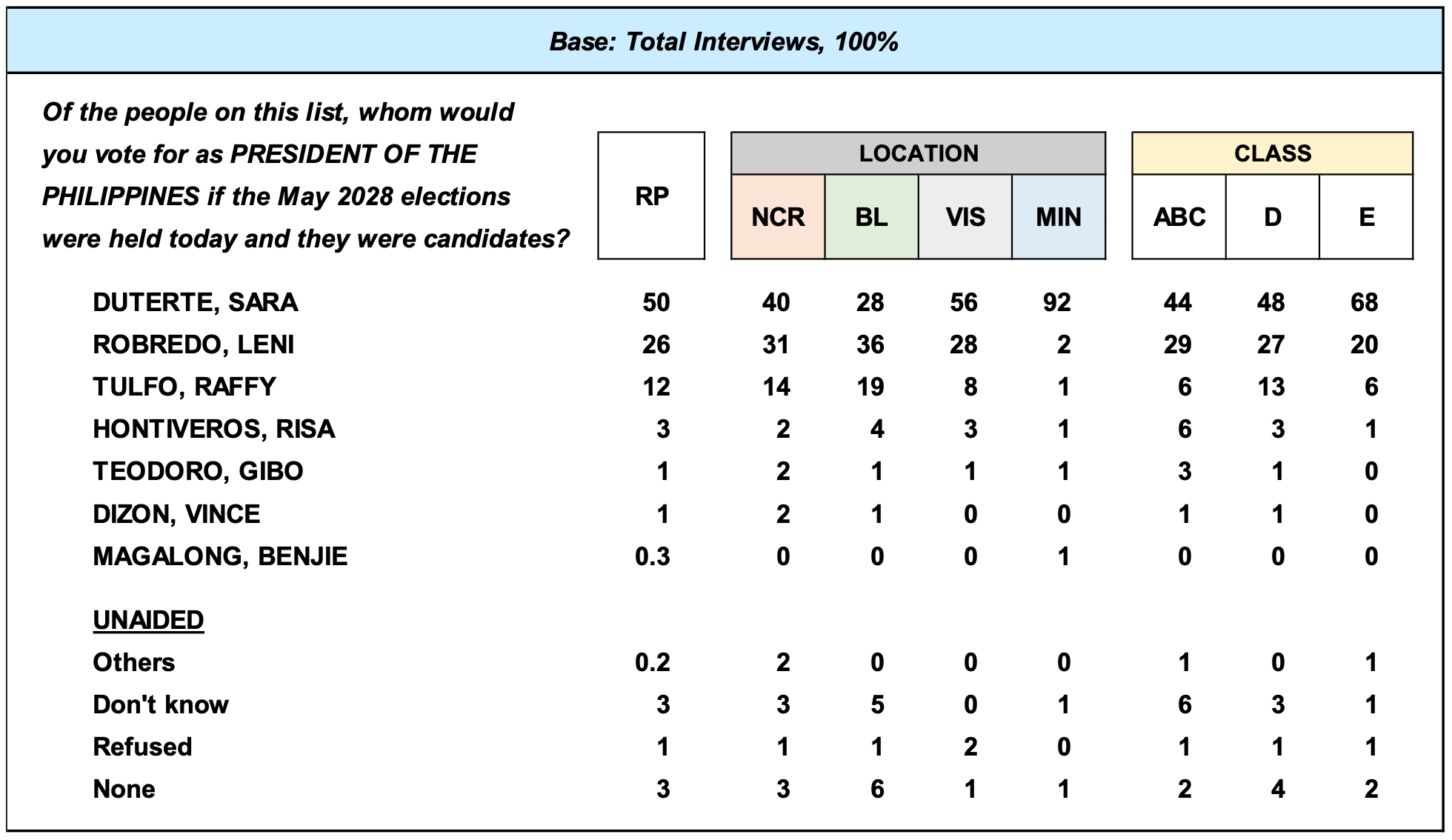
Long list. If the May 2028 elections were held during the survey period, half of Filipino adults (50%) would vote for the Vice-President if she ran against Naga City Mayor Maria Leonor G. Robredo (26%), Senator Raffy Tulfo (12%), Senator Risa Hontiveros (3%), Department of National Defense (DND) Secretary Gilberto Teodoro Jr. (1%), Department of Public Works and Highways (DPWH) Secretary Vince Dizon (1%), and Baguio City Mayor Benjamin Magalong (0.3%). The rest of Filipino adults are undecided regarding their choice for president (3%), are not inclined to support any possible presidential bet
(3%), or refuse to identify their preferred candidate for the post (1%). (Please refer to Table 2.)
As may be expected, electoral support for the Vice-President is almost universal in Mindanao (92%). Huge pluralities to big majorities in Metro Manila (40%), the Visayas (56%), and every socioeconomic class (44% to 68%) also express support for the latter. Practically the same percentages of those in the rest of Luzon are inclined to vote for either Naga City Mayor Robredo (36%) or the Vice-President (28%).
Table 2
AWARENESS & PERFORMANCE RATINGS
2028 ELECTIONS: PRESIDENTIAL PREFERENCE (LONG LIST)
September 17 - 24, 2026 / Philippines / PR1&2
(In Percent)
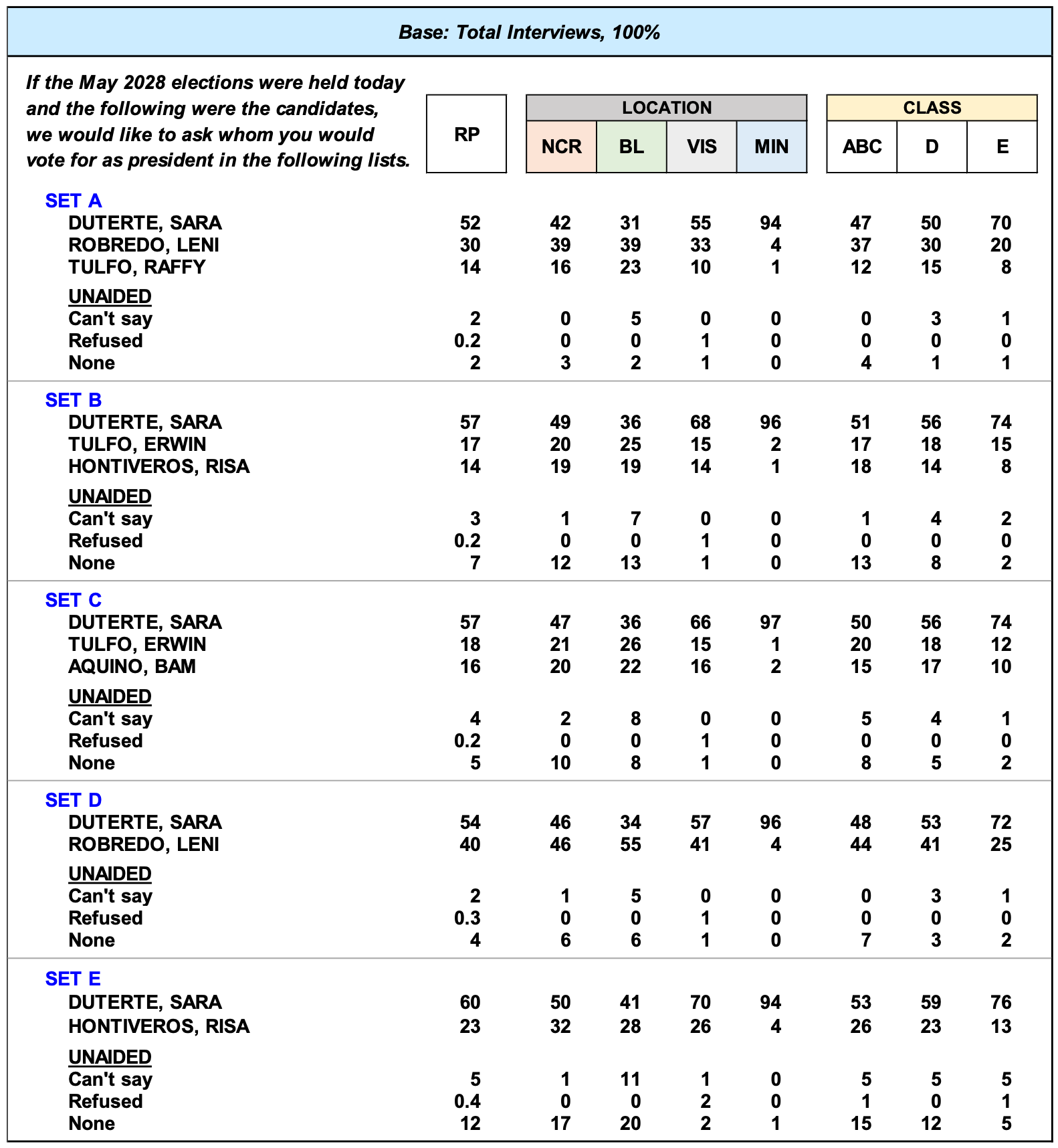
Set A. In a three-way race for the presidential post, the Vice-President (52%) would win against Naga City Mayor Robredo (30%) and Senator R. Tulfo (14%) if the May 2028 elections coincided with the conduct of survey interviews. Ambivalence regarding presidential preference in this alternative set is expressed by 2% of adults while another
2% are not supporting any possible presidential candidate. (Please refer to Table 3.)
At least half of adults in the Visayas (55%), Mindanao (94%), Class D (50%), and Class E (70%) prefer the Vice-President over either Naga City Mayor Robredo or Senator R. Tulfo. Meanwhile, about the same voting figures are obtained by the Vice-President and Naga City Mayor Robredo in Metro Manila (42% versus 39%), the rest of Luzon (31% versus 39%), and Class ABC (47% versus 37%).
Set B. A small majority of Filipino adults (57%) would elect the Vice-President as the country’s next chief executive if she ran against Senator Erwin Tulfo (17%) and Senator Hontiveros (14%) and the May 2028 elections took place during the survey period. In this scenario, the Vice-President enjoys sizeable plurality to nearly universal levels of electoral support across geographic areas and socioeconomic classes (36% to 96% and 51% to 74%, respectively). Disinclination to support any possible presidential candidate is a sentiment shared by 7% of adults while 3% express indecision on the matter of whom to vote for as president in the next elections. (Please refer to Table 3.)
Set C. Another three-person set that includes the Vice-President, Senator E. Tulfo, and Senator Paolo Benigno Aquino IV indicates another majority win by the Vice-President (57%). The latter leads in every area and class (36% to 97% and 50% to 74%, respectively). In this alternative electoral scenario, the rest of Filipino adults would vote for either Senator E. Tulfo (18%) or Senator Aquino (16%), would not support any possible presidential bet (5%), or are unable to say whom they would elect as the next president (4%). (Please refer to Table 3.)
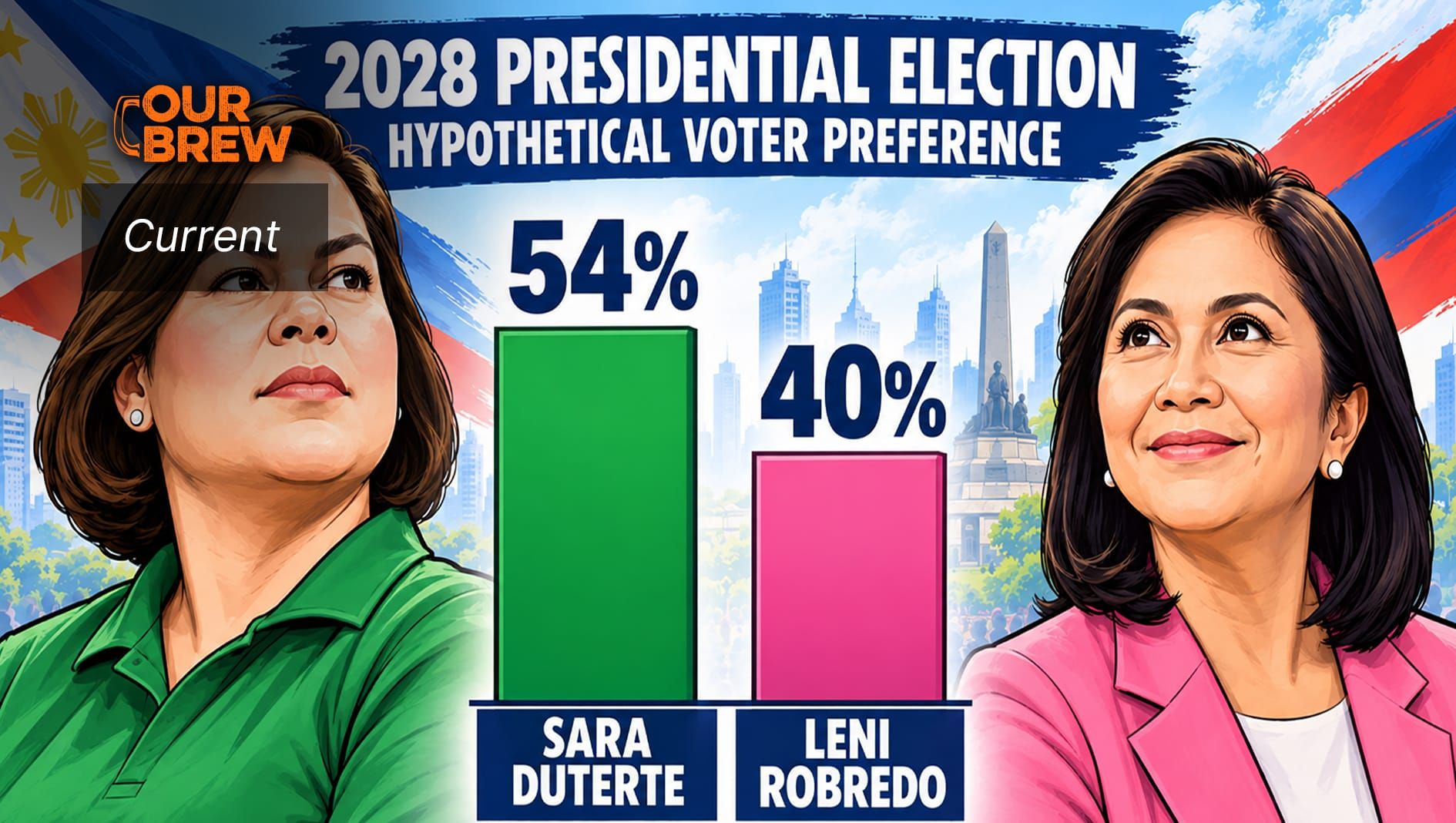
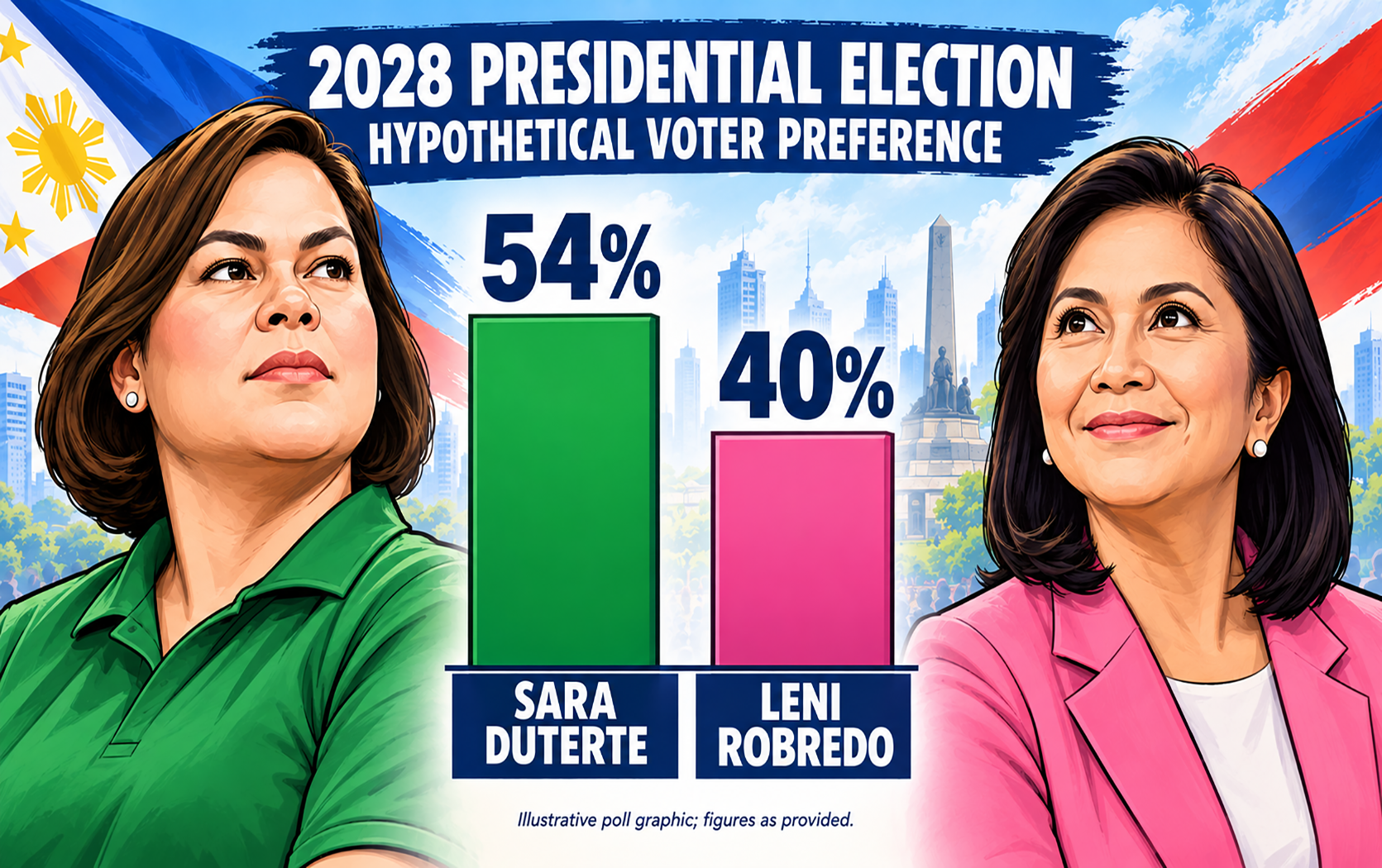
Set D. A one-on-one presidential scenario involving only the Vice-President and Naga City Mayor Robredo shows the former winning by a 14-percentage point margin (54% versus 40%). Non-support for any possible presidential bet is at 4% while ambivalence regarding their choice for president is expressed by 2% of Filipino adults. (Please refer to Table 3.)
While the Vice-President enjoys majority voter preferences in the Visayas (57%), Mindanao (96%), Class D (53%), and Class E (72%), Naga City Mayor Robredo is the leading choice for president in the rest of Luzon (55%). The Vice-President and Naga City Mayor Robredo post virtually or exactly the same voting figures in Metro Manila (both at 46%) and Class ABC (48% versus 44%).
Set E. If the Vice-President ran for the presidency only against Senator Hontiveros and the May 2028 elections occurred during the survey period, 60% of Filipino adults would vote for her. Additionally, the Vice-President has the lead across geographic and socioeconomic subgroupings (41% to 94% and 53% to 76%, respectively). The rest of the adult population back Senator Hontiveros (23%), are disinclined to elect any possible candidate for the post (12%), or express indecision regarding their presidential preference (5%). (Please refer to Table 3.)
Table 3
2028 ELECTIONS: PRESIDENTIAL PREFERENCE SETS
September 17 - 24, 2026 / Philippines / PR1&2
(In Percent)
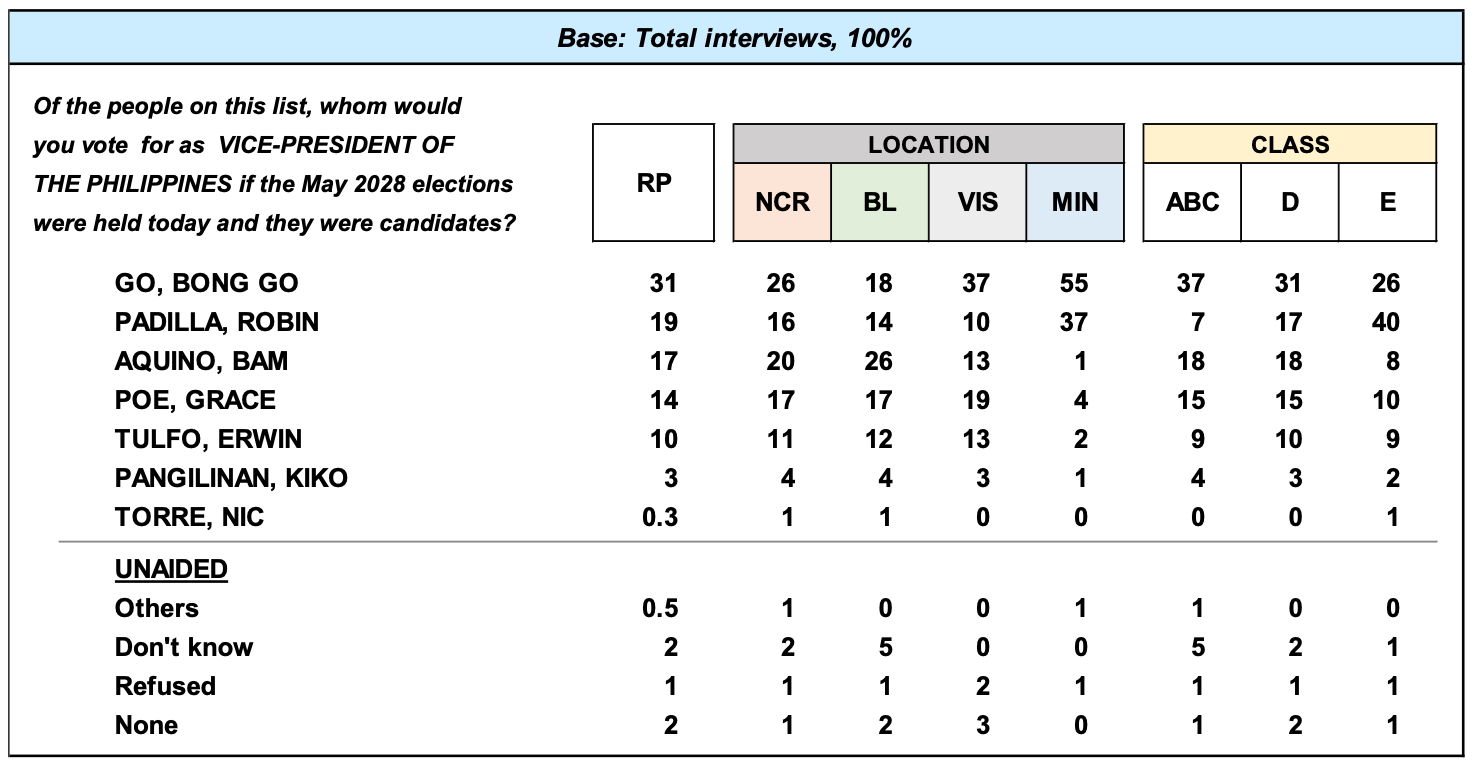
Senator Christopher Go is the favored vice-presidential candidate of nearly a third of Filipino adults (31%)
Out of seven (7) possible candidates for vice-president in the May 2028 national elections, Senator Christopher Go would emerge as the winner with the support of 31% of Filipino adults. Sharing second place are Senators Robin Padilla and Aquino (19% and 17%, respectively) while former Senator Grace Poe occupies third place (14%). In fourth place is Senator E. Tulfo (10%), followed by Senator Francis Pangilinan (3%) and Metropolitan Manila Development Authority (MMDA) General Manager Nicolas Torre III (0.3%). Other names are volunteered by 0.5% of Filipino adults while 2% are undecided on the matter of whom to vote for a vice-president, 2% are not electing any possible candidate for the post, and 1% refuse to identify their preferred vice-presidential bet. (Please refer to Table 4.)
A small majority of Mindanawons (55%) express support for Senator Go’s vicepresidential bid. The lawmaker is also the preferred candidate by sizeable pluralities in the Visayas (37%), Class ABC (37%), and Class D (31%). Meanwhile, Senator Padilla enjoys the lead in Class E (40%). Around the same voting figures are recorded by Senators Go and Aquino in Metro Manila (26% versus 20%) and the rest of Luzon (18% versus 26%).
Table 4
2028 ELECTIONS: VICE-PRESIDENTIAL PREFERENCE (LONG LIST)
September 17 - 24, 2026 / Philippines / PR1&2
(In Percent)
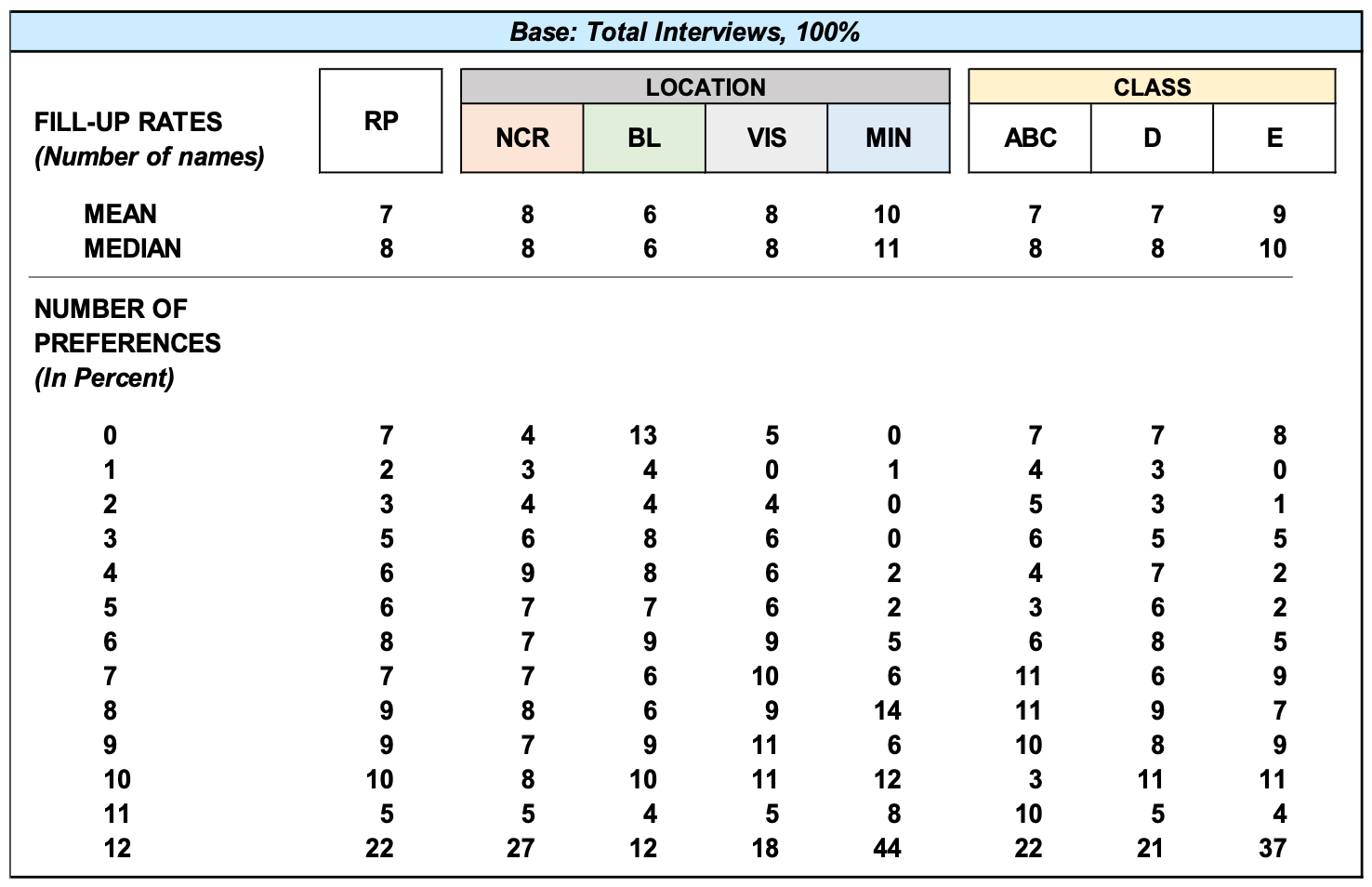
Filipino adults are naming a mean of seven (7) and a median of eight (8) of their favored candidates for senator in the May 2028 elections; around a fifth of the adult population (22%) has a complete senatorial slate; 15 out of 66 possible candidates have a statistical chance of winning a senatorial seat
With about 20 months to go before the next national elections, Filipino adults are identifying a mean of 7 and a median of 8 of the possible senatorial candidates they are inclined to support in May 2028. In the different areas and classes, mean figures vary from 6 to 10 and 7 to 9, respectively. Meanwhile, median figures range from 6 to 11 and 8 to 10, respectively. About a fifth of adults in the country (22%) have 12 preferred candidates for the Senate, with figures ranging from 12% to 44% and 21% to 37% across geographic and socioeconomic subgroupings, respectively. The biggest percentage of those with a complete senatorial slate is recorded in Mindanao (44%) while the lowest figures are posted in the rest of Luzon (12%) and the Visayas (18%). (Please refer to Table 5.)
Table 5
2028 SENATORIAL ELECTIONS:
FILL-UP RATES AND NUMBER OF PREFERENCES
September 17 - 24, 2026 / Philippines / PR1&2
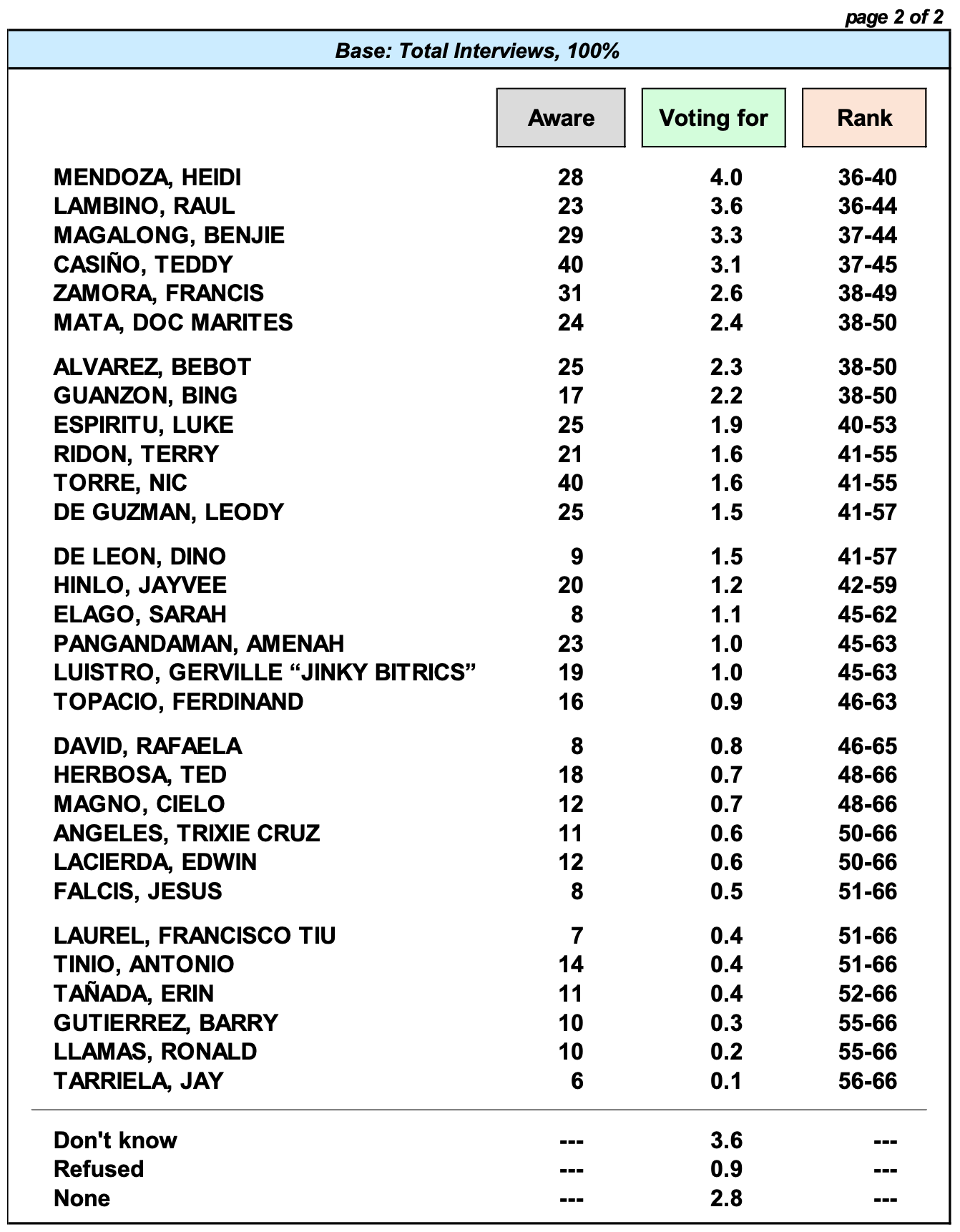
Among the 66 individuals included in the senatorial electoral probe, 15 make it to the list of probable winners. Most of those with a statistical chance of winning are either former or current members of Congress. In the lead are former Senator Poe (50.2%, 1st to 2nd places) and Senator Alan Peter Cayetano (46.5%, 1st to 4th places). Sharing 2nd to 4th places are Senator Padilla (45.9%) and Senator R. Tulfo (44.4%). Completing the top half of the list of possible senatorial winners are Davao City Mayor Sebastian Z. Duterte (37.2%, 5th to 6th places), former Senator Emmanuel Pacquiao (36.5%, 5th to 7th places), and Senator Loren Legarda (33.0%, 6th to 9th places). (Please refer to Table 6.)
Makati City Mayor Maria Lourdes Nancy Binay (31.7%) and Senate President Francis Escudero (30.1%) occupy 7th to 9th places while Department of Education (DepEd) Secretary Juan Edgardo Angara (26.3%) is in 10th place. The other personalities with a statistical chance of making it to the Senate if the May 2028 elections were held during the survey period are Mr. Ben Tulfo (21.5%, 11th to 12th places), Tourism Infrastructure and Enterprise Zone Authority (TIEZA) Chief Operating Officer (COO) Mark Lapid (19.8%, 11th to 15th places), Senator Jinggoy Estrada (18.2%, 12th to 18th places), Mr. Willie Revillame (17.7%, 12th to 18th places), and former AnaKalusugan Party-List Representative Michael Defensor (16.9%, 12th to 20th places).
Indecision on the matter of whom to vote for as senator is expressed by 3.6% of Filipino adults while 2.8% are not inclined to support any possible candidate for senator. Almost 1% refuse to state an opinion on the matter.
Table 6
2028 ELECTIONS: SENATORIAL PREFERENCES
September 17 - 24, 2026 / Philippines / PR1&2
(Multiple Response, up to 12 names allowed)
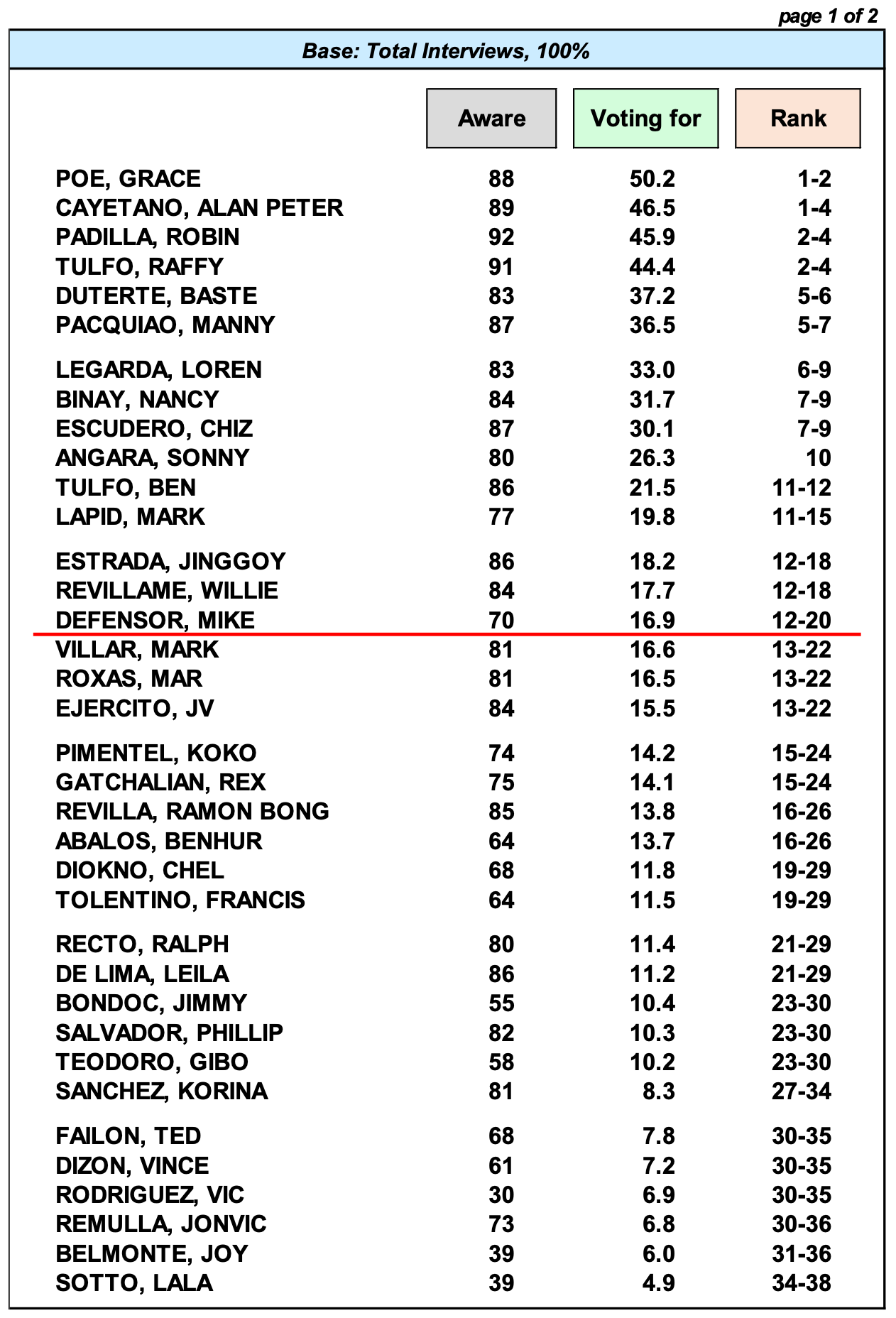
Table 6
2028 ELECTIONS: SENATORIAL PREFERENCES
September 17 - 24, 2026 / Philippines / PR1&2
(Multiple Response, up to 12 names allowed)
If you liked what you just read and want more of Our Brew, subscribe to get notified. Just enter your email below.
Related Posts
Net satisfaction with President Ferdinand Marcos, Jr. falls to -11 in September 2026 from -7 in June 2026 - SWS
Oct 12, 2026
Meralco Nears Full Power Restoration
Sep 02, 2026
When a Mountain Falls: How Ice and Rock Triggered Nepal’s Catastrophic Flood – And Why Climate Change is Raising the Risks
Sep 01, 2026